 Safekipedia
West Saxon dialect
Adapted from Wikipedia · Adventurer experience
West Saxon
West Saxon is a special way of speaking Old English from the kingdom of Wessex. There were two types of West Saxon: Early West Saxon and Late West Saxon.
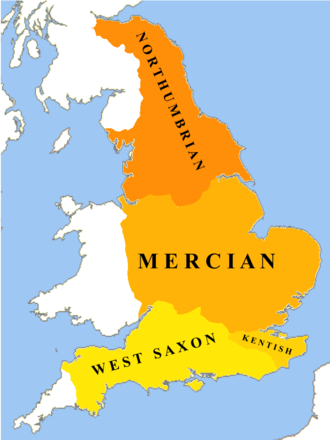
West Saxon was one of four main dialects of Old English. The other three were Kentish, Mercian, and Northumbrian. Mercian and Northumbrian were quite similar and were called Anglian dialects together.
West Saxon became very important because the Saxons were a strong and powerful group. Because of this, West Saxon was used a lot in writing. Early West Saxon was used around the time of Alfred the Great, and Late West Saxon was used later on. This made West Saxon the main dialect used in many important old books and writings.
Early West Saxon
Early West Saxon was the language used by King Alfred (849–899). It was used in many important books from his time, including some he wrote himself. This form of Old English is sometimes called Alfredian Old English. The language in these books sometimes shows influences from other dialects.
The important texts from this time include:
- King Alfred's Preface to Gregory's Pastoral Care
- The Old English translation of Orosius's Historia adversus paganos
- Cambridge, Corpus Christi College, MS 173: The Parker Chronicle (The Anglo-Saxon Chronicle)
Late West Saxon
By the time of the Norman conquest of England in 1066, the language had changed into Late West Saxon. This version became a written language and replaced an older style, thanks to changes started by Bishop Æthelwold of Winchester. Abbot Ælfric of Eynsham, known as Ælfric the Grammarian, helped this change happen.
Late West Saxon became the first standard written form of "English," often called the "Winchester standard" or "classical" Old English. It was mainly spoken in the south and west, near the important monastery at Winchester, the capital of the Saxon kings. Even though other Old English dialects were still spoken elsewhere, all writers used this special form when they wrote and copied books. Famous poems like Beowulf and Judith were written in this language, though they were originally in other dialects before being copied into Late West Saxon.
In the Wessex Gospels from around 990, the text of Matthew 6 (Matthew 6:9–13), the Lord's Prayer, is shown here:
Fæder ure þu þe eart on heofonum,
si þin nama gehalgod.
To becume þin rice,
gewurþe ðin willa,
on eorðan swa swa on heofonum.
Urne gedæghwamlican hlaf syle us todæg,
and forgyf us ure gyltas,
swa swa we forgyfað urum gyltendum.
And ne gelæd þu us on costnunge,
ac alys us of yfele.
Soþlice. List of texts:
- Ælfric of Eynsham's Lives of the Saints
Later developments
See also: Kildare Poems, Yola dialect, Fingallian, and West Country English
After the year 1066, when the Norman Conquest happened, the old way of writing called "Winchester standard" was no longer used. The new leaders brought their own books and writing styles, mostly in Latin. English was not used for important documents anymore. Latin became the main language for learning and laws, while the Norman language was used by the nobility.
Later forms of English came from the East Midlands dialect, not from West Saxon. But Late West Saxon is related to the English spoken in the West Country today.
Related articles



This article is a child-friendly adaptation of the Wikipedia article on West Saxon dialect, available under CC BY-SA 4.0.
Images from Wikimedia Commons. Tap any image to view credits and license.