
7th century
The 7th century is the time period from the year 601 through 700, following the Julian calendar in the Christian Era. This century saw many important changes across the world.
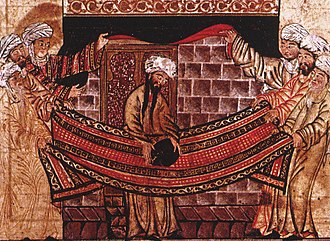
One of the biggest changes was the spread of Islam and the Muslim conquests. It began with the teachings of Muhammad in 622. After his death in 632, Islam grew quickly under leaders called the Rashidun Caliphate and later the Umayyad Caliphate. Many lands such as Syria, Palestine, Armenia, Egypt, and North Africa became part of this new empire.
In Europe, the Byzantine Empire faced challenges as its lands shrank. However, it kept control of Asia Minor after winning a big battle. In the Iberian Peninsula, many important meetings happened, and in Northumbria became strong in the British Isles.
Asia also had big changes. In China, the Sui dynasty was replaced by the Tang dynasty, which grew very powerful. Silla helped the Tang and brought together the Korean Peninsula. In India, Harsha brought many small states together under one rule.
Events
The 7th century was a time of big changes around the world. The world's population grew to about 208 million people. In England, the Anglo-Saxons formed several small kingdoms called the Heptarchy. Important places like Sutton Hoo in England showed rich burial traditions.
Islam began in the Arabian Peninsula. Muhammad started teaching about Islam, and after he passed away, his followers continued to spread the religion. They traveled far and wide, reaching many lands and bringing new ideas with them. Guangzhou in China became a busy port where people from many different places came to trade.
Many cultures and religions mixed together during this time. In Japan, new religious ideas blended with local beliefs. In India, important temples were built, showing the rich art and culture of the time. This century was full of journeys, new ideas, and the meeting of many different peoples.
Inventions, discoveries, introductions
Some very old and important things started in the 7th century. One of the earliest records of a game called Chaturanga, which is a predecessor to Chess, was made during this time. A smart Indian mathematician named Brahmagupta shared new ideas about math.
In 636, a special building called the Xumi Pagoda was built in Zhengding, China. Around this time, the first Chinese paper money was created. Sailors from Ethiopia brought Islam to China and built the first Islamic mosque in Guangzhou. In Constantinople, a powerful weapon called Greek fire was invented. The stirrup also came from China to Persia in the late 7th century. And during this time, people in Persia also invented cookies.
Inventions
Pictures
Keep exploring


This article is a child-friendly adaptation of the Wikipedia article on 7th century, available under CC BY-SA 4.0.
Images from Wikimedia Commons. Tap any image to view credits and license.