
Actinopterygii
Actinopterygii, often called ray-finned fish, make up almost 99% of all fish species alive today. They are a class of bony fish and include over 30,000 different types. Most of these fish are teleosts, and they are found all over the world in freshwater, brackish, and marine environments — from deep oceans to hidden underground waters and high mountain streams.
These fish are called ray-finned because their fins have thin bony spines called lepidotrichia, which help them move easily through the water. Unlike the fleshy fins of their close relatives, the lobe-finned fish, ray-finned fish fins can change shape and direction quickly. This helps them swim very efficiently.
Ray-finned fish come in many sizes. The smallest living species, Paedocypris, is only 8 mm long, while the largest living ones, like the giant sunfish and the giant oarfish, can weigh over 2,700 kg or grow up to 8 meters long. Even bigger than these, the extinct Leedsichthys from the Jurassic period might have reached 16.5 meters.
Characteristics
Ray-finned fishes come in many different shapes and sizes. One special feature they often have is called the swim bladder, which helps them stay afloat in water. Most ray-finned fishes develop this bladder from a part near their digestive system. In some fish, like bowfins and gars, the swim bladder can also help them breathe air. In others, like the arapaima, it has changed to let them breathe air directly.
These fish also have different kinds of scales. A group called teleosts have special thin, clear scales that grow in layers as the fish gets bigger. These scales are different from the harder scales found in some other fish. Some groups of ray-finned fishes, like sturgeons and paddlefish, have experienced changes in their genes that happened millions of years ago.
Body shapes and fin arrangements
Further information: Fish fin and Diversity of fish
Ray-finned fish come in many different sizes and shapes. They also have special ways of feeding and arrange their fins in unique ways.
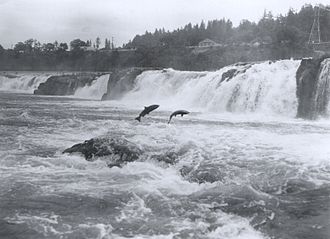
Some fish, like tuna, are built for speed with a special tail shape. Others, like the swordfish, are even faster. Salmon use their tail fins to jump over obstacles in rivers. Cod have extra fins that help them move easily through the water. Flatfish have fins that help them stay balanced. The four-eyed fish can see both above and below the water at the same time. Some fish, like the fangtooth, wait to catch their prey by surprise. The anglerfish has a special fin that looks like a fishing rod with a lure. Bichirs have lungs and are closely related to other ray-finned fish. The flying fish has special fins that help it glide through the air.
Reproduction
Most ray-finned fish have separate males and females. In many species, females lay eggs that are fertilized by males outside the body. The young then grow up as free-swimming larvae. However, there are other ways these fish can reproduce. In some, the fish start life as females and later change into males, which is triggered by something inside or outside their body. Changing from male to female is less common. Most of these fish use external fertilization, meaning the eggs are fertilized outside the body. Only a small number of species give birth to live young or care for their eggs, and when they do, it is often the males who help protect the young. One special fish, the mangrove rivulus, can live out of water and can fertilize its own eggs, which helps it survive in its unique habitat.
Classification and fossil record
Ray-finned fish, also called actinopterygians, make up nearly all of the world's fish species. They are divided into groups like Cladistia, Chondrostei, and Neopterygii. The Neopterygii group includes Holostei and Teleostei, which contains most living fish species.
The earliest known ray-finned fish fossils are from about 420 million years ago. These fish have evolved into many different types, living in all kinds of water environments, from deep oceans to tiny streams.
The classification of ray-finned fishes can be summarized as follows:
- Cladistia, which include bichirs and reedfish
- Actinopteri, which include:
- Chondrostei, which include Acipenseriformes (paddlefishes and sturgeons)
- Neopterygii, which include:
- Teleostei (most living fishes)
- Holostei, which include:
- Lepisosteiformes (gars)
- Amiiformes (bowfin)
The cladogram below shows the main groups of living ray-finned fishes and their evolutionary relationships to other fish groups and four-limbed vertebrates (tetrapods). Tetrapods evolved from bony fish during the Devonian period.
The polypterids (bichirs and reedfish) are the closest relatives of all other ray-finned fishes. The Acipenseriformes (sturgeons and paddlefishes) are the closest relatives of Neopterygii, and Holostei (bowfin and gars) are the closest relatives of teleosts. The Elopomorpha (eels and tarpons) are among the most basic teleosts. The earliest known fossil ray-finned fish, Andreolepis hedei, dates back 420 million years and was found in Russia, Sweden, and Estonia. Crown group ray-finned fishes likely originated near the Devonian-Carboniferous boundary. The earliest fossil relatives of modern teleosts are from the Triassic period, although teleosts may have originated during the Paleozoic Era.
Taxonomy
The listing below is a summary of all extinct and living groups of Actinopterygii with their respective taxonomic rank.
- Order †?Asarotiformes Schaeffer 1968
- Order †?Discordichthyiformes Minikh 1998
- Order †?Paphosisciformes Grogan & Lund 2015
- Order †Cheirolepidiformes Kazantseva-Selezneva 1977
- Order †Paramblypteriformes Heyler 1969
- Order †Rhadinichthyiformes
- Order †Palaeonisciformes Hay 1902
- Order †Tarrasiiformes sensu Lund & Poplin 2002
- Order †Ptycholepiformes Andrews et al. 1967
- Order †Haplolepidiformes Westoll 1944
- Order †Aeduelliformes Heyler 1969
- Order †Platysomiformes Aldinger 1937
- Order †Dorypteriformes Cope 1871
- Order †Eurynotiformes Sallan & Coates 2013
- Subclass Cladistia Pander 1860
- Order Polypteriformes Bleeker 1859 (bichirs and reedfishes)
- Order †?Scanilepiformes Selezneya 1985
- Subclass Actinopteri Cope 1972 s.s.
- Order †Elonichthyiformes Kazantseva-Selezneva 1977
- Order †Phanerorhynchiformes
- Order †Bobasatraniiformes Berg 1940
- Order †Guildayichthyiformes Lund 2000
- Order †Saurichthyiformes Aldinger 1937
- Subclass Chondrostei Müller, 1844
- Order †Birgeriiformes Heyler 1969
- Order †Chondrosteiformes Aldinger, 1937
- Order Acipenseriformes Berg 1940 (includes sturgeons and paddlefishes)
- Subclass Neopterygii Regan 1923 sensu Xu & Wu 2012
- Order †Pholidopleuriformes Berg 1937
- Order †Redfieldiiformes Berg 1940
- Order †Platysiagiformes Brough 1939
- Order †Polzbergiiformes Griffith 1977
- Order †Perleidiformes Berg 1937
- Order †Louwoichthyiformes Xu 2021
- Order †Peltopleuriformes Lehman 1966
- Order †Colobodontiformes Xu et al 2024
- Order †Luganoiiformes Lehman 1958
- Order †Pycnodontiformes Berg 1937
- Infraclass Holostei Müller 1844
- Division Halecomorphi Cope 1872 sensu Grande & Bemis 1998
- Order †Parasemionotiformes Lehman 1966
- Order †Ionoscopiformes Grande & Bemis 1998
- Order Amiiformes Huxley 1861 sensu Grande & Bemis 1998 (bowfins)
- Division Ginglymodi Cope 1871
- Order †Dapediiformes Thies & Waschkewitz 2015
- Order †Semionotiformes Arambourg & Bertin 1958
- Order Lepisosteiformes Hay 1929 (gars)
- Division Halecomorphi Cope 1872 sensu Grande & Bemis 1998
- Teleosteomorpha Arratia 2000 sensu Arratia 2013
- Order †Prohaleciteiformes Arratia 2017
- Division Aspidorhynchei Nelson, Grand & Wilson 2016
- Order †Aspidorhynchiformes Bleeker 1859
- Order †Pachycormiformes Berg 1937
- Infraclass Teleostei Müller 1844 sensu Arratia 2013
- Order †?Araripichthyiformes
- Order †?Ligulelliiformes Taverne 2011
- Order †?Tselfatiiformes Nelson 1994
- Order †Pholidophoriformes Berg 1940
- Order †Dorsetichthyiformes Nelson, Grand & Wilson 2016
- Order †Leptolepidiformes
- Order †Crossognathiformes Taverne 1989
- Order †Ichthyodectiformes Bardeck & Sprinkle 1969
- Teleocephala de Pinna 1996 s.s.
- Megacohort Elopocephalai Patterson 1977 sensu Arratia 1999 (Elopomorpha Greenwood et al. 1966)
- Order Elopiformes Gosline 1960 (ladyfishes and tarpon)
- Order Albuliformes Greenwood et al. 1966 sensu Forey et al. 1996 (bonefishes)
- Order Notacanthiformes Goodrich 1909 (halosaurs and spiny eels)
- Order Anguilliformes Jarocki 1822 sensu Goodrich 1909 (true eels)
- Megacohort Osteoglossocephalai sensu Arratia 1999
- Supercohort Osteoglossocephala sensu Arratia 1999 (Osteoglossomorpha Greenwood et al. 1966)
- Order †Lycopteriformes Chang & Chou 1977
- Order Hiodontiformes McAllister 1968 sensu Taverne 1979 (mooneye and goldeye)
- Order Osteoglossiformes Regan 1909 sensu Zhang 2004 (bony-tongued fishes)
- Supercohort Clupeocephala Patterson & Rosen 1977 sensu Arratia 2010
- Cohort Otomorpha Wiley & Johnson 2010 (Otocephala; Ostarioclupeomorpha)
- Subcohort Clupei Wiley & Johnson 2010 (Clupeomorpha Greenwood et al. 1966)
- Order †Ellimmichthyiformes Grande 1982
- Order Clupeiformes Bleeker 1859 (herrings and anchovies)
- Subcohort Alepocephali
- Order Alepocephaliformes Marshall 1962
- Subcohort Ostariophysi Sagemehl 1885
- Section Anotophysa (Rosen & Greenwood 1970) Sagemehl 1885
- Order †Sorbininardiformes Taverne 1999
- Order Gonorynchiformes Regan 1909 (milkfishes)
- Section Otophysa Garstang 1931
- Order Cypriniformes Bleeker 1859 sensu Goodrich 1909 (barbs, carp, danios, goldfishes, loaches, minnows, rasboras)
- Order Characiformes Goodrich 1909 (characins, pencilfishes, hatchetfishes, piranhas, tetras, dourado / golden (genus Salminus), pacu)
- Order Gymnotiformes Berg 1940 (electric eels and knifefishes)
- Order Siluriformes Cuvier 1817 sensu Hay 1929 (catfishes)
- Section Anotophysa (Rosen & Greenwood 1970) Sagemehl 1885
- Subcohort Clupei Wiley & Johnson 2010 (Clupeomorpha Greenwood et al. 1966)
- Cohort Euteleosteomorpha (Greenwood et al. 1966) (Euteleostei Greenwood 1967 sensu Johnson & Patterson 1996)
- Subcohort Lepidogalaxii
- Order Lepidogalaxiiformes Betancur-Rodriguez et al. 2013 (salamanderfish)
- Subcohort Protacanthopterygii Greenwood et al. 1966 sensu Johnson & Patterson 1996
- Order Argentiniformes (barreleyes and slickheads) (formerly in Osmeriformes)
- Order Galaxiiformes
- Order Salmoniformes Bleeker 1859 sensu Nelson 1994 (salmon, trout and pike)
- Subcohort Stomiati
- Order Osmeriformes (smelts)
- Order Stomiiformes Regan 1909 (bristlemouths and marine hatchetfishes)
- Subcohort Neoteleostei Nelson 1969
- Infracohort Ateleopodia
- Order Ateleopodiformes (jellynose fish)
- Infracohort Eurypterygia Rosen 1973
- Section Aulopa [Cyclosquamata Rosen 1973]
- Order Aulopiformes Rosen 1973 (Bombay duck and lancetfishes)
- Section Ctenosquamata Rosen 1973
- Subsection Myctophata [Scopelomorpha]
- Order Myctophiformes Regan 1911 (lanternfishes)
- Subsection Acanthomorpha Betancur-Rodriguez et al. 2013
- Division Lampridacea Betancur-Rodriguez et al. 2013 [Lampridomorpha; Lampripterygii]
- Order Lampriformes Regan 1909 (oarfish, opah and ribbonfishes)
- Division Paracanthomorphacea sensu Grande et al. 2013 (Paracanthopterygii Greenwood 1937)
- Order Percopsiformes Berg 1937 (cavefishes and trout-perches)
- Order †Sphenocephaliformes Rosen & Patterson 1969
- Order Zeiformes Regan 1909 (dories)
- Order Gadiformes Goodrich 1909 (cods)
- Division Polymixiacea Betancur-Rodriguez et al. 2013 (Polymyxiomorpha; Polymixiipterygii)
- Order †Pattersonichthyiformes Gaudant 1976
- Order †Ctenothrissiformes Berg 1937
- Order Polymixiiformes Lowe 1838 (beardfishes)
- Division Euacanthomorphacea Betancur-Rodriguez et al. 2013 (Euacanthomorpha sensu Johnson & Patterson 1993; Acanthopterygii Gouan 1770 sensu])
- Order Trachichthyiformes (fangtooths and pineconefishes)
- Subdivision Berycimorphaceae Betancur-Rodriguez et al. 2013
- Order Beryciformes (alfonsinos and holocentrids) (incl. Holocentriformes, Stephanoberyciformes; Cetomimiformes)
- Subdivision Percomorphaceae Betancur-Rodriguez et al. 2013 (Percomorpha sensu Miya et al. 2003; Acanthopteri)
- Series Ophidiimopharia Betancur-Rodriguez et al. 2013
- Order Ophidiiformes (pearlfishes)
- Series Batrachoidimopharia Betancur-Rodriguez et al. 2013
- Order Batrachoidiformes (toadfishes)
- Series Gobiomopharia Betancur-Rodriguez et al. 2013
- Order Gobiiformes (cardinalfishes, sleepers and gobies)
- Series Syngnathomorpharia Betancur-Rodriguez et al. 2013
- Order Syngnathiformes (seahorses, pipefishes, sea moths, cornetfishes and flying gurnards)
- Order Scombriformes (Tunas and (mackerels)
- Series Carangimopharia Betancur-Rodriguez et al. 2013
- Subseries Anabantaria Betancur-Rodriguez et al. 2014
- Order Synbranchiformes (swamp eels)
- Order Anabantiformes (Labyrinthici) (gouramies, snakeheads, )
- Subseries Carangaria Betancur-Rodriguez et al. 2014
- Order Carangiformes (Jack mackerels, pompanos, flatfishes, billfishes)
- Subseries Ovalentaria Smith & Near 2012 (Stiassnyiformes sensu Li et al. 2009)
- Order Atheriniformes Rosen 1964 (silversides and rainbowfishes)
- Order Cyprinodontiformes Berg 1940 (livebearers, killifishes)
- Order Beloniformes Berg 1940 (flyingfishes and ricefishes)
- Order Cichliformes Betancur-Rodriguez et al. 2013 (Cichlids, Convict blenny, leaf fishes)
- Order Mugiliformes Berg 1940 (mullets)
- Order Blenniiformes Springer 1993 (Blennies, damselfish, Clingfishes)
- Subseries Anabantaria Betancur-Rodriguez et al. 2014
- Series Eupercaria Betancur-Rodriguez et al. 2014 (Percomorpharia Betancur-Rodriguez et al. 2013)
- Order Perciformes Bleeker 1859
- Order Centrarchiformes Bleeker 1859 (Sunfishes and mandarin fishes)
- Order Labriformes (Wrasses and Parrotfishes)
- Order Acropomatiformes
- Order Acanthuriformes
- Order Lophiiformes Garman 1899 (Anglerfishes)
- Order Tetraodontiformes Regan 1929 (Filefishes and pufferfish)
- Series Ophidiimopharia Betancur-Rodriguez et al. 2013
- Division Lampridacea Betancur-Rodriguez et al. 2013 [Lampridomorpha; Lampripterygii]
- Subsection Myctophata [Scopelomorpha]
- Section Aulopa [Cyclosquamata Rosen 1973]
- Infracohort Ateleopodia
- Subcohort Lepidogalaxii
- Cohort Otomorpha Wiley & Johnson 2010 (Otocephala; Ostarioclupeomorpha)
- Supercohort Osteoglossocephala sensu Arratia 1999 (Osteoglossomorpha Greenwood et al. 1966)
- Megacohort Elopocephalai Patterson 1977 sensu Arratia 1999 (Elopomorpha Greenwood et al. 1966)
| Chondrostei | Chondrostei (cartilage bone) is a subclass of primarily cartilaginous fish showing some ossification. Earlier definitions of Chondrostei are now known to be paraphyletic, meaning that this subclass does not contain all the descendants of their common ancestor. There used to be 52 species divided among two orders, the Acipenseriformes (sturgeons and paddlefishes) and the Polypteriformes (reedfishes and bichirs). Reedfish and birchirs are now separated from the Chondrostei into their own sister lineage, the Cladistia. It is thought that the chondrosteans evolved from bony fish but lost the bony hardening of their cartilaginous skeletons, resulting in a lightening of the frame. Elderly chondrosteans show beginnings of ossification of the skeleton, suggesting that this process is delayed rather than lost in these fish. This group had once been classified with the sharks: the similarities are obvious, as not only do the chondrosteans mostly lack bone, but the structure of the jaw is more akin to that of sharks than other bony fish, and both lack scales (excluding the Polypteriforms). Additional shared features include spiracles and, in sturgeons, a heterocercal tail (the vertebrae extend into the larger lobe of the caudal fin). However the fossil record suggests that these fish have more in common with the Teleostei than their external appearance might suggest. | |
|---|---|---|
| Neopterygii | Neopterygii (new fins) is a subclass of ray-finned fish that appeared somewhere in the Late Permian. There were only few changes during its evolution from the earlier actinopterygians. Neopterygians are a very successful group of fishes because they can move more rapidly than their ancestors. Their scales and skeletons began to lighten during their evolution, and their jaws became more powerful and efficient. While electroreception and the ampullae of Lorenzini is present in all other groups of fish, with the exception of hagfish, neopterygians have lost this sense, though it later re-evolved within Gymnotiformes and catfishes, who possess nonhomologous teleost ampullae. |
Pictures
Keep exploring



This article is a child-friendly adaptation of the Wikipedia article on Actinopterygii, available under CC BY-SA 4.0.
Images from Wikimedia Commons. Tap any image to view credits and license.