 Safekipedia
Ahmadiyya Caliphate
Adapted from Wikipedia · Discoverer experience
The Ahmadiyya Caliphate is a non-political caliphate that began on May 27, 1908, after the death of Mirza Ghulam Ahmad, the founder of the Ahmadiyya Muslim Community. Mirza Ghulam Ahmad claimed to be a Prophet, a Messenger, the promised Messiah, and Mahdi, the redeemer Muslims believe is coming. The Ahmadiyya Caliphate is seen by its followers as a revival of the Rashidun Caliphate that started after the death of the Islamic prophet Muhammad.
The leaders of this Caliphate are called Khalīfatul Masīh, meaning Caliph of the Messiah, or simply Khalifa. They are chosen to guide the Ahmadiyya Muslim Community around the world and are considered spiritually guided leaders. The current leader is the 5th Caliph, Mirza Masroor Ahmad.
After Ghulam Ahmad’s death, the leaders first guided the community from Qadian in India. Later, in 1947 when Pakistan was created, the community’s headquarters moved to Rabwah in Pakistan. In 1984, new laws in Pakistan made it hard for Ahmadi Muslims to openly practice their faith, so the 4th Caliph moved the headquarters to London, England, to the Fazl Mosque.
Many Muslims who follow mainstream Sunni or Shia traditions see the Ahmadiyya movement as different from traditional Islam, and most do not recognize their Caliphate.
Overview
Ahmadi Muslims believe that the caliphate is very important. It helps continue the work of a prophet, guiding believers after the prophet's death. In the Ahmadiyya community, the caliphs are seen as successors to the prophets.
Ahmadis think the caliphate can only be created by God. Even though people elect the caliph, it is believed that God guides believers to choose the right person. The caliph is not just a political leader but a religious one, focused on supporting and spreading Islam. The caliphate helps organize the Muslim community and keep high moral standards, no matter which country they are from.
Basis in Qur'an and Hadith
According to Ahmadiyya belief, the Qur'an promises that God will choose a righteous successor. One verse, number 56 in Surah Al-Nur (or 55 if the opening phrase is not counted), says that God will make believers successors on Earth, letting them follow their chosen religion safely and peacefully.
The founder of Islam, Muhammad, also shared a prophecy recorded in Musnad Ahmad. He said that after the time of prophets ends, a righteous leadership called Khilafat will come. This good leadership will last for a time, followed by other kinds of rule. But in the end, true and fair leadership like the prophets’ time will return again.
The second Manifestation of God’s power
The succession of the caliph is believed by the Ahmadis to be the second big sign of God’s power. Mirza Ghulam Ahmad, the founder of the Ahmadiyya Muslim Community, wrote about this in his last book called Al-Wassiyyat (The Will). He said that after he passed away, God would send this second sign to continue guiding the community forever.
The Lahore Ahmadiyya Movement does not share this belief. Instead, they follow a different idea called Anjuman (Council) that was also described in the same book.
List of Ahmadiyya Caliphs
Timeline
The Ahmadiyya Caliphate began on May 27, 1908, after the passing of Mirza Ghulam Ahmad, the founder of the Ahmadiyya Muslim Community. It is seen by followers as a renewal of an important Islamic leadership role. The leaders of this community are called Khalīfatul Masīh, meaning "Caliph of the Messiah," and they guide the community in their faith.
| Name | Picture | Lifespan | Office held |
|---|---|---|---|
| Khalifatul Masih I. |  | 1834–1914 | 1908–1914 |
| Khalifatul Masih II. | 1889–1965 | 1914–1965 | |
| Khalifatul Masih III. | 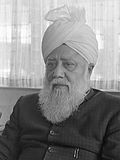 | 1909–1982 | 1965–1982 |
| Khalifatul Masih IV. | 1928–2003 | 1982–2003 | |
| Khalifatul Masih V. | 1950–present | 2003–present |
Related articles


This article is a child-friendly adaptation of the Wikipedia article on Ahmadiyya Caliphate, available under CC BY-SA 4.0.
Images from Wikimedia Commons. Tap any image to view credits and license.