
Architecture of Vatican City
Vatican City is home to some of the world's most striking architecture through several centuries and a world cultural heritage. The area of the Vatican is small, but it contains many famous landmarks. The architecture of Vatican City, dominated by religious buildings, shows many different styles such as Roman, Gothic, and Baroque. The most important buildings were built during the medieval period and the 16th to 18th centuries. These structures tell the story of art and history over many years.
Periodization
Roman period
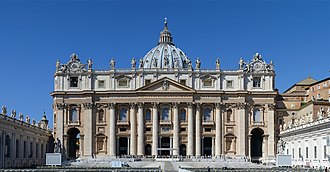
There are few examples of Roman architecture in Vatican City. In the 4th century AD, Emperor Constantine I built a basilica over a small shrine believed to mark the burial place of St. Peter. This Constantine's basilica was the predecessor of today’s St. Peter's Basilica. It had small, high windows that created a mysterious, dimly lit space. The design showed typical Roman features like huge, complex structures and simple decorations.
Renaissance (14th-16th century)
Further information: Italian Renaissance architecture and Roman Renaissance
The early Renaissance began in Florence and later spread to Rome. Important buildings like the Vatican Library and the Sistine Chapel were built in the 15th century. Pope Nicholas V started building the Apostolic Palace and planned a new design for St. Peter's Basilica.
In 1471, Pope Sixtus IV began building the Sistine Chapel, decorated by famous artists. Later, Michelangelo Buonarroti painted its ceiling under Pope Julius II. These buildings show Renaissance features like orderly courtyards and balanced designs. Renaissance architecture also brought back ideas from ancient Greece and Rome, making buildings more symmetrical and graceful.
Baroque period (17th–18th century)
Further information: Baroque architecture
The Baroque style began in the 17th century. It was used to show the wealth and importance of the church. Baroque buildings are grand and dramatic, with lots of decoration. St. Peter's Basilica was finished in this style, with beautiful paintings and sculptures inside. The design uses light and space in special ways to create a powerful feeling.
19th Century
In the 19th century, architects mostly used older styles. They built structures like the Braccio Nuovo using designs from the previous century.
20th Century
During the 20th century, Vatican City added some modern buildings to fit its needs. The government palace is one example. Restorations were also done on important sites like St. Peter's Basilica and the Sistine Chapel. Many of these projects were supported by groups like the Knights of Columbus.
21st Century
In 2007, the Vatican library closed for three years for restoration and reopened in 2010 after work costing $11.5 million.
Vatican City features with architecture in brief
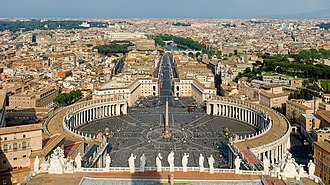
Vatican City has an unusual shape, like a four-sided figure that isn't perfectly even. The most famous building, St. Peter's Church, and its square take up much of the southern part of the eastern side of the city. Nearby, in the northwest, is the Sistine Chapel, across from a hall where the Pope can be seen. In the eastern half, you'll also find the Belvedere Palace courtyard, the Vatican Museums, and the Central Post Office. The Vatican Gardens cover most of the northeast part of the city.
Unlike many cities that have a central square or balanced layout, Vatican City is split into two parts. The east focuses on important religious buildings like St. Peter's Basilica and the Sistine Chapel. The west is mainly for living spaces, such as the Vatican Gardens. This separation shows how religious life and everyday living are both important but kept in different areas of the city.
Different periods of distribution of buildings in the Vatican City
Vatican City has buildings from many different times. Only a few structures were built in very old times. Most famous buildings started in older times and were finished between the 16th and 18th centuries. During the Middle Ages, important buildings like St. Peter's Basilica were built in the southeast part of Vatican City. In the 16th century, buildings were placed around the middle of St. Peter's Church and near the north of Belvedere Palace courtyard. In the 17th century, places like St. Peter's Square appeared mainly in the southeast. Buildings from the 18th to 19th centuries were mostly around the church, with some guard areas and offices spread out. In the 20th century, new buildings such as post offices, banks, and places for the pope to welcome visitors were built in the northeast and southwest parts of Vatican City.
The pavilion of the Vatican in Paris in 1937
Pictures
Keep exploring




This article is a child-friendly adaptation of the Wikipedia article on Architecture of Vatican City, available under CC BY-SA 4.0.
Images from Wikimedia Commons. Tap any image to view credits and license.