 Safekipedia
Balkan Mountains
Adapted from Wikipedia · Discoverer experience
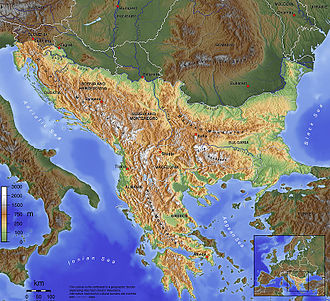
The Balkan mountain range is located in the eastern part of the Balkan peninsula in Southeastern Europe. It begins at the peak of Vrashka Chuka on the border between Bulgaria and Serbia and runs for about 560 kilometres (350 mi). The mountains form a natural barrier between the northern and southern halves of Bulgaria and end at the Black Sea near Cape Emine. The highest point is Botev Peak, which stands at 2,376 metres (7,795 ft).
These mountains are important because they create a watershed between the Black Sea and the Aegean. A famous gap in the mountains is the narrow Iskar Gorge, close to the Bulgarian capital, Sofia. The area has many caves, including Magura, which contains some of the oldest known cave paintings in Europe. Another notable feature is the Belogradchik Rocks in the west.
There are several protected areas in the Balkan Mountains, such as Central Balkan National Park, Vrachanski Balkan, Bulgarka, and Sinite Kamani. These areas are home to many plants and animals, including the brown bear, wolf, boar, chamois and deer. The mountains give the region its name, the Balkans, and in Bulgarian and Serbian, they are called Стара планина Stara planina, meaning 'old mountain'.
Etymology
It is thought that the name of the Balkan Mountains may have come from the Ottoman Turks, but it might originally come from a Persian word meaning "high" or "proud house." In Bulgarian, the word balkan means "mountain." This name is also used in places like the Balkan Daglary and the Balkan Province of Turkmenistan.
In older times, these mountains were called Haemus, from an ancient Thracian word meaning "mountain ridge." There are also stories from Greek mythology that try to explain the name Haemus.
Other names for these mountains have included Aemon, Haemimons, Hem, Emus, the Slavonic Matorni gori, and the Turkish Kocabalkan. The name "Stara Planina" was first recorded in the 16th century.
Mythology
In old stories, the Balkan Mountains were named after a king called Haemus and his wife Rhodope. They were turned into mountains because they tried to say they were the same as the gods Zeus and Hera.
Another story tells of a giant named Typhon fighting Zeus. Typhon threw mountains at Zeus, but Zeus turned them away with his lightning. Typhon's blood fell to the ground, and the mountains were named Haemus from an old word for "blood."
Geography
The Balkan Mountains are a chain of mountains formed by the squeezing and breaking of rock layers. They are part of a larger mountain system that stretches across most of Eurasia. The mountains can be split into two parts: the main Balkan Chain and the Pre-Balkans to the north.
The Balkan Mountains have around 30 peaks. In Bulgaria, they can be divided into three sections. The Western Balkan Mountains run from the border with Serbia to Arabakonak, with the highest peak being Midžor. The Central Balkan Mountains run from Arabakonak to Vratnik Pass, and include Botev Peak, the highest in the range. The Eastern Balkan Mountains extend from Vratnik Pass to Cape Emine and form the lowest part of the range.
Hydrology
The mountains create a divide between rivers flowing north to the Danube and rivers flowing south to the Aegean Sea. However, Bulgaria's longest river, the Iskar, flows through the mountains. Several rivers start in the Balkan Mountains and flow north to the Danube. The Kamchiya river flows directly into the Black Sea. There are also some spas in the area.
Passes
The mountains are crossed by many passes and two gorges. Some of the main passes include Petrohan Pass, Iskar Gorge, Vitinya Pass, and others connecting different towns in Bulgaria.
Peaks
Some of the highest peaks in the Balkan Mountains include Botev Peak, Malkiyat yumruk, Golyam Kademliya, and many more.
| Section | Area, km2 | % | Average altitude, m | 0 – 200 m, km2 | % | 200 – 600 m, km2 | % | 600 – 1000 m, km2 | % | 1000 – 1600 m, km2 | % | over 1600 m, km2 | % |
|---|---|---|---|---|---|---|---|---|---|---|---|---|---|
| Western Balkan Mountains | 4 196,9 | 36.19 | 849 | – | – | 907.1 | 21.61 | 2 074,9 | 49.44 | 1 139,6 | 27.15 | 75.3 | 1.79 |
| Central Balkan Mountains | 3 400,9 | 29.33 | 961 | – | – | 549.8 | 16.17 | 1 512,7 | 44.48 | 1 076,7 | 31.66 | 261.7 | 7.70 |
| Eastern Balkan Mountains | 3 998,6 | 34.48 | 385 | 560 | 14.00 | 2 798,9 | 70.00 | 624.1 | 15.61 | 15.6 | 0.39 | – | — |
| Total | 11 596,4 | 100 | 722 | 560 | 4.83 | 4 255,8 | 36.70 | 4 211,7 | 36.32 | 2 231,9 | 19.25 | 337 | 2.91 |
History
The Balkan Mountains have been very important in the history of Bulgaria since it began in 681. They acted like a strong wall for the Bulgarian Empire, helping to protect it from attacks. Many big battles happened here between the Bulgarian and Byzantine Empires.
During the time when the Ottoman Empire ruled the area, many brave people called haiduks hid in these mountains. Near the highest point, Botev Peak, is the town of Kalofer. This is where the famous Bulgarian poet and hero Hristo Botev was born. He fought against the Ottoman Empire and passed away in 1876. Close to Botev Peak is Shipka Pass, where important battles took place during the Russo-Turkish War, 1877-78. These battles helped end the rule of the Ottoman Empire in the Balkans.
Protected areas and ecology
Bulgaria
Main articles: Central Balkan National Park, Vrachanski Balkan Nature Park, and Bulgarka Nature Park
Many parts of the Balkan mountains in Bulgaria are protected. This includes one national park — Central Balkan National Park; three nature parks — Vrachanski Balkan Nature Park, Bulgarka Nature Park and Sinite Kamani Nature Park; over 20 nature reserves; and many natural landmarks.
Central Balkan National Park is one of the largest and most important protected areas in Europe. Since 2017, its old beech forests have been part of the Primeval Beech Forests UNESCO World Heritage Site. It is the third largest protected area in Bulgaria, covering 716.69 km2. It stretches 85 km from west to east and is about 10 km wide. The park is home to Botev Peak, the highest point in the Balkans, and Raysko Praskalo, the tallest waterfall in the region. The park has many gorges, cliffs, waterfalls, and caves.
The park has many different plants and animals. It is home to over 300 types of vertebrates, including mammals like the Balkan chamois, Eurasian brown bear, and Eurasian wolf. There are also many birds, such as the eastern imperial eagle and the saker falcon, as well as reptiles and amphibians like the common European adder and the European toad.
Vrachanski Balkan Nature Park is in the western part of the mountain range and covers 301.29 km2. It has many caves, tall cliffs, and waterfalls. The park has many different plants and animals, including birds like the golden eagle and the long-legged buzzard. There have been efforts to bring back vulture species that were lost from the area.
Serbia
The first trees in the Serbian part of the Balkan mountains were protected in 1966. Nature park Stara Planina was created in 1997 and covers 1,143.22 km2. The park has many different types of rocks and landforms, including canyons and gorges. There are also many springs and waterfalls.
The park has many different plants, including some that are rare or found only in this area. There are also many animals, such as butterflies, fish, and birds like the golden eagle and the Ural owl. Some bird species that had disappeared from the area are being brought back through special programs.
People have lived in this area for a very long time, and there are many old buildings and structures to see. Recently, the park has become a popular place for filming movies.
Images
Related articles



This article is a child-friendly adaptation of the Wikipedia article on Balkan Mountains, available under CC BY-SA 4.0.
Images from Wikimedia Commons. Tap any image to view credits and license.