
Casualties of the September 11 attacks
The September 11 attacks were the deadliest terrorist attacks in human history. They caused the deaths of 2,996 people, including the 19 hijackers who crashed airplanes into buildings. Thousands more were injured, and many people later became sick because of the dust and smoke from the damage.
Most of the people who died were ordinary people, called civilians. But some were New York City Fire Department and New York Fire Patrol members, law enforcement officers, and military personnel. People from at least 102 countries lost loved ones in these attacks.
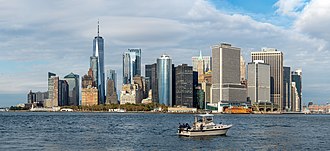
The worst damage happened in New York City, where the Twin Towers of the World Trade Center in Lower Manhattan were attacked. Many years later, people who were near the towers began getting very sick, and some of them passed away because of it. The attacks changed many lives and remain one of the most remembered events in history.
Evacuation
See also: Communication during the September 11 attacks
Most tall buildings in the United States at the time were not designed for complete evacuation during a crisis. After a similar event in 1993, some improvements were made to the buildings and evacuation plans. People who evacuated in both 1993 and 2001 said they were better prepared the second time.
Both towers had three stairwells in the center. On some floors with machinery, the stairwells connected through corridors. The stairwells were very narrow, with two being only 44 inches wide and the third being 56 inches wide.
In the immediate aftermath of the attacks, media reports suggested that tens of thousands might have been killed. Estimates of the number of people present in the Twin Towers that morning range between 14,000 and 19,000. Almost all of the deaths in the Twin Towers occurred on floors trapped by the plane impacts. In interviews with survivors, researchers found that most people stayed behind to wait for more information or to do tasks like collecting belongings or calling family members. Many also stopped during their evacuation to rest or because of congestion on the stairs.
North Tower
Within moments of the first plane’s impact, an order was given to evacuate the North Tower, but only those below the 92nd floor could follow it. The towers were not designed for a mass evacuation, and each had only three stairwells. For anyone above the 91st floor, escape was impossible. Emergency responders arrived quickly and began helping with the evacuation.
South Tower
In the South Tower, many people knew something serious had happened when they heard and saw the first plane hit the North Tower. Because it was not yet clear that a terrorist attack was happening, the Port Authority did not order a full evacuation right away. Some people chose to leave on their own, while others stayed because they were told to remain in their offices. Later, officials advised workers to leave, and many did.
Pentagon
Since the Pentagon was struck after the World Trade Center, many who worked there did not think the attack would extend past New York City.
World Trade Center Hotel
Main article: Marriott World Trade Center
During evacuations of the two larger towers, the hotel was used as an evacuation route for about 1,000 people. Guests and others were guided by hotel staff to leave the building.
Surrounding area
Main articles: Rescue and recovery effort after the September 11 attacks and Maritime response following the September 11 attacks
After both towers had been struck, the order to evacuate spread to most high-rise buildings in Lower Manhattan and surrounding areas. Evacuees were directed to leave through underground shopping areas and onto streets. Boats and ferries helped evacuate many people from Lower Manhattan.
Disabled individuals
See also: Salty and Roselle
Some disabled individuals were able to evacuate with help. For example, a person who used an evacuation chair was carried down from the 69th floor, and another person who was blind evacuated with the help of a guide dog.
Survivors
See also: Collapse of the World Trade Center
In the North Tower, no one survived in the area where the plane hit or just above or below it. The highest floor with survivors was floor 91. About 15 people in a central staircase on floor 22 or lower survived the building's collapse, escaping or being rescued from the rubble.
At least 42 people escaped from the area where the plane hit the South Tower, with the highest survivor coming from floor 98. Most of these people used a single staircase that stayed open after the plane hit. Because of problems with communication, many people were told to wait for help instead of using this staircase. A few people survived in a different way because the emergency brakes on the elevators they were in stopped working properly.
Although few people survived from the areas where the planes hit, some may have started to leave but couldn’t get down before the building collapsed. Some survivors mentioned coworkers who were trapped.
Two of the 42 survivors were babies who were not born yet when the attacks happened — their mothers were pregnant with them.
One survivor, Doris Torres, later died from her injuries on September 16th after escaping from the 78th floor.
After collapses
After the buildings collapsed, only a few people managed to escape from the rubble. Twelve firefighters and three police officers from the Port Authority made it out alive. Sixteen people inside the North Tower who were trying to leave through a central staircase also survived. Four people in the area between the two towers survived as well. Only one person who was inside the South Tower when it collapsed survived.
The last survivor found in the rubble of the North Tower was Genelle Guzman-McMillan. She was found 27 hours after the building fell. She and another worker, Pasquale Buzzelli, were the only two from their group to survive.
Some people survived the collapse but were trapped in small spaces under the rubble and couldn’t be rescued in time.
Survivor advocacy
Main articles: Health effects arising from the September 11 attacks and World Trade Center Health Program
Many police officers, firefighters, and others who helped after the attacks have faced health problems, including breathing issues, mental health challenges, stomach problems, and cancer. In 2015, a law was passed to provide continuing health care for these responders and extend the time for victims to receive compensation.
Fatalities
A total of 2,606 people who were in the World Trade Center and on the ground perished as a result of the attacks and the subsequent collapse of the towers. This included 2,192 civilians, 343 members of the New York City Fire Department, and 71 law enforcement officers from various agencies.
The average age of the victims in New York City was 40. The youngest victim was a two-and-a-half-year-old girl, and the oldest was an 85-year-old retiree. Ten pregnant women and their unborn children were also among those who died.
Other victims included well-known individuals such as a photojournalist, an actor, a cricket player, a Hall of Fame lacrosse player, and an NBA basketball player.
At least 125 people working at the Pentagon were killed, most of whom worked for the United States Army or the United States Navy.
The 265 fatalities aboard the four planes included 87 civilians on American Airlines Flight 11, 60 civilians on United Airlines Flight 175, 59 civilians on American Airlines Flight 77, and 39 civilians on United Airlines Flight 93. The dead included eight children, with the youngest being a two-and-a-half-year-old and the oldest an 85-year-old.
During the attacks and afterwards, there was a large amount of toxic dust, debris and ash that centralized around Ground Zero and created long-term health problems. Many first responders and victims developed serious health issues as a result.
Forensic identification
After the attacks, many people were not found whole because of the large amount of debris. Only 174 complete bodies were found, but many small pieces of bone and tissue were collected. Scientists used DNA testing to try to match these pieces to families. This was difficult because the extreme heat and time in the rubble damaged the DNA.
Over many years, scientists have worked hard to identify more victims. By 2025, they had identified more than 1,600 people, but many still wait for answers. Each identification is done carefully, respecting the wishes of families.
Pictures
Keep exploring




This article is a child-friendly adaptation of the Wikipedia article on Casualties of the September 11 attacks, available under CC BY-SA 4.0.
Images from Wikimedia Commons. Tap any image to view credits and license.