New York City
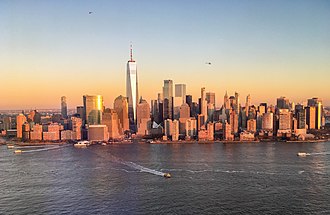
New York, often called New York City (NYC), is the most populous city in the United States. It is located at the southern tip of New York State on New York Harbor, one of the world's largest natural harbors. The city has five boroughs: Manhattan, Brooklyn, Queens, the Bronx, and Staten Island. Each borough is the same area as its respective county. New York is the geographical and demographic center of both the Northeast megalopolis and the New York metropolitan area, the largest metropolitan area in the United States by both population and urban area. It is also one of the world's most populous urban agglomerations.
New York is a global center of technology, finance, commerce, culture, entertainment and media, academics and scientific output, the arts and fashion. It is also home to the headquarters of the United Nations, which takes part in international diplomacy. New York City is known for its fast pace and continuous urban energy. With an estimated population of 8,586,038 as of 2026, New York is the most densely populated major city in the United States. It has more than double the population of Los Angeles, the country's second-most populous city. The city and its metropolitan statistical area, which has more than 20.1 million people, serve as the premier gateway for legal immigration to the United States. An estimated 800 languages are spoken in New York City, making it the most linguistically diverse city in the world. The New York City metropolitan region is home to the largest foreign-born population of any metropolitan region in the world, numbering approximately 5.9 million people as of 2023.
Manhattan Island was inhabited by Munsee-speaking Lenape around 1624. By then, Dutch colonists had established Fort Amsterdam as a center of trade on the island. This was the first European settlement in what would become New York City. The settlement was named New Amsterdam in 1626 and was chartered as a city in 1653. The city came under English control in 1664 and was temporarily renamed New York after Charles II granted the lands to his brother, the Duke of York, James II. This name was permanently adopted in 1674. Following independence from the Kingdom of Great Britain, New York City was the national capital of the United States from 1785 until 1790. The modern city was formed by the 1898 consolidation of its five boroughs.
Anchored by Wall Street in Manhattan's Financial District, New York City has been called both the world's premier financial and fintech center and the most economically powerful city in the world. As of 2024, the New York metropolitan area is the largest metropolitan economy in the world, with a gross metropolitan product of over US$2.44 trillion. Its economy is larger than all but nine countries. Despite having a 24/7 rapid transit system, New York also leads the world in urban automobile traffic congestion. The city is home to the world's two largest stock exchanges by market capitalization of their listed companies: the New York Stock Exchange and Nasdaq. As of 2025, New York City is the most expensive city in the world for expatriates, and there are growing concerns about affordability in the city. New York County (Manhattan) is, by a large margin, the most expensive U.S. county in terms of average home price per square foot. It also produces the highest U.S. county GDP by both absolute and per capita measures. Fifth Avenue is an ultra-luxury international shopping corridor that is undergoing additional infrastructure investment. New York City is home to the highest number of billionaires, individuals of ultra-high net worth (greater than US$30 million), and millionaires of any city in the world by a significant margin.
Etymology
See also: Nicknames of New York City
In 1664, New York was named after the Duke of York, who later became King James II of England. His older brother, Charles II, made him the proprietor, or owner, of the old land called New Netherland. That land included the city of New Amsterdam, which England seized from Dutch control. New Netherland was then renamed the Province of New York, which is now called New York State.
History
Main articles: History of New York City and Timeline of New York City
Further information: History of Manhattan, Timeline of Brooklyn, Timeline of Queens, Timeline of the Bronx, and Timeline of Staten Island
Long before Europeans arrived, the area was home to Algonquians, including the Lenape people, whose homeland, Lenapehoking, covered much of what is now New York City. In 1524, the Italian explorer Giovanni da Verrazzano became the first recorded European to visit New York Harbor. Later, the English explorer Henry Hudson sailed there for the Dutch East India Company in 1609. The Dutch built a fur trading settlement called New Amsterdam on Manhattan Island, and the settlement grew slowly. In 1664, England took control and renamed it New York.
Over the next centuries, the city grew into a major trading port. It became an important part of the young United States. For a time, New York City was the national capital, and the first President, George Washington, was inaugurated there. In the 1800s, the city grew quickly as immigrants arrived, and the Statue of Liberty welcomed many of them to America. In 1898, the city became the five boroughs we know today. Later, the city faced hard times, including economic troubles in the 1970s, but it recovered and became a world center for business and culture. The city was deeply affected by the September 11 attacks in 2001, Hurricane Sandy in 2012, and the COVID-19 pandemic that began in 2020.
Geography
Main articles: Geography of New York City and Geography of New York–New Jersey Harbor Estuary
Main articles: Boroughs of New York City and Neighborhoods in New York City
Main article: Climate of New York City
Main article: Environmental issues in New York City
New York City is in the northeastern United States, about halfway between Washington, D.C. and Boston. It sits at the mouth of the Hudson River, where a sheltered harbor leads to the Atlantic Ocean. This location helped the city become an important trading port. Most of the city is built on three islands: Long Island, Manhattan, and Staten Island. The city is made up of five boroughs. Manhattan is the smallest and most crowded, and it is home to Central Park and most of the city's skyscrapers. Brooklyn has the most people, and Queens is the largest borough by area. The Bronx is the only borough that is mostly on the U.S. mainland, and Staten Island is the most suburban.
The city has a humid subtropical climate, with chilly, damp winters and hot, humid summers. Hurricanes are rare here, but Hurricane Sandy brought a destructive storm surge to the city on October 29, 2012. New York City has a large park system, and Central Park is one of the most visited urban parks in the world. The city's drinking water comes from the protected Catskill Mountains watershed, and many people in the city use public transportation, walk, or ride bikes.
| Climate data for JFK Airport, New York (1991–2020 normals, extremes 1948–present) | |||||||||||||
|---|---|---|---|---|---|---|---|---|---|---|---|---|---|
| Month | Jan | Feb | Mar | Apr | May | Jun | Jul | Aug | Sep | Oct | Nov | Dec | Year |
| Record high °F (°C) | 71 (22) | 71 (22) | 85 (29) | 90 (32) | 99 (37) | 102 (39) | 104 (40) | 101 (38) | 98 (37) | 95 (35) | 82 (28) | 75 (24) | 104 (40) |
| Mean maximum °F (°C) | 57.7 (14.3) | 58.3 (14.6) | 67.5 (19.7) | 77.9 (25.5) | 85.6 (29.8) | 92.4 (33.6) | 95.2 (35.1) | 91.9 (33.3) | 87.9 (31.1) | 79.7 (26.5) | 68.9 (20.5) | 60.6 (15.9) | 96.8 (36.0) |
| Mean daily maximum °F (°C) | 39.5 (4.2) | 41.7 (5.4) | 48.7 (9.3) | 58.8 (14.9) | 68.4 (20.2) | 78.0 (25.6) | 83.6 (28.7) | 82.2 (27.9) | 75.8 (24.3) | 64.7 (18.2) | 53.8 (12.1) | 44.5 (6.9) | 61.6 (16.4) |
| Daily mean °F (°C) | 32.8 (0.4) | 34.5 (1.4) | 41.1 (5.1) | 50.9 (10.5) | 60.5 (15.8) | 70.2 (21.2) | 76.1 (24.5) | 75.0 (23.9) | 68.4 (20.2) | 57.2 (14.0) | 46.8 (8.2) | 38.3 (3.5) | 54.3 (12.4) |
| Mean daily minimum °F (°C) | 26.2 (−3.2) | 27.4 (−2.6) | 33.6 (0.9) | 42.9 (6.1) | 52.5 (11.4) | 62.4 (16.9) | 68.7 (20.4) | 67.8 (19.9) | 61.0 (16.1) | 49.8 (9.9) | 39.8 (4.3) | 32.0 (0.0) | 47.0 (8.3) |
| Mean minimum °F (°C) | 10.2 (−12.1) | 13.3 (−10.4) | 20.2 (−6.6) | 32.6 (0.3) | 42.9 (6.1) | 52.6 (11.4) | 62.8 (17.1) | 60.1 (15.6) | 50.0 (10.0) | 37.9 (3.3) | 26.9 (−2.8) | 18.6 (−7.4) | 8.2 (−13.2) |
| Record low °F (°C) | −2 (−19) | −2 (−19) | 7 (−14) | 20 (−7) | 34 (1) | 45 (7) | 55 (13) | 46 (8) | 40 (4) | 30 (−1) | 15 (−9) | 2 (−17) | −2 (−19) |
| Average precipitation inches (mm) | 3.23 (82) | 2.76 (70) | 3.94 (100) | 3.55 (90) | 3.66 (93) | 3.85 (98) | 3.86 (98) | 4.11 (104) | 3.58 (91) | 3.72 (94) | 3.07 (78) | 3.96 (101) | 43.29 (1,100) |
| Average snowfall inches (cm) | 7.5 (19) | 8.6 (22) | 4.3 (11) | 0.6 (1.5) | 0.0 (0.0) | 0.0 (0.0) | 0.0 (0.0) | 0.0 (0.0) | 0.0 (0.0) | 0.0 (0.0) | 0.4 (1.0) | 4.5 (11) | 25.9 (66) |
| Average precipitation days (≥ 0.01 inch) | 10.7 | 9.8 | 10.8 | 11.4 | 11.8 | 10.6 | 9.4 | 9.0 | 8.2 | 9.4 | 8.9 | 11.2 | 121.2 |
| Average snowy days (≥ 0.1 in) | 4.6 | 3.8 | 2.5 | 0.3 | 0.0 | 0.0 | 0.0 | 0.0 | 0.0 | 0.0 | 0.2 | 2.6 | 14.0 |
| Average relative humidity (%) | 64.9 | 64.4 | 63.4 | 64.1 | 69.5 | 71.5 | 71.4 | 71.7 | 71.9 | 69.1 | 67.9 | 66.3 | 68.0 |
| Source: NOAA (relative humidity 1961–1990) | |||||||||||||
| Climate data for New York LaGuardia Airport, NY (1991-2020 normals, extremes 1939-present) | |||||||||||||
|---|---|---|---|---|---|---|---|---|---|---|---|---|---|
| Month | Jan | Feb | Mar | Apr | May | Jun | Jul | Aug | Sep | Oct | Nov | Dec | Year |
| Record high °F (°C) | 72 (22) | 79 (26) | 86 (30) | 94 (34) | 97 (36) | 101 (38) | 107 (42) | 104 (40) | 102 (39) | 95 (35) | 83 (28) | 75 (24) | 107 (42) |
| Mean maximum °F (°C) | 60.2 (15.7) | 60.0 (15.6) | 69.3 (20.7) | 81.7 (27.6) | 89.3 (31.8) | 94.1 (34.5) | 97.4 (36.3) | 94.7 (34.8) | 89.6 (32.0) | 81.2 (27.3) | 70.9 (21.6) | 62.8 (17.1) | 98.7 (37.1) |
| Mean daily maximum °F (°C) | 40.2 (4.6) | 42.7 (5.9) | 49.9 (9.9) | 61.3 (16.3) | 71.8 (22.1) | 81.1 (27.3) | 86.4 (30.2) | 84.5 (29.2) | 77.2 (25.1) | 66.0 (18.9) | 55.0 (12.8) | 45.4 (7.4) | 63.5 (17.5) |
| Daily mean °F (°C) | 34.4 (1.3) | 36.3 (2.4) | 43.1 (6.2) | 53.6 (12.0) | 63.7 (17.6) | 73.4 (23.0) | 79.2 (26.2) | 77.7 (25.4) | 70.8 (21.6) | 59.6 (15.3) | 49.1 (9.5) | 40.0 (4.4) | 56.8 (13.8) |
| Mean daily minimum °F (°C) | 28.6 (−1.9) | 29.9 (−1.2) | 36.2 (2.3) | 46.0 (7.8) | 55.7 (13.2) | 65.7 (18.7) | 71.9 (22.2) | 71.0 (21.7) | 64.4 (18.0) | 53.3 (11.8) | 43.2 (6.2) | 34.7 (1.5) | 50.1 (10.1) |
| Mean minimum °F (°C) | 11.1 (−11.6) | 13.6 (−10.2) | 21.0 (−6.1) | 34.2 (1.2) | 45.6 (7.6) | 54.3 (12.4) | 63.5 (17.5) | 62.4 (16.9) | 52.9 (11.6) | 40.7 (4.8) | 29.4 (−1.4) | 19.4 (−7.0) | 8.7 (−12.9) |
| Record low °F (°C) | −3 (−19) | −7 (−22) | 7 (−14) | 22 (−6) | 36 (2) | 46 (8) | 56 (13) | 51 (11) | 42 (6) | 30 (−1) | 17 (−8) | −2 (−19) | −7 (−22) |
| Average precipitation inches (mm) | 3.25 (83) | 2.93 (74) | 4.01 (102) | 3.85 (98) | 3.58 (91) | 4.03 (102) | 4.30 (109) | 4.41 (112) | 3.88 (99) | 3.81 (97) | 3.15 (80) | 4.08 (104) | 45.28 (1,150) |
| Average snowfall inches (cm) | 8.6 (22) | 9.8 (25) | 5.4 (14) | 0.4 (1.0) | 0.0 (0.0) | 0.0 (0.0) | 0.0 (0.0) | 0.0 (0.0) | 0.0 (0.0) | 0.1 (0.25) | 0.3 (0.76) | 5.2 (13) | 29.8 (76) |
| Average precipitation days (≥ 0.01 in) | 10.3 | 10.2 | 10.9 | 11.2 | 11.6 | 10.7 | 9.7 | 9.5 | 8.3 | 9.0 | 8.8 | 11.5 | 121.7 |
| Average snowy days (≥ 0.1 in) | 4.4 | 3.7 | 2.6 | 0.2 | 0.0 | 0.0 | 0.0 | 0.0 | 0.0 | 0.0 | 0.2 | 2.7 | 13.8 |
| Source: NOAA | |||||||||||||
Demographics
Main articles: Demographics of New York City and Demographic history of New York City
Main articles: LGBTQ culture in New York City, Transgender culture of New York City, Same-sex marriage in New York, and NYC Pride March
Further information: St. Patrick's Cathedral (Midtown Manhattan), Rockefeller Center Christmas Tree, History of the Jews in New York City, Jewish arrival in New Amsterdam, Islam in New York City, Hindu Temple Society of North America, Mahayana Buddhism North America, and Falun Gong
New York City is the most populous city in the United States, with 8,804,190 residents counted in the 2020 census. This is the highest count the city has ever had. In 2020, about 35.9% of residents were White, 22.7% were Black, 14.6% were Asian, 10.5% were Mixed, and 28.4% were Hispanic or Latino. Between 2010 and 2020, the city grew by 629,000 people, more than the next four largest American cities combined. The city has the densest population of any American city with more than 100,000 people, and Manhattan has the highest population density of any county in the United States. About 43.6% of New York State's people live in the city, which is part of the New York metropolitan area. Many immigrants have come to the city over its history, and it has long been a major port of entry. About 36.3% of residents were born outside the country. The largest ancestries include Dominican, Chinese, Puerto Rican, and Italian, and no single country dominates. Christianity is the largest religion, followed by Judaism and Islam. New York City has been described as the gay capital of the world. Same-sex marriage became legal in New York in 2011, and the city holds a large annual NYC Pride March each June.
| Year | Pop. | ±% |
|---|---|---|
| 1698 | 4,937 | — |
| 1712 | 5,840 | +18.3% |
| 1723 | 7,248 | +24.1% |
| 1737 | 10,664 | +47.1% |
| 1746 | 11,717 | +9.9% |
| 1756 | 13,046 | +11.3% |
| 1771 | 21,863 | +67.6% |
| 1790 | 33,131 | +51.5% |
| 1800 | 60,515 | +82.7% |
| 1810 | 96,373 | +59.3% |
| 1820 | 123,706 | +28.4% |
| 1830 | 202,589 | +63.8% |
| 1840 | 312,710 | +54.4% |
| 1850 | 515,547 | +64.9% |
| 1860 | 813,669 | +57.8% |
| 1870 | 942,292 | +15.8% |
| 1880 | 1,206,299 | +28.0% |
| 1890 | 1,515,301 | +25.6% |
| 1900 | 3,437,202 | +126.8% |
| 1910 | 4,766,883 | +38.7% |
| 1920 | 5,620,048 | +17.9% |
| 1930 | 6,930,446 | +23.3% |
| 1940 | 7,454,995 | +7.6% |
| 1950 | 7,891,957 | +5.9% |
| 1960 | 7,781,984 | −1.4% |
| 1970 | 7,894,862 | +1.5% |
| 1980 | 7,071,639 | −10.4% |
| 1990 | 7,322,564 | +3.5% |
| 2000 | 8,008,288 | +9.4% |
| 2010 | 8,175,133 | +2.1% |
| 2020 | 8,804,190 | +7.7% |
| 2025 est. | 8,584,629 | −2.5% |
Economy
Main article: Economy of New York City
New York City is a global hub of business and commerce, sometimes called the "Capital of the World." Greater New York has the world's largest metropolitan economy, with a gross metropolitan product estimated at US$2.16 trillion in 2022. The city is a center for banking and finance, life sciences, medical technology, new media, traditional media, advertising, legal services, accountancy, insurance, and the arts. The Port of New York and New Jersey is a major economic engine, benefitting post-Panamax ships from the expansion of the Panama Canal. Many Fortune 500 companies and multinational corporations have their headquarters in the city. Its fashion industry employs about 180,000 people, and the garment industry, once centered in the Garment District, peaked in 1950. In 2024, the city's economy produced over US$1 trillion, or 77%, from Manhattan alone. The city also has income disparity, and it levies an income tax on residents, yet it had the most billionaires of any city in the world in 2024.
Wall Street
Main articles: Wall Street and Financial District, Manhattan
The city's most important economic sector is its role as a major financial center, known as Wall Street. Lower Manhattan is home to the New York Stock Exchange and the Nasdaq, which are the world's largest and second largest stock exchanges. New York City remains the largest global center for trading in public equity and debt capital markets, and it also leads in hedge fund management, private equity, and commercial banking in the United States. Midtown Manhattan is the largest central business district in the world.
Tech and biotech
Further information: Tech:NYC, Tech companies in New York City, Biotech companies in New York City, and Silicon Alley
New York is a top-tier global technology hub, and as of 2025, the New York metropolitan area has the largest tech talent hub in the world. The city's tech work now includes artificial intelligence, financial technology, cryptocurrency, biotechnology, and game design. The biotechnology sector is growing, based on the city's strength in scientific research. Tech:NYC, founded in 2016, is a non-profit organization that represents the city's technology industry.
Real estate
New York City real estate is a haven for global investors. The total value of all city property was assessed at US$1.479 trillion for the 2017 fiscal year. Fifth Avenue in Midtown Manhattan has the highest retail rents in the world. The city has one of the highest costs of living in the world, which is made worse by a housing shortage. In 2023, the vacancy rate was 1.4%, the lowest since 1968.
Tourism
Main article: Tourism in New York City
Tourism is a vital industry, and as many as 66.6 million visitors came to the city in a year. I Love New York is a logo and song that has been used since 1977 to promote tourism in New York City. Major landmarks include the Metropolitan Museum of Art, the Statue of Liberty, the Empire State Building, and Central Park. Times Square attracts 50 million visitors each year.
Media and entertainment
Main article: Media in New York City
Further information: New Yorkers in journalism
New York City has been described as the entertainment and digital media capital of the world. Many of the world's largest media conglomerates are based here, including Warner Bros. Discovery, Bloomberg L.P., and NBCUniversal. The city's major newspapers include The Wall Street Journal and The New York Times, and public broadcaster WNET produces a third of national Public Broadcasting Service (PBS) television programming.
Education
Main article: Education in New York City
New York City has the largest educational system of any city. It includes primary education, secondary education, higher education, and research. The New York City Public Schools system, managed by the New York City Department of Education, is the largest public school system in the United States. As of 2017–2018, it served about 1.1 million students in roughly 1,800 primary and secondary schools, including charter schools. About 900 more private schools, both secular and religious, also operate in the city.
The New York Public Library (NYPL) has the largest collection of any public library system in the United States. Queens Borough Public Library (QPL) serves Queens and is the nation's second-largest public library system, while the Brooklyn Public Library (BPL) serves Brooklyn. More than a million students attend the city's more than 120 higher education institutions, the highest number of any city in the United States, and nearly a quarter million of them study in the City University of New York (CUNY) system. The public CUNY system has 25 institutions across all five boroughs. The public State University of New York (SUNY) system has campuses in the city, including SUNY Downstate Health Sciences University, Fashion Institute of Technology, SUNY Maritime College, and SUNY College of Optometry. Notable private universities in the city include Adelphi University, Bank Street College of Education, Barnard College, Columbia University, Cooper Union, Fordham University, New York University, New York Institute of Technology, Rockefeller University, Mercy University, Cornell Tech, and Yeshiva University. Several of these rank among the top universities in the world, and Princeton University and Yale University are in the New York metropolitan area. Much of the scientific research in the city is done in medicine and the life sciences. In 2019, the New York metropolitan area ranked first by share of published articles in life sciences. New York City awards more postgraduate life sciences degrees each year than any other city in the United States. In 2012, 43,523 licensed physicians were practicing in the city, and as of 2004 there were 127 Nobel laureates with roots in local institutions.
Culture
Main article: Culture of New York City
New York City is often the setting for novels, movies, and television programs and has been described as the cultural capital of the world. The city is the birthplace of many cultural movements, including the Harlem Renaissance in literature and art, and hip-hop and disco in music. People often say the city is known for its fast pace, and its residents are known for their toughness, especially in handling the September 11 terrorist attacks and the COVID-19 pandemic. Broadway is one of the most famous theater scenes in the world, and the Tony Awards celebrate the best live Broadway theater each year. The city also has a distinctive accent, the New York dialect, and its architecture ranges from old brownstone houses to the modern One World Trade Center. The Metropolitan Museum of Art is the largest art museum in the Americas.
New York City is also known for its food, fashion, and parades. Immigrants brought many foods to the city, including New York-style bagels and New York-style pizza. New York is a fashion capital, and New York Fashion Week is a big event that shows the latest clothing designs. The annual Macy's Thanksgiving Day Parade is the world's largest parade and draws millions of people. The city's sports teams include the New York Yankees, the New York Knicks, and the New York Mets, and the New York City Marathon is the world's largest running marathon.
Human services
Health
New York City is a center for healthcare and medical training, with over 750,000 people working in the city's health care sector. Private hospitals include the Hospital for Special Surgery, Lenox Hill Hospital, Long Island Jewish Medical Center, Memorial Sloan Kettering Cancer Center, Mount Sinai Hospital, NewYork-Presbyterian Hospital, and NYU Langone Health. Medical schools include SUNY Downstate College of Medicine in Brooklyn, Albert Einstein College of Medicine in the Bronx, and CUNY School of Medicine, Touro College of Osteopathic Medicine, Columbia University Vagelos College of Physicians and Surgeons, Weill Cornell Medicine, Icahn School of Medicine at Mount Sinai, and New York University School of Medicine in Manhattan. NYC Health + Hospitals is a public-benefit corporation started in 1969 that runs the city's public hospitals and a network of outpatient clinics. As of 2021, it is the largest American municipal healthcare system, with $10.9 billion in yearly revenues. It serves 1.4 million patients, including more than 475,000 city residents without insurance. It runs eleven acute-care hospitals, four skilled nursing facilities, six diagnostic and treatment centers, and more than 70 community-based primary care sites, mainly serving the city's poor and working-class residents. Its MetroPlus Health Plan is one of the city's largest providers of government-sponsored health insurance, enrolling 670,000 city residents as of June 2022. Its facilities serve millions of New Yorkers each year, in more than 190 languages. The best-known hospital in this system is Bellevue Hospital, the oldest public hospital in the United States, established in 1736. Bellevue is the designated hospital for treating the president and other world leaders if they need care while in New York City. The city banned smoking in most parts of restaurants in 1995 and banned it in bars, restaurants, and places of public employment in 2003. Pharmacies are banned from selling smoked and vaped products in New York State. New York City enforces a right-to-shelter law that guarantees shelter to anyone who needs it, whatever their immigration, income, or housing status. As a result, New York has the highest total homeless population of American cities, but in 2024 only 5% were unsheltered, a much lower share of outdoor homelessness than in other cities. As of 2023, 92,824 homeless people slept nightly in the shelter system.
Public safety
The New York Police Department (NYPD) is the largest police force in the United States, with more than 36,000 sworn officers. Its members are often called New York's Finest by politicians, the media, and even their own police cars. Crime spiked from the 1970s through the 1990s, then trended downward, and violent crime fell more than 75% from 1993 to 2005. The NYPD's stop-and-frisk program was declared unconstitutional in 2013 as a "policy of indirect racial profiling" of Black and Mixed residents. The program had been widely credited with the drop in crime, though crime kept falling in the years after it ended. The city recorded a record high of 2,245 murders in 1990 and a near-70-year low of 289 in 2018. In 2017, the number of murders and the rate of 3.3 per 100,000 residents were the lowest since 1951. The city recorded 386 murders in 2023, a 12% decline from the year before. In 2021, New York City had one of the lowest homicide rates among the ten largest U.S. cities, at 5.5 per 100,000 residents. New York City has stricter gun laws than most other cities in the United States. A license is required to own any firearm, and the NY SAFE Act of 2013 banned assault weapons. In 2020, New York State had the fifth-lowest gun death rate of the states. Organized crime has long been linked to New York City, beginning with the Forty Thieves and the Roach Guards in the Five Points neighborhood in the 1820s, followed by the Tongs in the same area, which eventually became Chinatown, Manhattan. The 20th century saw the rise of the Mafia, led by the Five Families, and of gangs, including the Black Spades. Mafia and gang activity has declined in the city in the 21st century. The Fire Department of New York (FDNY) provides fire protection, technical rescue, first response to biological, chemical, and radioactive hazards, and emergency medical services. It responds to building types ranging from wood-frame single-family homes to high-rise structures, as well as fires in the New York City Subway. Remote bridges and tunnels, and large parks and wooded areas that can have brush fires, also present challenges. The FDNY is headquartered at 9 MetroTech Center in Downtown Brooklyn, and the FDNY Fire Academy is on Randalls Island.
Transportation
Main article: Transportation in New York City
Rapid transit
Mass transit in New York City, most of which runs 24 hours a day, carries one in every three mass transit users in the country. Two-thirds of the nation's rail riders live in the New York City area.
Buses
New York City's public bus fleet runs 24/7 and is the largest in North America. In 2022, MTA New York City Transit buses served 483.5 million trips, and MTA Regional Bus Operations handled 100.3 million trips. The Port Authority Bus Terminal is the city's main intercity bus terminal and the world's busiest bus station. It serves 250,000 passengers on 7,000 buses each workday. The Port Authority announced a 2021 plan to spend $10 billion to expand and modernize the building. In 2024, it also announced plans for a new terminal with a glass atrium at a new main entrance on 41st Street.
Rail
The New York City Subway opened on October 27, 1904. It is one of the world's oldest public transit systems and has the most stations of any, with 423 stations in operation. Nearly all of it is open 24 hours a day. The subway is the busiest metropolitan rail transit system in the Western Hemisphere, with 1.28 billion passenger rides in 2025.
Public transport is widely used in New York City. In 2005, 54.6% of New Yorkers commuted to work by mass transit. Across the rest of the country, 91% of commuters travel to work by automobile. According to the New York City Comptroller, workers in the New York City area spend an average of 6 hours and 18 minutes commuting each week, the longest commute time in the nation among large cities. New York is the only American city where a majority (52%) of households do not have a car. Only 22% of Manhattanites own one. Because of their high usage of mass transit, New Yorkers spend less of their income on transportation than the national average.
The city's commuter rail network is the largest in North America. It connects the city to its suburbs through the Long Island Rail Road, Metro-North Railroad, and New Jersey Transit. These systems meet at Grand Central Terminal and New York Penn Station, and together they have more than 250 stations and 20 rail lines. The elevated AirTrain JFK in Queens connects JFK International Airport to the subway and the Long Island Rail Road. For inter-city rail, the city is served by Amtrak. Its busiest station, by a large margin, is Penn Station on the West Side of Manhattan. From there, Amtrak connects to Boston, Philadelphia, and Washington, D.C., along the Northeast Corridor, and also runs long-distance trains to other North American cities.
The Staten Island Railway serves only Staten Island and runs 24 hours a day. People can reach Manhattan from the St. George Terminal by the Staten Island Ferry. The PATH train links Midtown and Lower Manhattan with Hoboken Terminal and Newark Penn Station in New Jersey. It also connects those stations with the World Trade Center Oculus across the Hudson River. Like the subway, PATH runs 24 hours a day. This means three of the five American rapid transit systems that run on 24-hour schedules are wholly or partly in New York. Grand Central Terminal is the world's largest train station by number of rail platforms and acres occupied.
Large heavy rail transit projects are being built in New York City, including the Second Avenue Subway.
Air
Main article: Aviation in the New York metropolitan area
New York's airspace is the busiest in the United States and one of the busiest air corridors in the world. In 2022, 127.9 million travelers used the three busiest airports in the New York area: John F. Kennedy International Airport (55.3 million passengers), Newark Liberty International Airport (43.6 million), and LaGuardia Airport (29.0 million). In 2023, JFK and Newark Liberty were the busiest and fourth-busiest U.S. gateways for international air passengers. As of 2022, JFK was the busiest airport for international passengers in North America, with 26.8 million.
In 2014, then–Vice President Joe Biden described LaGuardia Airport as the kind of airport travelers would see in a poor country. Since then, LaGuardia has had an $8 billion project, with federal and state support, that replaced its aging facilities with modern terminals and roadways. Plans have also moved forward to expand passenger volume at Stewart International Airport, near Newburgh, New York, run by the Port Authority of New York and New Jersey. Other commercial airports in or serving the New York metropolitan area include Long Island MacArthur Airport, Trenton–Mercer Airport, and Westchester County Airport. The main general aviation airport in the area is Teterboro Airport.
Ferries, taxis and trams
Main articles: Staten Island Ferry, NYC Ferry, Taxis of New York City, and Roosevelt Island Tramway
The Staten Island Ferry is the world's busiest ferry. From July 2015 through June 2016, it carried more than 23 million passengers on a 5.2-mile (8.4 km) route between Staten Island and Lower Manhattan. It runs 24/7. Other ferries carry commuters between Manhattan and other places in the city and metropolitan area. NYCEDC started NYC Ferry in 2017. Its routes are planned to reach all five boroughs.
The city's 13,587 yellow taxicabs, identified by their color and taxi medallion, are the only vehicles allowed to pick up street hails throughout the city. Apple green boro taxis can pick up street hails in Upper Manhattan and the four outer boroughs. Yellow taxis long dominated, but high-volume for-hire vehicles from Uber and Lyft have provided the most trips in the city since December 2016. By October 2023, the 78,000 for-hire vehicles made 20.3 million trips, while yellow taxis made 3.5 million.
The Roosevelt Island Tramway, an aerial tramway that began operating in 1976, carries 2 million passengers a year. It travels 3,140 feet (960 m) between Roosevelt Island and 59th Street and Second Avenue on Manhattan Island.
Cycling network
Main article: Cycling in New York City
New York City has mixed conditions for cycling. The city is dense and mostly flat, but its roads are often crowded with stop-and-go traffic and many pedestrians. Its many cyclists include utility cyclists, such as delivery and messenger workers, members of recreational cycling clubs, and a growing number of commuters. In 2022, about 61,200 people commuted to work by bicycle each day, and there were 610,000 daily bike trips. Both numbers nearly doubled over the previous decade. As of 2022, the city had 1,525 miles (2,454 km) of bike lanes, including 644 miles (1,036 km) of protected lanes.
Streets and highways
Streets are also a defining feature of the city. New York has been found to lead the world in urban automobile traffic congestion. The Commissioners' Plan of 1811 greatly shaped the city's physical development. New York City has a large network of freeways and parkways. They link the boroughs to each other and to North Jersey, Westchester County, Long Island, and southwestern Connecticut through bridges and tunnels. Many suburban and outer borough residents drive into Manhattan on these highways, so drivers are often stuck for hours in heavy traffic, especially during rush hour.
In January 2025, the nation's first congestion pricing program went into effect. It applies to most motor vehicle traffic in the area of Manhattan south of 60th Street. It aims to encourage commuters to use rapid transit instead. Unlike much of the country, New York State bans turns on red lights in cities with more than one million people, to reduce collisions and improve pedestrian safety. In New York City, all turns on red lights are illegal unless a sign permits them.
Bridges and tunnels
Further information: List of bridges and tunnels in New York City and Commissioners' Plan of 1811
Manhattan and Staten Island are on islands with the same names. Queens and Brooklyn are at the western end of the larger Long Island, and the Bronx is on the New York State mainland. An extensive network of bridges and tunnels links Manhattan Island to the outer boroughs and New Jersey. The 14-lane George Washington Bridge connects Manhattan to New Jersey across the Hudson River and is the world's busiest motor vehicle bridge. The Verrazzano–Narrows Bridge, which spans the Narrows between Brooklyn and Staten Island, is the longest suspension bridge in the Americas and one of the longest in the world. The Brooklyn Bridge is an icon of the city. It opened in 1883 and was the first steel-wire suspension bridge. It was the longest suspension bridge in the world until 1903. The Queensboro Bridge "was the longest cantilever span in North America" from 1909 to 1917. The Manhattan Bridge, opened in 1909, "is considered to be the forerunner of modern suspension bridges." The Throgs Neck Bridge and Whitestone Bridge connect Queens and the Bronx. The Triborough Bridge connects Manhattan, Queens, and the Bronx.
The Lincoln Tunnel carries 120,000 vehicles a day under the Hudson River between New Jersey and Midtown Manhattan. It is the world's busiest vehicle tunnel. It was built instead of a bridge so that large ships could pass up the Hudson River to Manhattan's piers. The Holland Tunnel, which connects Lower Manhattan to Jersey City, New Jersey, was the first mechanically ventilated vehicle tunnel when it opened in 1927. The Queens–Midtown Tunnel was built to relieve congestion on the bridges between Manhattan and Queens and Brooklyn. It was the largest non-federal project of its time when it was completed in 1940. The Brooklyn–Battery Tunnel, officially the Hugh L. Carey Tunnel, is the longest continuous underwater vehicle tunnel in North America. It runs under Battery Park, connecting the Financial District, Manhattan to Red Hook, Brooklyn.
Government and politics
Main articles: Government of New York City, Politics of New York City, and Elections in New York City
New York City is a metropolitan municipality with a strong mayor–council form of government. The city government takes care of public education, jails, public safety, parks and recreation, cleaning the streets, water supply, and welfare services. The City Council is a unicameral body with 51 members, and each member represents a district based on population. The mayor and council members serve four-year terms and can serve no more than two terms in a row, consecutive-term limit. Each borough is part of a judicial district of the state Unified Court System, and the New York Supreme Court handles major trials and appeals.
The city's current and 112th mayor is Zohran Mamdani, a Democrat and Democratic Socialist who was elected in November 2025. He took office shortly after midnight in a private ceremony on January 1, 2026. Most public offices are held by the Democratic Party. As of November 2023, 67% of active registered voters in the city were Democrats and 10.2% were Republicans. The city has not been carried by a Republican presidential candidate since (/wiki/1924_United_States_presidential_election_in_New_York). In 2006, the city's sister city program was restructured as New York City Global Partners.
See also: List of sister cities in New York § New York City
Notable people
Main article: List of people from New York City

Quiz time!
5 questions about New York City
Why did New York City become an important trading port?
Pictures
Keep exploring




This article is a child-friendly adaptation of the Wikipedia article on New York City, available under CC BY-SA 4.0.
Images from Wikimedia Commons. Tap any image to view credits and license.