 Safekipedia
Christian state
Adapted from Wikipedia · Discoverer experience
A Christian state is a country that chooses a form of Christianity as its official religion. In these countries, there is often a special church called a state church or established church. This church works closely with the government, and the government supports the church.
Many famous empires and nations throughout history have been Christian states. This includes places like the Roman Empire, the Byzantine Empire, the Holy Roman Empire, and the Russian Empire. Even today, several countries still call themselves Christian states or have state churches. Some of these places are Argentina, Armenia, Denmark, England, Greece, and Vatican City.
In some Christian countries, their laws say that the ruler must be a Christian. For example, in Denmark, Norway, and Sweden, the king or queen has to belong to a certain Christian group, usually the Evangelical Lutheranism church. This shows how important Christianity is in the way these countries are organized and governed.
History
Armenia was the first country to make Christianity its official religion in the year 301 AD. This happened during the rule of King Tiridates III. Before this, Armenia had strong ties to the early Christian church through leaders like Bartholomew and Thaddeus (Jude).
Later, in 380 AD, Roman emperors made Christianity the official religion of the Roman Empire through the Edict of Thessalonica. After the Western Roman Empire ended, the Eastern Roman Empire, also called the Byzantine Empire, continued as a major Christian state under Emperor Justinian. This empire was very focused on building churches and creating beautiful religious art.
Other countries that later became Christian states include Georgia in the 300s AD and the Kingdom of Aksum in the 400s AD. During the Middle Ages, many European leaders tried to unite Christian countries into one big Christian community.
Modern era
Argentina
Argentina's constitution says the government supports the Roman Catholic Faith, though it does not make it the official religion. Catholic Christianity has a special place, and the president used to have to be Catholic before 1994.
Armenia
Armenia is very important to Christianity, though it is not the official religion. The Armenian Apostolic Church helps keep Armenian traditions alive.
Costa Rica
Costa Rica's constitution says Catholicism is the religion of the state. Catholic holidays are government holidays, and public schools teach Catholic religious education, but parents can choose to opt their children out.
Denmark
Denmark has been a Christian country since the 11th century. The Church of Denmark is the state church, and over 82% of people belong to it. The queen is the official head of the church, and clergy are government employees.
England
Since 1701, England has had the Church of England as its official church. The monarch is its supreme governor, and together with Parliament, helps appoint bishops. Religious education is taught in schools, and there is a daily act of worship that is mostly Christian.
Dominican Republic
The Dominican Republic is a Christian country with Catholicism as the official religion. The government gives special privileges to the Catholic Church. Important Christian holidays are national holidays, and religious education in schools must be Catholic or Protestant.
Faroe Islands
The Church of the Faroe Islands is the state church.
Georgia
Georgia is one of the oldest Christian countries. The Georgian Orthodox Church has special privileges, including legal immunity for its leader, the Patriarch.
Greece
Greece is a Christian country, with the Church of Greece playing a big role. The monastic community of Mount Athos is governed separately and is under the Ecumenical Patriarch of Constantinople.
Greenland
Greenland, part of Denmark, has the Church of Denmark as its established church, supported by the state.
Hungary
Hungary's constitution describes the country as part of Christian Europe and acknowledges Christianity's role in preserving the nation. It says the state will work with churches for community goals but also guarantees freedom of religion.
Iceland
Around the year 1000, Iceland became a Christian country. Most people belong to the state church, and almost all children are baptized and confirmed. The church performs most marriages and funerals. Public schools teach Christianity, though parents can request an exemption.
Liechtenstein
Liechtenstein's constitution names the Catholic Church as the state church. Religious education in public schools is provided by church authorities.
Malta
Malta's constitution says the state religion is the Roman Catholic Apostolic Faith. The Catholic Church has the duty to teach right from wrong, and Catholic religious teaching is part of compulsory education in state schools.
Monaco
Monaco's constitution says Catholicism is the state religion.
Norway
Norway has been a Christian country for over a thousand years with the Church of Norway as its state church. The constitution says Lutheranism is the official religion, and the king is the supreme head of the church. The church is supported by state and local taxes. In 2017, the church became self-governing but still receives public funding.
Samoa
Samoa became a Christian country in 2017. Its constitution states that Samoa is a Christian nation founded by God the Father, the Son, and the Holy Spirit.
Serbia
Serbia became a Christian country long ago. Today, it is a secular country with freedom of religion, but most people are Orthodox Christians, and the Serbian Orthodox Church has strong cultural influence.
Sweden
Sweden became an Evangelical-Lutheran country under Gustav Vasa. The Church of Sweden was the state church but this changed in 2000. The monarch must still be a member of the church.
Tonga
Tonga became a Christian country under George Tupou I in the 19th century, with the Free Wesleyan Church as the state church.
Tuvalu
Tuvalu's constitution says it is an independent state based on Christian principles, and the Church of Tuvalu is the state church.
Vatican City
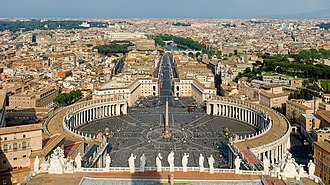
Vatican City is a Christian country where the Pope is the leader of the Catholic Church and also the head of state.
Zambia
Zambia declared itself a Christian nation in 1991. The constitution says it is a Christian nation, and Christianity is taught in public schools. The government works with Christian groups.
Established churches and former state churches
Current
Former
National church
Main article: National church
Some countries have a national church that is not the official religion of the nation but is still recognized by the government for special events and ceremonies. Examples include Scotland, with its Church of Scotland, and Sweden, with its Church of Sweden. Usually, a national church is the only one recognized by the government, but Finland has two: the Evangelical Lutheran Church of Finland and the Finnish Orthodox Church, both recognized by the law.
Images
Related articles



This article is a child-friendly adaptation of the Wikipedia article on Christian state, available under CC BY-SA 4.0.
Images from Wikimedia Commons. Tap any image to view credits and license.