 Safekipedia
Clerical fascism
Adapted from Wikipedia · Discoverer experience
Clerical fascism is an ideology that mixes the ideas of fascism with clericalism. It describes groups or movements that bring together religious beliefs with fascist politics. These groups often get support from religious organizations that agree with fascist ideas, or they may be part of fascist governments where religious leaders have a big role.
One key point that makes clerical fascism different from other right-wing Catholic politics is that it says the government must follow the moral and social teachings of the Catholic Church. The Church’s ideas are placed above the state’s own goals.
The term was first used in the 1920s in Italy. It described the political beliefs of the Roman Catholic Italian People's Party, which backed Benito Mussolini and his fascist government. It was also used for Catholics in Northern Italy who tried to mix Roman Catholic teachings with fascism.
History
The term clerical fascism started in the early 1920s in the Kingdom of Italy. It described a group within the Roman Catholic Partito Popolare Italiano that supported Benito Mussolini and his government. A priest named Don Luigi Sturzo is said to have created the term. He was a leader who opposed Mussolini and left Italy in 1924.
Some Catholics supported Mussolini’s ideas, while others did not. Over time, those who supported him left the party and joined Mussolini’s government. The party was later closed down by Mussolini’s regime in 1926.
Scholars have used this term to talk about strict and controlling forms of Christian politics. During the early 1900s, some extreme Christian groups in Europe started to mix strict religious ideas with very powerful government control.
Fascist Italy
See also: Fascist Italy (1922–1943), Roman Question, and Freedom of religion in Italy § History
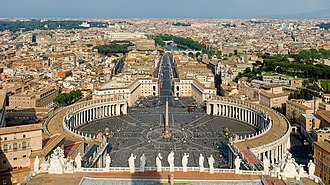
In 1870, Italy took over areas controlled by the Pope. But in 1929, Mussolini signed an agreement recognizing the Pope as the leader of Vatican City State. This made Roman Catholicism the official religion of Italy.
In 1929, Italy held a vote to support this agreement. Many people voted yes, though some were pressured to do so. Not long after, Mussolini and the Church had disagreements again. He made it hard for Catholic newspapers to share their ideas.
In 1938, Italy started unfair laws against Jewish and some Protestant people. Thousands suffered and many died. Even though Italy was allied with Germany, they did not always follow Germany’s harsh rules against Jewish people. After Mussolini lost power in 1943, Germany took control and began rounding up Jewish people in Italy.
Some Catholic groups joined the fight against the war in Italy. After the war, old disagreements between different groups came up again in Italian politics.
Examples of clerical fascism
Many political movements have mixed ideas from a special kind of politics called clerical fascism. These movements blend strong national feelings with religious beliefs.
Some examples include:
- The Fatherland Front in Austria, led by Engelbert Dollfuss and Kurt Schuschnigg.
- The Rexist Party in Belgium, led by Léon Degrelle.
- The Brazilian Integralist Action in Brazil, led by Plínio Salgado.
- The Nationalist Liberation Alliance in Argentina, led by Juan Queraltó.
- The Ustaše movement in the Independent State of Croatia, led by Ante Pavelić.
- The ZBOR movement in Nedić's Serbia, led by Dimitrije Ljotić and supported by Nikolaj Velimirović and the Serbian Orthodox Church.
- The Lapua Movement and the Patriotic People's Movement in Finland, led by Vihtori Kosola and Vilho Annala, with Pastor Elias Simojoki leading the youth group the Blue-and-Blacks.
- The German Christians in Nazi Germany, led by Ludwig Müller.
- Metaxism and the 4th of August Regime in Greece, led by Ioannis Metaxas and supported by the Greek Orthodox Church.
- The National Synarchist Union in Mexico, led by José Antonio Urquiza.
- The National Radical Camp in Poland, led by Boleslaw Piasecki and others.
- The National Union in Portugal, led by António de Oliveira Salazar and Marcelo Caetano.
- The National-Christian Defense League/Iron Guard in Romania, led by Corneliu Zelea Codreanu.
- Serbian Action, an ultranationalist movement in Serbia active since 2010.
- The Slovak People's Party (Ľudaks) in Slovakia, led by Jozef Tiso.
- The FET y de las JONS in Spain, led by Francisco Franco.
- The Silver Legion of America in the United States, led by William Dudley Pelley.
Historians have different views on whether some of these movements, like the National Union in Portugal, should be called fully fascist. The term "clerical fascism" is used carefully, as it describes a mix of religious ideas with extreme national politics, mainly seen between the two world wars. Some scholars warn that the term should not be used too broadly.
Related articles




This article is a child-friendly adaptation of the Wikipedia article on Clerical fascism, available under CC BY-SA 4.0.
Images from Wikimedia Commons. Tap any image to view credits and license.