
Nazi Germany
Nazi Germany, officially the German Reich and later the Greater German Reich, was the German state from 1933 to 1945. During this time, Adolf Hitler and the Nazi Party controlled the country and turned it into a totalitarian dictatorship. The Nazis called their state the "Third Reich," meaning "Third Realm" or "Third Empire," and claimed it was the successor to the Holy Roman Empire (800–1806) and the German Empire (1871–1918). They also called it the Thousand-Year Reich, but it lasted only 12 years. In May 1945, the Allies defeated Germany and entered Berlin, ending World War II in Europe.
After Hitler was appointed Chancellor of Germany in 1933, the Nazi Party removed political opponents and gained more power. A 1934 referendum confirmed Hitler as sole Führer (leader), and his word became the highest law. To fight the effects of the Great Depression, the Nazis spent heavily on the military and on public works, including the Autobahnen (motorways). They also carried out a secret rearmament programme and built the Wehrmacht (armed forces). Economic recovery and the end of mass unemployment made the regime more popular. Hitler then made increasingly aggressive territorial demands. Germany seized Austria in 1938 and the Sudetenland region of Czechoslovakia. In 1939, Germany invaded Poland, starting World War II in Europe. Allied with Fascist Italy and other Axis powers, Germany conquered most of Europe by 1940, but it failed to subdue Britain.
The regime was built on ideas of racism and antisemitism, which were central to its beliefs. The Nazis claimed that Germanic peoples were the "master race." Jews, Slavs, Romani people, and many others were imprisoned, deported, or murdered. Churches and citizens who opposed Hitler's rule were oppressed, and opposition leaders were imprisoned. The Nazi Propaganda Ministry spread antisemitic canards and organised mass rallies to build a cult of personality around Hitler. Genocide, mass murder, and large-scale forced labour became hallmarks of the regime, and its racial policies ended in the Holocaust.
After invading the Soviet Union in 1941, Nazi Germany carried out its war of extermination in Eastern Europe. By 1943, Germany had lost the initiative in the war, and by late 1944 it had been pushed back to its 1939 border. Germany was conquered from the east by the Soviet Union and from the west by the other Allies, and it capitulated in 1945. Afterward, the Allies began a policy of denazification and put many surviving Nazi leaders on trial for war crimes at the Nuremberg trials.
Name
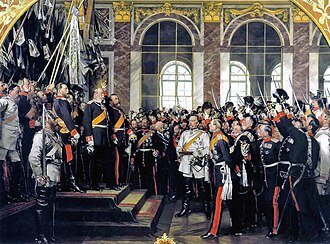
People often use the English names "Nazi Germany" and the "Third Reich" for Germany during the Nazi era. Hitler and the Nazis also called it the "Thousand-Year Reich" (Tausendjähriges Reich). This name was a translation of the Nazi propaganda term Drittes Reich, which was first used in Das Dritte Reich, a 1923 book by Arthur Moeller van den Bruck.
The book counted the Holy Roman Empire as the first Reich and the German Empire as the second.
Background
Further information: Adolf Hitler's rise to power
Germany's economy suffered severe setbacks after World War I ended, partly because of reparations payments required under the 1919 Treaty of Versailles. The government printed money to make the payments and to repay the country's war debt. This caused hyperinflation, which made prices rise sharply, caused economic chaos, and led to food riots. In January 1923, after the government stopped its reparations payments, French troops occupied German industrial areas along the Ruhr, and widespread civil unrest followed. The National Socialist German Workers' Party, commonly known as the Nazi Party, was founded in 1920. Its platform called for destroying the Weimar Republic and rejecting the Treaty of Versailles. It also promoted antisemitism, opposed Bolshevism, and promised a strong central government and Lebensraum ("living space") for Germanic peoples. It wanted a national community based on race and the suppression of Jews, who would lose their citizenship and civil rights. The Nazis based their ideas for national and cultural renewal on the Völkisch movement. Their paramilitary group, the Sturmabteilung (SA; Storm Detachment), also called the Brownshirts, used physical violence to advance their politics. Such far-right armed groups were common in Bavaria, where the far-right state government of Gustav Ritter von Kahr tolerated them.
When the stock market in the United States crashed in 1929, Germany was hit hard. Millions lost their jobs, and several major banks collapsed. Hitler and the Nazis used this emergency to win support. They promised to strengthen the economy and create jobs, and many voters came to believe the party could restore order and improve Germany's standing in the world. After the federal election of 1932, the Nazi Party was the largest party in the Reichstag, with 230 seats and 37.4 per cent of the popular vote.
History
Further information: History of Germany
Although the Nazis won the most votes in the 1932 elections, they did not have a majority. On 30 January 1933, President Paul von Hindenburg appointed Adolf Hitler Chancellor of Germany. Soon after, the Nazis used a fire at the Reichstag building to remove most civil liberties, and the Enabling Act let Hitler's government pass laws without needing the approval of the president or the Reichstag. By July 1933, the Nazi Party was the only legal party. In 1934, Hitler had the SA leadership and some political opponents arrested and killed in the Night of the Long Knives. After President Hindenburg died in August 1934, Hitler became both head of state and head of government. Jews were stripped of their basic rights by the Nuremberg Laws of 1935. Germany also rebuilt its military, broke the Treaty of Versailles, and took over Austria and parts of Czechoslovakia. The Munich Agreement of 1938 allowed Germany to annex the Sudetenland.
In September 1939, Germany invaded Poland, which began World War II in Europe. Germany quickly conquered much of Europe, but it failed to win the Battle of Britain. In June 1941, Germany attacked the Soviet Union in Operation Barbarossa. Germany suffered heavy losses, including at Stalingrad. The Allies landed in Normandy on D-Day in June 1944 and advanced into Germany. In the Battle of Berlin, Soviet forces took the city in 1945. Most of the German armed forces surrendered in early May 1945, and the German Instrument of Surrender was signed on 8 May, marking the end of the Nazi regime.
Geography
Territorial changes
Main article: Areas annexed by Nazi Germany
See also: Territorial evolution of Germany and Administrative divisions of Nazi Germany
After World War I and the Treaty of Versailles, Germany lost Alsace-Lorraine, Eupen-Malmedy, Northern Schleswig, and Memel. The Saarland became a protectorate of France, and its people would later vote on which country to join. Poland became a separate nation and gained access to the sea through the Polish Corridor, while Danzig was made a free city. Germany took back the Saarland through a vote in 1935 and annexed Austria in 1938. The Munich Agreement gave Germany the Sudetenland, and six months later Germany seized most of Czechoslovakia's remaining land. Under threat of invasion by sea, Lithuania gave up the Memel district in March 1939. Between 1939 and 1941, German forces invaded Poland, Denmark, Norway, France, Luxembourg, the Netherlands, Belgium, Yugoslavia, Greece, and the Soviet Union. Germany annexed parts of northern Yugoslavia in April 1941, and Mussolini gave Trieste, South Tyrol, and Istria to Germany in 1943. After the armistice between Italy and the Allies in September 1943, Germany invaded Italy, and Benito Mussolini set up the Italian Social Republic as a fascist puppet state. Germany also set up the Operational Zone of the Alpine Foothills and the Operational Zone of the Adriatic Littoral. These were not considered Reich territory, but they were in effect joined to Germany and Germanized.
Occupied territories
Main article: German-occupied Europe
Some conquered lands became part of Germany as part of Hitler's long-term goal of a Greater Germanic Reich. Several areas, such as Alsace-Lorraine, were placed under an adjacent Gau (regional district). Quasi-colonial regimes called Reichskommissariate were set up in some occupied countries. Areas under German control included the Protectorate of Bohemia and Moravia, Reichskommissariat Ostland (covering the Baltic states and Belarus), and Reichskommissariat Ukraine. Conquered parts of Belgium and France were placed under the Military Administration in Belgium and Northern France. Belgian Eupen-Malmedy, part of Germany until 1919, was annexed. Part of Poland was joined to the Reich, and the General Government was set up in occupied central Poland. Denmark, Norway (Reichskommissariat Norwegen), and the Netherlands (Reichskommissariat Niederlande) were placed under civilian administrations staffed largely by local people. Hitler intended to eventually bring many of these areas into the Reich. Germany occupied the Italian protectorate of Albania and the Italian governorate of Montenegro in 1943, and in 1941 it installed a puppet government in occupied Serbia.
Politics
Main article: Nazism
The Nazis were a far-right fascist political party that grew during the social and money troubles after World War I. At first the party stayed small, winning 2.6% of the national vote in 1928. By 1930 it had won 18.3%, making it the second largest party in the Reichstag. While Hitler was in prison after the failed Beer Hall Putsch of 1923, he wrote Mein Kampf, which described his plan to change German society based on race. Nazi ideas mixed racial hygiene, eugenics, and hatred of Jewish people with pan-Germanism and a wish to gain more Lebensraum (living space) for the Germanic people. The regime planned to take land by attacking Poland and the Soviet Union, aiming to harm or force out the Slavs and Jews living there, whom it saw as inferior to the master race and part of a Jewish-Bolshevik plot. Other groups the Nazis targeted included life unworthy of life victims such as disabled people, Romani people, homosexuals, Jehovah's Witnesses, and social misfits, while Freemasons were heavily monitored and persecuted. Influenced by the Völkisch movement, the regime opposed modernism and built a large military. Art was controlled and used for propaganda. Symbols like the Blood Flag and the Nazi Party rallies were used to build unity and popularity.
Main article: Government of Nazi Germany
Hitler ruled as an absolute leader using the Führerprinzip ("leader principle"), which demanded total obedience from everyone below him. Party positions were given by appointment rather than elections, and propaganda built a cult of personality around him. Top officials had a lot of freedom to act, but Hitler gave contradictory orders that caused competition and conflict among them. Through a series of Reichsstatthalter decrees, the old German constituent states were replaced with new administrative divisions called Gaue, led by Gauleiters. The Weimar Republic's federal system was ended in favour of a highly centralised unitary state. Jewish civil servants lost their jobs in 1933, and local elections were abolished in 1935. In 1934, officials and soldiers swore an oath of obedience to Hitler, and his word was treated as overriding all laws. Legislation had to be approved by the Deputy Führer, Rudolf Hess. A new Volksgerichtshof ("People's Court") handed out over 5,000 death sentences for political cases before it was closed in 1945. The Nazis used the idea of Rassenschande ("race defilement") to justify racial laws, and the Nuremberg Laws of 1935 took away German citizenship from Jews and other non-Aryans.
Military and paramilitary
Main article: Wehrmacht
See also: Myth of the clean Wehrmacht
From 1935 to 1945, Germany's united armed forces were called the Wehrmacht, which means "defence force." It included the Heer (army), the Kriegsmarine (navy), and the Luftwaffe (air force). In 1934, soldiers had to swear an oath of complete obedience to Hitler personally, even when he ordered something illegal. The army was also expected to support the Einsatzgruppen, mobile units that carried out millions of murders in Eastern Europe. Wehrmacht troops also took part in the Holocaust, claiming they were fighting partisans. The German army relied on Blitzkrieg ("lightning war"), which used fast, coordinated attacks. Victories continued until mid-1940, but failing to defeat Britain was an early turning point. Attacking the Soviet Union and the defeat at Stalingrad led to Germany's retreat and its eventual loss of the war. About 18.2 million people served in the Wehrmacht between 1935 and 1945, and 5.3 million of them died.
Main articles: Sturmabteilung and Schutzstaffel
The Sturmabteilung (SA), also called the Brownshirts, was founded in 1921 as the Nazi Party's first paramilitary group. Under Ernst Röhm, it grew to over half a million members by 1934. Röhm wanted to take over the army, and the army's leaders threatened action against the SA. Hitler then ordered the SA leadership, including Röhm, to be killed, and the SA was no longer a major force afterward. The Schutzstaffel (SS) started as a small bodyguard unit under the SA and grew into one of the most powerful groups in Nazi Germany, led by Reichsführer-SS Heinrich Himmler. The Waffen-SS, its military branch, became a second army, though it relied on the regular army for heavy weapons and was partly under the High Command of the Armed Forces. The SS also ran the concentration camps and extermination camps through the SS-Totenkopfverbände, and it led the persecution of Jews. The SS intelligence service, the Sicherheitsdienst (SD), was set up in 1931 to find and arrest political opponents.
Economy
Main article: Economy of Nazi Germany
When the Nazis took power, the biggest economic problem was unemployment, which was about 30 per cent. The economist Hjalmar Schacht, President of the Reichsbank and Minister of Economics, made a plan in May 1933 to pay for building projects with promissory notes called Mefo bills. When these notes were presented for payment, the Reichsbank printed money. Hitler expected that future territorial expansion would pay back the growing national debt. Unemployment fell faster than in any other country during the Great Depression, but recovery was uneven, and people became unhappy with the regime as early as 1934. Major projects included a network of Autobahnen roads. In October 1933 the Junkers Aircraft Works was taken over, and aircraft production grew greatly. Hitler also asked designer Ferdinand Porsche to plan the KdF-wagen (Strength Through Joy car), which was shown at the International Motor Show in Berlin on 17 February 1939. When World War II began, the factory was changed to make military vehicles. None were sold until after the war, when the car was renamed the Volkswagen (people's car).
Further information: Forced labour under German rule during World War II
See also: List of companies involved in the Holocaust
Unemployment dropped from six million in 1933 to fewer than one million by 1937, partly because women were removed from the workforce. Real wages fell by 25 per cent between 1933 and 1938. Trade unions were shut down, and the German Labour Front, led by Robert Ley, took their place. From 1935, rearmament became the main focus, and Hermann Göring was given control of the Four Year Plan in 1936. Germany's wartime economy was a mixed economy, somewhere between the command economy of the Soviet Union and the capitalist system of the United States, according to the historian Richard Overy. After Fritz Todt died in 1942, Albert Speer took over production, which used using forced labour and slavery on a large scale. About 12 million people from 20 European countries were forced to work in factories and on farms. Foreign workers were placed in four groups with different rules. By late 1944, Allied strategic bombing targeted refineries producing synthetic oil and gasoline and the transport system, and the war economy began to break down.
Racial policy and eugenics
Main articles: Racial policy of Nazi Germany and Nazi eugenics
Racism and antisemitism were basic beliefs of the Nazi Party and the Nazi government. The Nazis claimed there was a conflict between the Aryan master race and inferior races, especially Jews, whom they blamed for harming society. Discrimination against Jews began soon after the Nazis took power in 1933. Jewish businesses faced a national boycott, and a nationwide book burning was held in May 1934. In November 1938, after a young Jewish man, Herschel Grynszpan, shot a German diplomat, the Nazis encouraged attacks on Jews known as the pogrom of Kristallnacht, the Night of Broken Glass. At least 91 Jews were murdered. Romani people were also persecuted from the early days of the regime and were sent to concentration camps, where many were murdered. Under the Nazis, people with disabilities were also targeted in Aktion T4, a programme of murder that mainly took place from 1939 to 1941. Many people were forced to have compulsory sterilisation under a law passed in 1933.
The Nazis also planned to remove and replace Polish people through Generalplan Ost. About 2.7 million ethnic Poles died during the German occupation of Poland. The Nazis captured 5.75 million Soviet prisoners of war, and an estimated 3.3 million of them were killed. At the Wannsee Conference in January 1942, the Nazis made plans for the murder of Europe's Jews, a plan known as the Final Solution. The total number of Jews murdered is estimated at 5.5 to six million, including over a million children.
Society
Further information: University education in Nazi Germany
Main article: Women in Nazi Germany
Further information: Animal welfare in Nazi Germany
Main article: Religion in Nazi Germany
The Nazis changed schools and universities to match their ideas. Laws passed in 1933 removed all Jewish teachers, professors, and officials from the education system. Teachers had to take an oath of loyalty to Hitler, and those who did not show enough support for Nazi ideas were often reported and dismissed. Students at Adolf Hitler Schools and National Political Institutes of Education were trained from the age of 12 to become future party leaders. Lessons were changed to focus on race, and Nazi ideas were taught in most subjects. Women were encouraged to focus on home and family, and a law limited the number of women allowed into university. From 1939, membership in the Hitler Youth was made compulsory for all children over ten.
The Nazis also tried to control health, nature, and religion. Smoking was linked to lung cancer, and the government tried to limit it. Jewish doctors were gradually forbidden to treat patients, and their right to practise medicine was removed in 1938. The government passed an animal-protection law in 1933 and protected natural land through a law in 1935. When the Nazis took power in 1933, most Germans were Protestant or Roman Catholic. Hitler tried to bring the Protestant churches under Nazi control, and many pastors were arrested when they resisted. The Nazis also moved quickly to end political Catholicism, and by July 1933 all non-Nazi political parties had ceased to exist. Catholic schools were pressured, and Catholic publications faced censorship.
See also: Nazi propaganda
Main articles: Nazi architecture and Art in Nazi Germany
See also: List of authors banned in Nazi Germany
See also: Music in Nazi Germany
Main article: Nazism and cinema
The regime promoted the idea of a Volksgemeinschaft, a national German ethnic community, with the goal of building a classless society based on racial purity and preparing for war, conquest and a struggle against Marxism. In 1933 the German Labour Front founded Kraft durch Freude (KdF; Strength Through Joy), which took control of many private recreational clubs and offered strictly organised holidays and entertainment. In September 1933 the Reich Chamber of Culture was placed under the control of the Propaganda Ministry. Jews and people considered politically unreliable were kept from working in the arts, and many left the country. Books had to be approved before they could be published, and the Reich Chamber of Literature oversaw authors, publishers and bookshops. Newspapers were also controlled by the state, and the Völkischer Beobachter was the Nazi Party's daily paper. Radio became very popular, and by 1939 over 70 per cent of households owned a receiver, more than in any other country. Goebbels insisted that more music be played so that listeners would not turn to foreign broadcasters.
Many authors who opposed the regime went into exile, and Goebbels encouraged the remaining writers to focus on blood and soil and Germanic myths. In 1933 Nazi book burnings took place, and tens of thousands of books by authors including Albert Einstein, Sigmund Freud, Helen Keller, Alfred Kerr, Marcel Proust, Erich Maria Remarque, Upton Sinclair, Jakob Wassermann, H. G. Wells, and Émile Zola were burned. Hitler worked with Paul Troost and Albert Speer to design public buildings in a neoclassical style based on Roman architecture, such as the Nazi party rally grounds in Nuremberg and the Reich Chancellery in Berlin. Plans for a dome based on the Pantheon and a triumphal arch taller than the Arc de Triomphe were never built. Hitler considered abstract, Dadaist, expressionist and modern art decadent, and about 6,500 works were removed from museums. The Degenerate Art Exhibition ran in Munich in 1937 and attracted over two million visitors. Richard Strauss became president of the Reichsmusikkammer (Reich Music Chamber), while musicians seen as racially unacceptable were shut out and atonal music and jazz were disapproved of. Hitler favoured the music of Richard Wagner and attended the Bayreuth Festival each year from 1933 to 1942. Movies were very popular, with over a billion admissions in each of 1942, 1943 and 1944. The Propaganda Ministry bought the two largest film companies, Universum Film AG and Tobis. Leni Riefenstahl's Triumph of the Will (1935) and Olympia (1938), which covered the 1936 Summer Olympics, pioneered new camera techniques.
Legacy
Main article: Consequences of Nazism
See also: Denazification
After the war, the Allies held trials for war crimes, starting with the Nuremberg trials... Actually, the first trials were held in Nuremberg from November 1945 to October 1946, and 23 top Nazi officials were charged with war crimes and crimes against humanity. Most were found guilty, and twelve were sentenced to death. Later trials and investigations followed, and many people were convicted. The Nazi policies led to a world war that left Europe devastated, and Germany itself was largely destroyed, a time known as Stunde Null (Zero Hour). Today, many people regard Nazi ideology and actions as deeply wrong, and historians and politicians often call Hitler and the Nazi regime "evil." The display of Nazi symbolism is illegal in Germany and Austria.
Nazi Germany was followed by three states: West Germany, East Germany, and Austria. The Allies tried to remove Nazi influence, but this was only partly successful. Expressing Nazi views was frowned upon, and people who did so were often dismissed from their jobs. For many years, Germans rarely spoke about their wartime experiences. The 1961 trial of Adolf Eichmann and the 1978 television miniseries Holocaust led many Germans to face the past through Vergangenheitsbewältigung (coping with the past). Studying Nazi Germany became part of the curriculum in schools from the 1970s, and this helped build a strong democracy, although some neo-Nazi ideas still exist. In a 2017 survey by the Körber Foundation, 47 per cent of 14- to 16-year-olds knew what Auschwitz was. The journalist Alan Posener said that German film and television had not always shown the country's history accurately, which he saw as part of a "growing historical amnesia."
Pictures
Keep exploring




This article is a child-friendly adaptation of the Wikipedia article on Nazi Germany, available under CC BY-SA 4.0.
Images from Wikimedia Commons. Tap any image to view credits and license.