 Safekipedia
Currency
Adapted from Wikipedia · Discoverer experience
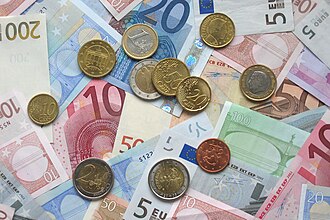
A currency is a special kind of money that people use to buy things and trade with each other. It comes in many forms, like pieces of paper called banknotes, small metal pieces called coins, numbers in online bank accounts, and even digital money made by governments called central bank digital currencies. For example, you might see the Pound sterling (£), euro (€), Japanese yen (¥), or U.S. dollars (US$) – these are all types of money that governments create and people use every day.
Currencies are very important because they help people trade between different countries. When someone in one country wants to buy something from another country, they need to exchange their money for the money used in that other country. This happens in special places called foreign exchange markets, where the value of one country’s money compared to another is decided.
Currencies can also be saved for later, which means they can hold value over time. Some types of money are backed by valuable things like gold, while others, like most money today, are just promised to be worth something by the government that makes them. This makes money very useful for paying for things like taxes or buying goods in stores.
Early currency
Long ago, people used different things as money. In places like Sumer and Ancient Egypt, people would store grain in special buildings and use metal pieces to show that they owned that grain. This helped people trade with each other for many years.
Later, new ways of trading developed. Some places used special shapes of metal, like copper pieces shaped like cow hides, to trade goods. Over time, different areas created their own kinds of money, such as coins, to make trading easier and safer. In Africa, people used many different things as money, like beads, animal hides, and even special metal rings. These helped people exchange goods even when they couldn’t use the same kind of money.
Coinage
Main article: Coin
Coins are pieces of metal that people use as money. Long ago, people used metals like copper, silver, and gold for coins because these metals were valuable. Today, coins are made from many kinds of metal.
Coins were made by stamping metal to give them a set weight. This way, people knew how much the coin was worth. Even if someone tried to cheat by shaving or changing a coin, its value could still be checked. Coins helped create a standard way to measure value, which was important for banking.
Paper money
Main article: Banknote
In old China, people needed something easier to carry than heavy copper coins, so they started using paper money. This began during the Tang dynasty and became common in the Song dynasty. Merchants would trade heavy coins for paper notes, which were like receipts. Later, the government began making its own paper money.
Around the same time, in the Middle East, people also developed new ways to handle money, like using checks and saving accounts. In Europe, paper money was first used regularly in Sweden in 1661. Paper money had many good points: it was safer than carrying gold or silver, made loans easier, and helped people buy and sell things. But it also had problems. If too much paper money was printed, it could lose value and cause prices to rise too fast. Some people did not trust paper money because it wasn’t made of real gold or silver.
By 1900, most countries used a system where paper money was tied to gold, but this changed over time, especially during wars and financial troubles. The United States stopped using the gold standard in 1971. Today, most countries use paper money that is not tied to gold or silver.
Banknote era
Main articles: Banknote and Fiat currency
A banknote or bill is a kind of money used in many places. Together with coins, banknotes are the physical forms of money. Banknotes were first made from paper, but in the 1980s, Australia made a new type of banknote from a special material called polymer. Polymer banknotes last much longer and help prevent fake money. Today, more than 20 countries use polymer banknotes.
Modern currencies
For a list of which currency or currencies are used by present-day countries or regions, see List of circulating currencies.
The currency used depends on each country deciding which money it will use. (See Fiat currency.)
Modern currency is also changing quickly into digital forms, thanks to new financial technology and fewer physical transactions. This change includes online or mobile payments and digital currency such as cryptocurrencies, stablecoins and government-backed Central bank digital currencies (CBDCs).
Currency codes and currency symbols
Main articles: List of currency codes and List of currency symbols
In 1978, a group called the International Organization for Standardization made a system of three-letter codes to name different kinds of money. These codes use the first two letters of a country’s name and one more letter for that country’s money.
Many kinds of money also have special signs. These signs are not the same everywhere, and the dollar sign is used in many places.
List of major world payment currencies
The table below shows SWIFT’s estimates of the 20 most commonly used currencies around the world for payments as of March 2026.
| Rank | ISO 4217 | Currency | % of world total |
|---|---|---|---|
| 100.00% | |||
| 1 | USD |  United States dollar United States dollar | 51.14% |
| 2 | EUR |  Euro Euro | 21.30% |
| 3 | GBP |  Pound sterling Pound sterling | 6.54% |
| 4 | JPY |  Japanese yen Japanese yen | 3.53% |
| 5 | CNY |  Renminbi (yuan) Renminbi (yuan) | 3.10% |
| 6 | CAD |  Canadian dollar Canadian dollar | 3.03% |
| 7 | HKD |  Hong Kong dollar Hong Kong dollar | 1.76% |
| 8 | AUD |  Australian dollar Australian dollar | 1.61% |
| 9 | SGD |  Singapore dollar Singapore dollar | 1.23% |
| 10 | CHF |  Swiss franc Swiss franc | 1.07% |
| 11 | SEK |  Swedish krona Swedish krona | 0.77% |
| 12 | PLN |  Polish złoty Polish złoty | 0.65% |
| 13 | NOK |  Norwegian krone Norwegian krone | 0.57% |
| 14 | NZD |  New Zealand dollar New Zealand dollar | 0.35% |
| 15 | DKK |  Danish krone Danish krone | 0.32% |
| 16 | MXN |  Mexican peso Mexican peso | 0.31% |
| 17 | ZAR |  South African rand South African rand | 0.31% |
| 18 | THB |  Thai baht Thai baht | 0.29% |
| 19 | HUF |  Hungarian forint Hungarian forint | 0.25% |
| 20 | MYR |  Malaysian ringgit Malaysian ringgit | 0.21% |
Control and production
A central bank usually has the power to create and control the money used in its country. This includes coins and paper money, and they also decide how much money other banks can lend out.
Exchange rates tell us how much one type of money is worth in another country. These rates can change daily based on what people want and need, or sometimes a government will try to keep the rate steady. When a country's money becomes more valuable, its products cost more for others to buy, but its own people get more for their money when buying from other countries. Countries control their money either through a central bank or a finance department. They use this control to help manage things like jobs, spending, and prices staying steady.
Some countries share the same name for their money, like dollars in Australia, Canada, and the United States. Other countries share the same actual money, like the euro used in many European nations. Some places even accept another country's money as their own, like Panama and El Salvador using the U.S. dollar. The U.S. dollar is also very important worldwide for trade and keeping money safe. Most currencies have smaller parts, like cents to a dollar, but some don’t use smaller parts at all. A few countries have special smaller parts that aren’t based on tens, but these aren’t used much anymore because prices have gotten too high.
| Currency | ISO 4217 code | Proportion of daily volume | Change (2022–2025) | |
|---|---|---|---|---|
| April 2022 | April 2025 | |||
| U.S. dollar | USD | 88.4% | 89.2% |  0.8pp 0.8pp |
| Euro | EUR | 30.6% | 28.9% |  1.7pp 1.7pp |
| Japanese yen | JPY | 16.7% | 16.8% | 0.1pp |
| Pound sterling | GBP | 12.9% | 10.2% | 2.7pp |
| Renminbi | CNY | 7.0% | 8.5% | 1.5pp |
| Swiss franc | CHF | 5.2% | 6.4% | 1.2pp |
| Australian dollar | AUD | 6.4% | 6.1% | 0.3pp |
| Canadian dollar | CAD | 6.2% | 5.8% | 0.4pp |
| Hong Kong dollar | HKD | 2.6% | 3.8% | 1.2pp |
| Singapore dollar | SGD | 2.4% | 2.4% |  |
| Indian rupee | INR | 1.6% | 1.9% | 0.3pp |
| South Korean won | KRW | 1.8% | 1.8% | |
| Swedish krona | SEK | 2.2% | 1.6% | 0.6pp |
| Mexican peso | MXN | 1.5% | 1.6% | 0.1pp |
| New Zealand dollar | NZD | 1.7% | 1.5% | 0.2pp |
| Norwegian krone | NOK | 1.7% | 1.3% | 0.4pp |
| New Taiwan dollar | TWD | 1.1% | 1.2% | 0.1pp |
| Brazilian real | BRL | 0.9% | 0.9% | |
| South African rand | ZAR | 1.0% | 0.8% | 0.2pp |
| Polish złoty | PLN | 0.7% | 0.8% | 0.1pp |
| Danish krone | DKK | 0.7% | 0.7% | |
| Indonesian rupiah | IDR | 0.4% | 0.7% | 0.3pp |
| Turkish lira | TRY | 0.4% | 0.5% | 0.1pp |
| Thai baht | THB | 0.4% | 0.5% | 0.1pp |
| Israeli new shekel | ILS | 0.4% | 0.4% | |
| Hungarian forint | HUF | 0.3% | 0.4% | 0.1pp |
| Czech koruna | CZK | 0.4% | 0.4% | |
| Chilean peso | CLP | 0.3% | 0.3% | |
| Philippine peso | PHP | 0.2% | 0.2% | |
| Colombian peso | COP | 0.2% | 0.2% | |
| Malaysian ringgit | MYR | 0.2% | 0.2% | |
| UAE dirham | AED | 0.4% | 0.1% | 0.3pp |
| Saudi riyal | SAR | 0.2% | 0.1% | 0.1pp |
| Romanian leu | RON | 0.1% | 0.1% | |
| Peruvian sol | PEN | 0.1% | 0.1% | |
| Other currencies | 2.6% | 3.4% | 0.8pp | |
| Total | 200.0% | 200.0% | ||
Currency convertibility
Currencies can be changed into one another in different ways depending on the country. Some currencies, like the US dollar, can be traded freely around the world without any special rules. Others, like the Indian rupee, need special approval before they can be converted into other currencies. Some currencies, like the North Korean won and the Cuban peso, cannot be converted at all by regular people.
The value of a currency is affected by many things, including trade between countries, investment opportunities, and government policies. When a country’s economy is strong and stable, its currency is more likely to be freely convertible. This helps the country’s economy grow by allowing fair competition and stable trade relationships.
Alternative currencies
Main article: Alternative currency
Further information: Cryptocurrency bubble and Ponzi scheme
Recently, the idea of a digital currency has appeared. It is still unclear if governments will create and use digital money successfully. Some digital currencies, like Bitcoin, are not made by governments. Their value changes based on what people are willing to pay, and they do not have extra protection.
Some countries worry that these digital currencies can be used for illegal activities. In 2014, the United States said that virtual money should be treated like property for taxes.
There are also private networks that support different kinds of money, called cryptocurrencies. Most of these are not backed by real assets. In 2019, a U.S. group said Bitcoin is a type of commodity. In the past, some companies used their own kind of money, called company scrip, which could only be used in stores owned by the company. Today, there are local systems for trading, but these are more like barter than real money. Many governments make it illegal to use alternative currencies to keep their own money system strong. For example, in the United States, Congress has the power to create and control the country's money to ensure everyone uses the same standard. It is against the law to create private money systems that compete with the official U.S. currency.
Local currency
Main articles: Local currency and Local Exchange Trading System
A local currency is a type of money used only in a small area, not by a big government. Some people think it helps places that are struggling by letting locals trade services and goods with each other. Others worry it might make it harder to share resources or do business with other areas.
Local currencies sometimes start when there are big money problems in a country. For example, during a tough time in Argentina in 2002, local governments began giving out special notes that acted like money. One well-known local currency is called LETS, which began on Vancouver Island in the 1980s when money was very hard to get.
Images
Related articles




This article is a child-friendly adaptation of the Wikipedia article on Currency, available under CC BY-SA 4.0.
Images from Wikimedia Commons. Tap any image to view credits and license.