 Safekipedia
Turkish lira
Adapted from Wikipedia · Discoverer experience
The lira is the official currency of Turkey. It is also used in the Turkish Republic of Northern Cyprus. One lira is divided into one hundred kuruş. The symbol for the lira is ₺ and its international code is TRY.
There have been two versions of the Turkish lira. The current one, called the Second Turkish lira, started in 2005. Before that, from 1923, Turkey used the first Turkish lira, which came after the Ottoman lira.
Since 2018, the value of the Turkish lira has dropped a lot. This happened because of decisions made by Turkey's president, Erdoğan, and the country's economic situation.
History
Ottoman lira (1844–1923)
Main article: Ottoman lira
The Turkish lira, like many currencies in Europe and the Middle East, started from an ancient Roman weight measure called the libra. This idea of money spread across many lands over time. In 1844, Turkey started using the lira as its main money, with smaller coins called kuruş making up one-hundredth of a lira. The Ottoman lira was used until the end of 1927.
First Turkish lira (1923–2005)
The early Turkish lira banknotes showed the face of Mustafa Kemal Atatürk, the leader who helped create modern Turkey. After Atatürk passed away, another leader, İsmet İnönü, appeared on some banknotes. Later, Atatürk’s picture returned and stayed on the money.
Over the years, the value of the Turkish lira changed a lot compared to other currencies like the US dollar. In the 1960s, one US dollar was worth about nine Turkish liras. But by the year 2000, one US dollar needed more than six hundred thousand liras to buy the same things! By 2005, the lira was worth so little that it was named one of the least valuable currencies in the world.
Second Turkish lira (2005–present)
Main article: Revaluation of the Turkish lira
In 2004, Turkey decided to change its money to make it easier to use. They removed six zeros from the lira, so one new lira equaled one million old liras. This new money started in January 2005 and was called the “New Turkish lira” for a few years. After January 2009, it was just called the Turkish lira again. All the new banknotes and coins showed pictures of Mustafa Kemal Atatürk.
2018–present currency crisis
Main article: Turkish economic crisis (2018–current)
Starting in 2018, the value of the Turkish lira began dropping quickly against other currencies like the US dollar. Some leaders in Turkey made choices that made the money lose value faster. Even when leaders tried to fix things by changing interest rates, the lira kept losing value for several years. By 2023, new leaders started using different methods, and the lira began to gain some value back, though it still faced challenges.
Coins
Main article: Coins of Turkey
Starting January 1, 2009, Turkey changed the name of its money back to simply "Turkish lira." New coins were made in amounts of 1, 5, 10, 25, and 50 kuruş, as well as 1 lira. The design of some coins was also changed.
Since 2012, Turkey has made special coins to remember important events. These include:
- 150th anniversary of the Court of Accounts (2012)
- 10th International Turkish Olympiad (2012)
- Remembering heroes and veterans of July 15th (2016)
- Hagia Sophia becoming a mosque again (2020)
- 100 years since Antep province was called a ghazi (2021)
- 2018: Celebration for the President Recep Tayyip Erdoğan
- 2020: 100th anniversary of the Grand National Assembly of Turkey
- 2022: Opening of the 1915 Çanakkale Bridge
- 2022: 100th anniversary of the Great Offensive
- 2023: 100th years of the republic (5 lira)
| Current Turkish lira coins | |||||||||||||
|---|---|---|---|---|---|---|---|---|---|---|---|---|---|
| Image | Value (kuruş) | Technical parameters | Description | Date of | |||||||||
| Obverse | Reverse | Diameter (mm) | Thickness (mm) | Mass (g) | Composition | Edge | Obverse | Reverse | first minting | issue | |||
 |  | 1kr. | 16.5 | 1.35 | 2.2 | 70% Cu, 30% Zn | Plain | Value, Crescent-star, year of minting | Snowdrop | "TÜRKİYE CUMHURİYETİ", Mustafa Kemal Atatürk | 2008 | 1 January 2009 | |
 |  | 5kr. | 17.5 | 1.65 | 2.9 | 65% Cu, 18% Ni, 17% Zn | Tree of life | ||||||
 |  | 10kr. | 18.5 | 3.15 | Rumi motif | ||||||||
 |  | 25kr. | 20.5 | 4 | Reeded | Kufic calligraphic | |||||||
 |  | 50kr. | 23.85 | 1.9 | 6.8 | Ring: 65% Cu, 18% Ni, 17% Zn Center: 79% Cu, 17% Zn, 4% Ni | Large reeded | Bosphorus Bridge and Istanbul silhouette | |||||
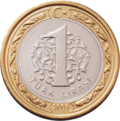 |  | ₺1 | 26.15 | 8.2 | Ring: 79% Cu, 17% Zn, 4% Ni Center: 65% Cu, 18% Ni, 17% Zn | inscribed, T.C. letters and tulip figure | Rumi motif | ||||||
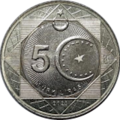 | 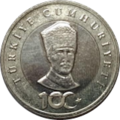 | ₺5 | 28.15 | 8.25 | Ring: 64% Cu, 32% Zn, 4% Ni Center: 64% Cu, 27% Ni, 9% Zn | Large reeded | Seljuk star, Türkiye Centenary logo | 2023 | 29 October 2023 | ||||
| These images are to scale at 2.5 pixels per millimetre. For table standards, see the coin specification table. | |||||||||||||
Banknotes
Main article: Banknotes of Turkey
A new set of money notes, called the "E-9 Emission Group," started being used on January 1, 2009. The older set, called the E-8 group, stopped being valid after December 31, 2009, but people could still trade them for new money until December 31, 2019. These new notes are called "Turkish lira" and include a new 200-lira note. The notes have different sizes to make them harder to copy falsely. Each note shows a well-known person from Turkey instead of pictures of places or buildings. The five-lira note is mostly purple.
| Current Turkish lira banknotes Image | Value (₺) | Dimensions (mm) | Main Colour | Description | Date of issue | |||||||||||||||
|---|---|---|---|---|---|---|---|---|---|---|---|---|---|---|---|---|---|---|---|---|
| Obverse | Reverse | Obverse | Reverse | Watermark | ||||||||||||||||
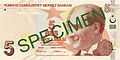 |  | 5 | 130 × 64 | Brown | Mustafa Kemal Atatürk | Aydın Sayılı: solar system, atom, left-handed Z-DNA helix. | Mustafa Kemal Atatürk, value | 1 January 2009 | ||||||||||||
 |  | Purple | 8 April 2013 | |||||||||||||||||
 | 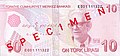 | 10 | 136 × 64 | Red | Cahit Arf: Arf invariant, arithmetic series, abacus, binary sequence | 1 January 2009 | ||||||||||||||
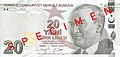 |  | 20 | 142 × 68 | Green | Mimar Kemaleddin: Gazi University main building, aqueduct, circular motif and cube-globe-cylinder symbolizing architecture | |||||||||||||||
| 50 | 148 × 68 | Orange | Fatma Aliye Topuz: flower and literary figures | |||||||||||||||||
| 100 | 154 × 72 | Blue | Buhurizade Itri: musical notes, instruments and Mevlevi figure | |||||||||||||||||
| 200 | 160 × 72 | Pink | Yunus Emre: Yunus's mausoleum, rose, pigeon and the line "Sevelim, sevilelim" (Let us love, let us be loved) | |||||||||||||||||
| These images are to scale at 0.7 pixel per millimetre (18 pixel per inch). For table standards, see the banknote specification table. | ||||||||||||||||||||
Currency sign
The Turkish lira has its own special symbol, ₺. Before this symbol was created, people used the letters TL to stand for the lira. The new symbol was made in 2012 by the Central Bank of the Republic of Turkey after a contest that had many entries. The symbol looks like a letter L shaped like half an anchor, with a T inside it. This design was chosen to show that the lira is strong and important.
Circulation
The Turkish lira, also called "Türk lirası" in Turkish, is the money used in Turkey. It is also used in the Turkish Republic of Northern Cyprus. Each lira is split into 100 smaller parts called kuruş.
Current exchange rates
The Turkish lira, shown as ₺ or TL, is the money used in Turkey and also in the Turkish Republic of Northern Cyprus. One lira is made up of one hundred smaller parts called kuruş.
Related articles


This article is a child-friendly adaptation of the Wikipedia article on Turkish lira, available under CC BY-SA 4.0.
Images from Wikimedia Commons. Tap any image to view credits and license.