 Safekipedia
Federal government of the United States
Adapted from Wikipedia · Discoverer experience
The federal government of the United States (U.S. federal government or U.S. government) is the national government of the United States. It is made up of three important parts, or branches: legislative, executive, and judicial. These branches work together to make, enforce, and interpret laws.
The powers of these branches are explained in the Constitution of the United States, which began guiding the country on March 4, 1789. Laws passed by acts of Congress also help define what each branch does, such as creating executive departments and smaller courts under the Supreme Court of the United States.
In the United States, the federal government shares power with each of the 50 states. It also works with Indigenous tribes, which have their own powers but are under the authority of federal law. This balance helps ensure that both national and state needs are considered.
Naming
The full name of the country is the "United States of America." This is the name used on money, in treaties, and in important legal documents. Sometimes people call it the "Government of the United States of America" or the "United States Government" to talk about the federal government instead of the states.
In everyday talk, people often say "Federal Government" or "U.S. Government." Words like "Federal" and "National" in the names of government groups show they are part of the federal government. For example, the Federal Bureau of Investigation, National Oceanic and Atmospheric Administration, and National Park Service. People sometimes use "Washington" or the White House to mean the federal government because that is where it is based, in Washington, D.C..
History
Main article: History of the United States government
The U.S. government began in the late 1700s. It started when leaders formed the Continental Army and chose George Washington to lead it. This army fought against the British in the American Revolutionary War, which started in 1775. In 1776, leaders in Philadelphia announced that the colonies were free from British rule. After winning the war in 1783, the leaders created the Constitution of the United States in 1789. This important document set up the country's rules and leaders.
The Constitution shares power among three groups: the leaders who carry out decisions, the group that makes laws, and the group that explains the laws. This system helps make sure no one group has too much power. Over time, the government's powers have grown and changed, but the idea of sharing power stays important.
Legislative branch
Main article: United States Congress
The United States Congress is the part of the U.S. government that makes the laws. It has two parts: the House of Representatives and the Senate. The House has 435 members, each representing a part of a state, and they serve for two years. The Senate has two members from each state, and they serve for six years.
Congress can approve important appointments, start bills about money, and work together to pass laws. Both the House and Senate must agree on a bill for it to become a law, which then needs the president's approval. Congress also has the power to remove leaders from office if needed and watches over the government to make sure everything is done fairly and correctly.
Executive branch
See also: Article Two of the United States Constitution and List of United States federal executive orders
President
Main articles: President of the United States and Powers of the president of the United States
The executive branch is led by the president, who serves as both the head of state and head of government. The president makes sure laws are followed and can make important decisions through orders and proclamations. The president is also the commander-in-chief of the armed forces and plays a key role in foreign affairs, such as signing treaties, though the Senate must agree to them.
The president can appoint important officials, like judges and ambassadors, with the Senate’s approval. The president also has the power to forgive people for certain federal crimes. In addition to these formal duties, the president can shape what issues the country focuses on and often leads a political party.
Election, succession, and term limits
Further information: United States presidential election
The president and vice president are chosen by voters through the Electoral College. Each state has a certain number of electoral votes based on its population. A president can serve up to two four-year terms, for a total of eight years, though there are some exceptions if they take over partway through a term.
Veto power, impeachment, and other issues
Under the rules of Congress, a bill that passes both houses must be sent to the president, who can sign it into law or reject it. If the president does not act on the bill within ten days, it becomes law unless Congress is not in session. Congress can override the president’s rejection with a large majority vote.
The president can be removed from office if accused of serious wrongdoing, through a process called impeachment.
Vice president
Main article: Vice President of the United States
The vice president is the second-highest official in the government. In Congress, the vice president serves as the president of the Senate, meaning they can decide ties in votes. If the president can no longer serve, the vice president becomes president. This has happened nine times in U.S. history.
Cabinet, executive departments, and agencies
Main articles: Cabinet of the United States, United States federal executive departments, and List of federal agencies in the United States
The president has a group of advisors called the Cabinet, which includes the leaders of 15 major departments, such as State, Treasury, and Defense. These leaders are chosen by the president and approved by the Senate. There are also many other agencies and offices that help carry out the work of the federal government, like the Postal Service and NASA.
Judicial branch
Main article: Federal judiciary of the United States
Further information: Supreme Court of the United States
See also: Article Three of the United States Constitution
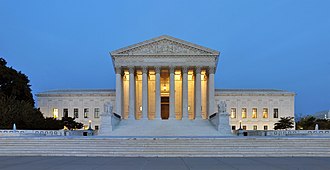
The judicial branch of the U.S. government explains and applies laws. It does this by listening to and deciding on different legal cases. The main court in this branch is the Supreme Court, which makes important decisions about laws and how they should be understood.
Below the Supreme Court are other courts that help decide smaller cases. These include courts of appeals and district courts, which handle most of the everyday legal matters. Together, these courts make sure that laws are followed fairly across the country.
Budget
Main article: United States federal budget
The budget document starts with the president suggesting money for the next fiscal year, which runs from October 1 to September 30. For the year 2018, the government spent $4.11 trillion. This spending was about 20.3% of the total money made by the country. The money came mostly from taxes, with a big part coming from income taxes and Social Security taxes.
Employees
Main article: United States federal civil service
The United States federal government had around 2.26 million civilian workers in the year 2023. Many of these workers were based in the District of Columbia, not including those who worked for the United States Postal Service.
Elections and voting
Main article: Elections in the United States
Voting in the United States has changed a lot over time. In the early days, only certain people could vote. Now, most U.S. citizens can vote when they turn 18, no matter who they are. This includes people of all races, genders, and wealth levels.
Some places, like Puerto Rico and the District of Columbia, don’t have full voting rights in Congress. People living there can still help choose the President, though.
State, tribal, and local governments
Main articles: State governments of the United States, Tribal sovereignty in the United States, and Local government in the United States
State governments play a big role in our daily lives. They handle many important issues like schools, roads, and public safety. Each state has its own rules and leaders, including a governor. States cannot print money, so they collect taxes to pay for services.
Tribes and local areas also have their own leaders and rules. Tribes are special groups with their own traditions and leaders. Local governments, like counties and cities, make rules about things such as traffic and parks. These local leaders work together to help their communities.
Images
Related articles




This article is a child-friendly adaptation of the Wikipedia article on Federal government of the United States, available under CC BY-SA 4.0.
Images from Wikimedia Commons. Tap any image to view credits and license.