
President of the United States
The president of the United States (POTUS) is the head of state and head of government of the United States. The president directs the executive branch of the federal government and is the commander-in-chief of the United States Armed Forces. This important role means the president helps make big decisions for the country and leads the military.
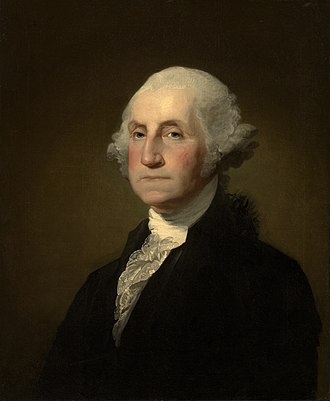
The power of the presidency has grown since the first president, George Washington, took office in 1789. Today, the president is one of the world's most powerful political figures and the leader of a superpower. As the leader of the nation with the largest economy by nominal GDP, the president has significant influence both inside and outside the United States.
The president is elected through the Electoral College to a four-year term, along with the vice president. No person can be elected to more than two presidential terms. Donald Trump is the current president, serving since January 20, 2025. Throughout history, many leaders have shaped the nation in important ways.
History and development
In July 1776, the Thirteen Colonies adopted the United States Declaration of Independence, declaring themselves free from British rule. They began creating a new government, but debates over how to balance power between the states and a central government led to the Articles of Confederation. This early system gave most power to the states, with a weak central government that could not collect taxes or enforce laws.
The Articles proved ineffective, leading to problems like trade disputes and economic struggles. By 1787, leaders met in Philadelphia to write a new plan, resulting in the U.S. Constitution. This created a stronger federal government with three branches, including the presidency. George Washington became the first president in 1789, setting many traditions that shaped the office, such as limiting himself to two terms. Over time, the role of the president grew, especially during major events like the Civil War and World War II, making the president one of the most powerful leaders in the world.
Main article: Imperial presidency
Legislative powers
The president of the United States has important roles in helping make laws. One big power is the ability to approve or disapprove laws that Congress passes. This is called a veto. If the president vetoes a law, Congress can still make it a law by voting with a big majority, called a two-thirds vote, in both houses.
Presidents also help suggest new laws. They talk about their ideas in a special speech called the State of the Union and can work with members of Congress to create laws they think are important. Presidents can also suggest changes to laws before they are passed.
The president can also call a special meeting of Congress if there is an urgent problem that needs quick action. This power has been used only a few times in history.
Executive powers
Main article: Powers of the president of the United States
The president leads the executive branch of the U.S. government and must make sure laws are followed. This branch has over four million workers, including the military.
Presidents can choose many important people, like ambassadors and members of their Cabinet, though some choices need approval from the U.S. Senate. They can also organize staff to help run the government and give special directions called executive orders to guide how things are done. These orders can be checked by courts or changed by Congress.
The president also plays a big role in foreign affairs, meeting with leaders of other countries and helping to make agreements. One of the most important jobs of the president is being the commander-in-chief of the U.S. Armed Forces. While Congress decides whether to declare war, the president directs the military when it is needed. This job has been used in many different ways by different presidents throughout history.
Judicial powers
Further information: List of people pardoned or granted clemency by the president of the United States
The president can suggest people for important jobs, like judges in federal courts and the Supreme Court. But these suggestions need approval from a group of leaders called the Senate before they can become judges. Presidents can also forgive people who broke the law, called giving pardons. For example, one president forgone someone right after starting his job, and another did it on his very last day.
There are special rules that let the president keep some secrets. One rule lets the president keep private messages safe from being shared. Another rule lets the president keep information secret if sharing it could danger the country’s safety. These rules have been used in many important cases over the years.
Leadership roles
As head of state, the president represents the United States to its own people and to the world. The president welcomes leaders from other countries and hosts special events, such as state dinners, to show hospitality and friendship. The president also takes part in many traditions, like throwing the first pitch at a baseball game or holding an egg-rolling contest for children on Easter.
The president is usually seen as the leader of their political party and plays an important role in global affairs. Because the United States is a strong and influential country, the president is often looked to as a key leader in the world.
Selection process
To become the president of the United States, a person must meet three basic requirements set by the Constitution. They must be a natural-born citizen of the United States, at least 35 years old, and have lived in the country for at least 14 years.
There are also some conditions that can prevent someone from becoming president. For example, if a person has already been impeached and convicted by Congress, they cannot hold the office. Also, someone who has taken an oath to support the Constitution but later rebelled against the United States may not be eligible, unless Congress agrees to lift this restriction. Additionally, no one can be elected president more than twice. If someone serves more than two years of another president’s term, they can only be elected president once.
Most presidents have had experience in government before becoming president, such as being a governor, senator, or member of Congress. Many have also been lawyers. While there are no rules requiring specific jobs before becoming president, most have had some political or leadership experience.
Presidential campaigns begin with primary elections, where members of each political party choose their candidate. The winning candidate from each party is then nominated at a national convention. These nominees often choose a vice presidential running mate. The nominees then campaign across the country, explaining their views and trying to win voters’ support. The president is elected by a group of electors from each state, known as the Electoral College, rather than by a direct popular vote.
Incumbency
When the first president, George Washington, announced in his Farewell Address that he was not running for a third term, he set a tradition that presidents should serve only two terms. This tradition continued until Franklin Roosevelt was elected to a third and then a fourth term. To prevent any president from serving too long, the Twenty-second Amendment was added to the Constitution in 1951. This amendment states that no one can be elected president more than twice.
If the president can no longer serve, such as through resignation, death, or removal, the vice president becomes the new president. Before the Twenty-fifth Amendment was added in 1967, it was unclear what would happen if the president could not serve. The amendment now clearly states that the vice president takes over in such situations. If both the president and vice president are unable to serve, the next in line is the speaker of the House, followed by the president pro tempore of the Senate, and then members of the president’s cabinet, in a specific order.
| Presidential pay history | ||
|---|---|---|
| Year established | Salary | Salary in 2025 USD |
| 1789 | $25,000 | $675,604 |
| 1873 | $50,000 | $1,343,750 |
| 1909 | $75,000 | $2,687,500 |
| 1949 | $100,000 | $1,353,147 |
| 1969 | $200,000 | $1,755,898 |
| 2001 | $400,000 | $727,307 |
| Sources: | ||
Post-presidency
Some former presidents have had important jobs after leaving the White House. For example, William Howard Taft became the chief justice of the United States, and Herbert Hoover worked on organizing the government after World War II. Two presidents, John Quincy Adams and Andrew Johnson, even served in Congress after their time as president. Others, like Grover Cleveland and Donald Trump, ran for president again and won a second term.
Many former presidents stayed busy with work, charity, or writing. Thomas Jefferson started the University of Virginia, and Jimmy Carter worked to support human rights around the world, earning a Nobel Peace Prize. Presidents sometimes help with important events, like helping other countries after natural disasters.
Pension and other benefits
The Former Presidents Act gives former presidents lifetime benefits, such as a monthly pension, medical care, and protection. This helps them after they leave office. The law also gives them money to pay for staff and office expenses.
Writing
Main article: List of autobiographies by presidents of the United States
Many presidents write books after leaving office. These books help them share their stories and sometimes earn money. Writing also lets them talk about their time as president.
Presidential libraries and historic sites
Main articles: Presidential library system and List of residences of presidents of the United States
Many presidents have libraries where their papers and records are kept. These libraries are maintained by the government or universities. Some of these libraries are also places where the president is buried and are open for people to visit.
Political affiliation
Political parties have played an important role in American politics for most of the country's history. Even though the leaders who created the United States did not plan for parties and thought they might cause problems, groups started forming in the 1790s. People who supported President Washington's policies became known as Federalists, while those who opposed them joined the Democratic-Republican Party.
President George Washington chose not to join any political party during his time in office, and he remains the only U.S. president who never belonged to a party. Since then, every president has been part of a political party when they took office. Starting in 1869, all presidents have been members of either the Republican or Democratic Parties.
Timeline of presidents
See also: List of presidents of the United States
This timeline shows the order of the presidents of the United States and which political groups they belonged to when they first took office. It helps us see how the leadership of the country has changed over time.
Pictures
Keep exploring


This article is a child-friendly adaptation of the Wikipedia article on President of the United States, available under CC BY-SA 4.0.
Images from Wikimedia Commons. Tap any image to view credits and license.