Federally recognized tribe
A federally recognized tribe is a Native American tribe that the United States Bureau of Indian Affairs recognizes as having a government-to-government relationship with the US federal government. In the United States, a Native American tribe is a basic unit of sovereign tribal government. As the Department of the Interior explains, "federally recognized tribes are recognized as possessing certain inherent rights of self-government (i.e., tribal sovereignty)...." The Constitution gives the U.S. Congress the power to interact with tribes.
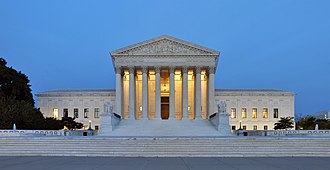
In 1831, the Supreme Court of the United States decided the case Cherokee Nation v. Georgia. Chief Justice of the United States John Marshall wrote that a Native American government is a "domestic dependent nation," with a relationship to the United States like that of a "ward to its guardian." This landmark decision helped lead to the United States recognizing over 574 federally recognized tribal governments and 326 Indian reservations. These are legally classified as domestic dependent nations with tribal sovereignty rights. In United States v. Sandoval, the Supreme Court said that Congress can treat a group as an Indian tribe, and can decide for distinctly Indian communities whether, how far, and for how long they should be recognized and dealt with as dependent tribes. Federal tribal recognition gives tribes the right to certain benefits, and the Bureau of Indian Affairs (BIA) manages it mostly.
In the 1970s, while trying to decide which groups could receive federal recognition, government officials saw the need for consistent procedures. Several federally unrecognized tribes faced obstacles in bringing land claims. The court case United States v. Washington (1974) confirmed the fishing treaty rights of Washington tribes. Other tribes asked the U.S. government to recognize their aboriginal titles.
All of these efforts led to the Indian Self-Determination and Education Assistance Act of 1975. This law recognized tribal entities by partly restoring Native American self-determination.
For a list of these tribes, see List of federally recognized tribes in the contiguous United States. For Alaska Native tribes, see List of Alaska Native tribal entities.
Native American sovereignty and the Constitution
The United States Constitution mentions Native American tribes three times. Article I, Section 2, Clause 3 leaves out "Indians not taxed" when counting people to divide up taxes and seats in Congress. Article I, Section 8 gives Congress the power to regulate trade with foreign nations, among the states, and with the Indian tribes, which shows that tribes were separate from the federal government, the states, and foreign nations. The Fourteenth Amendment, Section 2, changes how representatives are divided, as described in Article I, Section 2. Story's Commentaries on the U.S. Constitution also discusses how Indians were treated at that time.
These parts of the Constitution, along with later decisions by the Supreme Court, are often summed up in three ideas. The first is territorial sovereignty: tribal power over tribal land is organic and does not come from the states where the land is located. The second is the plenary power doctrine: Congress, rather than the Executive Branch or the Judicial Branch, has the final say on matters affecting the tribes, and courts give Congress more room to decide these issues. The third is the trust relationship: the federal government has a "duty to protect" the tribes, which courts have said includes the lawmaking and government powers needed to carry out that duty.
History
Europeans often moved Indigenous peoples off their homelands, sometimes through treaties made under pressure, through force, or through violence. Early English settlers also made treaties with Native American tribes, which were often unequal. The first reservation was set up by the Treaty of Easton in 1758. In 1824, the Office of Indian Affairs, now the Bureau of Indian Affairs, was founded to handle land matters. Three Supreme Court decisions in the early 1800s, known as the Marshall Trilogy, shaped the legal standing of Indian nations. They said that the federal government alone could deal with Indian nations. The Indian Removal Act of 1830 made it official U.S. policy to move Native peoples away from European-populated areas, and many were forced to leave their homelands in what became known as the Trail of Tears.
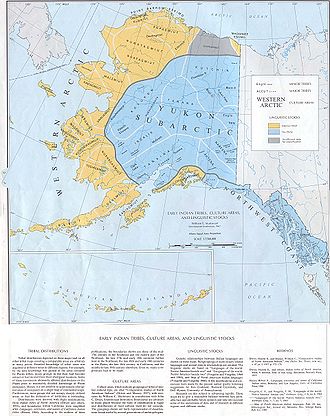
In 1868, President Ulysses S. Grant tried a "Peace Policy" to avoid violence, but it led to some of the bloodiest wars between Native Americans and the United States. The Indian Appropriations Act of 1871 ended the recognition of new tribes as independent nations that could make treaties. In 1887, the Dawes Act split up tribal land into small parcels for individual families, and much tribal land was lost. The Indian Reorganization Act of 1934 reversed some of this and encouraged tribal sovereignty. Later, the government tried a "termination" policy, but in 1969 President Richard Nixon called for "self-determination" instead. Today, the United States recognizes 574 tribal nations, 229 of which are in Alaska.
Federal acknowledgment
After decisions by the Indian Claims Commission in the 1950s, the BIA published final rules in 1978 that set out how groups could seek federal tribal acknowledgment. Groups must meet seven criteria. Four of them have been especially hard for most groups to prove: a long-standing historical community, being identified as Indians by outsiders, political authority, and descent from a historical tribe. Tribes seeking recognition must submit detailed petitions to the BIA's Office of Federal Acknowledgment. Congress can also recognize a tribe by passing a law.
The process can take years, or even decades, and delays of 12 to 14 years have happened. The Shinnecock Indian Nation petitioned in 1978 and was recognized 32 years later, in 2010. Witnesses at a Senate Committee on Indian Affairs hearing described the process as "broken, long, expensive, burdensome, intrusive, unfair, arbitrary and capricious, less than transparent, unpredictable, and subject to undue political influence and manipulation." Recent additions include the Pamunkey tribe in Virginia, recognized in July 2015, and six Virginia tribes covered by the Thomasina E. Jordan Indian Tribes of Virginia Federal Recognition Act of 2017, which was signed in January 2018. The Little Shell Tribe of Chippewa Indians of Montana became the 574th federally recognized tribe on December 20, 2019. The USA.gov website, the federal government's official web portal, also keeps an updated list of tribal governments.

Quiz time!
5 questions about Federally recognized tribe
What does it mean for a tribe to be "federally recognized"?
Pictures
Keep exploring




This article is a child-friendly adaptation of the Wikipedia article on Federally recognized tribe, available under CC BY-SA 4.0.
Images from Wikimedia Commons. Tap any image to view credits and license.