Fulgurite
Fulgurites are sometimes called "fossilized lightning." They are natural tubes, clumps, or masses formed when lightning strikes the ground and melts or fuses soil, sand, rock, plant and animal debris, and other sediments together. The name comes from the Latin word fulgur, meaning "lightning," and the ending -ite, which is used for many kinds of rock and mineral.
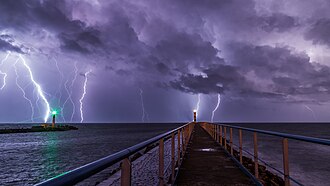
When an ordinary lightning bolt travels from a cloud down to the ground, it can carry more than 100 million volts (100 MV) of electrical energy. This powerful current can flow into sand, soil, clay, or other materials and quickly turn them into vapor or melt even the hardest parts. The result is usually a hollow or bubbly, branching shape made of glassy tubes, crusts, and clumps.
Fulgurites do not have one fixed chemical makeup. What they are made of depends on the material that the lightning hits. When they are made mostly of silica, they are classed as a type of mineraloid called lechatelierite.
Fulgurites look a lot like Lichtenberg figures. These are branching patterns that form on the surface of insulators when high-voltage electricity, such as lightning, causes dielectric breakdown.
Description
Fulgurites form when lightning strikes the ground, melting and glassing the mineral grains there. The main material in common tube fulgurites is lechatelierite, an amorphous silica glass. Many also show some crystal structure, being partly protocrystalline or microcrystalline. Because they are mostly amorphous, they are classified as mineraloids. Temperatures inside a lightning channel go above 30,000 K, and the pressure can create planar deformation features in SiO2, a kind of polymorphism also called shocked quartz. Fulgurites are sorted into five types by the sediment they form in: sand (Type I), soil (Type II), caliche or calcium-rich sediment (Type III), rock (Type IV), and droplet fulgurites (Type V). Type II can form in loessoid sediment, and Type IV can have a crust rich in silicide. A proposed extra class, phytofulgurite, forms from plants such as grasses and wood, but it is debatable whether it belongs with fulgurites.
Fulgurites vary in color, size, and texture depending on the lightning and on the surface it strikes, including its makeup and moisture. Most range from white to black, and iron can give a deep brownish-green color. Downed high voltage power lines have made brightly colored glass containing copper or other line materials. Such colorful ones are usually synthetic, though lightning can also strike man-made objects. Branching fulgurites look like root networks and show fractal-like self-similarity and scale invariance. Fulgurites can be over 20 cm across and reach 15 m deep into the subsoil. One of the longest found in modern times was just over 4.9 m long, in northern Florida, while the Yale University Peabody Museum of Natural History displays one about 4 m long. Charles Darwin recorded in The Voyage of the Beagle tubes in Drigg, Cumberland, UK that reached 9.1 m. Fulgurites at Winans Lake, Livingston County, Michigan, spread across a 30 m range and include what may be the largest fulgurite mass ever reported. Fulgurites are fragile, so large ones are hard to collect in the field.
Significance
The presence of fulgurites in an area can be used to estimate how often lightning has struck over a period of time. This can help scientists understand past regional climates. Paleolightning is the study of signs of past lightning strikes, mainly fulgurites and the magnetic traces that lightning leaves behind.
Many high-pressure, high-temperature materials have been found in fulgurites. Many of these minerals and compounds are also known to form in extreme places such as nuclear weapon tests, hypervelocity impacts, and interstellar space. Shocked quartz was first described in fulgurites in 1980. Since then, other materials have been identified, including silicides (highly reduced silicon-metal alloys), the allotropes C60 (buckminsterfullerenes) and C70, and high-pressure forms of SiO2. Reduced phosphides have also been found in fulgurites, in the form of schreibersite (Fe3P and (Fe,Ni)3P) and titanium(III) phosphide. These reduced compounds are otherwise rare on Earth because oxygen in Earth's atmosphere creates oxidizing conditions at the surface.
History
Persian scholars Avicenna and Al-Biruni wrote about fulgurite tubes in the 11th century, but they did not know how the tubes formed. Over the following centuries, people described fulgurites but often misunderstood them, thinking they came from underground fires. Some even wrongly believed they had healing powers. Other famous natural scientists, including Charles Darwin, Horace Bénédict de Saussure and Alexander von Humboldt, also studied fulgurites. Darwin was the only one who linked them to lightning. He also described experiments in Paris, where scientists made similar tubes by sending strong electric shocks of galvanism through powdered glass.
In 1805, agriculturist Hentzen and mineralogist and mining engineer Johann Karl Wilhelm Voigt identified the true way fulgurites form, when lightning strikes the ground. In 1817, mineralogist and mining engineer Karl Gustav Fiedler published a detailed account of the phenomenon in the Annalen der Physik.

Quiz time!
5 questions about Fulgurite
Why are fulgurites sometimes called "fossilized lightning"?
Pictures
Keep exploring


This article is a child-friendly adaptation of the Wikipedia article on Fulgurite, available under CC BY-SA 4.0.
Images from Wikimedia Commons. Tap any image to view credits and license.