 Safekipedia
Glacier
Adapted from Wikipedia · Discoverer experience
A glacier is a persistent body of natural ice, a form of rock, that is constantly moving under its own weight. It forms where the accumulation of snow exceeds its ablation over many years, often centuries. Glaciers slowly flows and deforms under stresses induced by gravity, creating interesting surface features, such as crevasses and seracs.
On Earth, most glacial ice is found in vast ice sheets in the polar regions, but glaciers can be found in mountain ranges on every continent except Australia. They cover about 10% of Earth's land surface. Glaciers are important because they store a lot of the world's fresh water and influence climate change and sea level.
Glacial ice often appears blue because large quantities of water appears blue, and because air bubbles are squeezed out by pressure, making the ice denser. This blue color is a special feature that helps identify glaciers from a distance.
Etymology and terminology
The word glacier comes from French. It started from a Latin word meaning "ice." When we talk about things related to glaciers, we call them glacial. The study of glaciers is called glaciology, and glaciers are part of something called the cryosphere, which includes all the ice on Earth.
Types
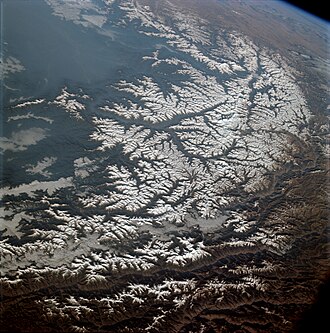
Glaciers can be grouped by their size, shape, and how they behave. Alpine glaciers form on mountain slopes and crests. When a glacier fills a valley, it is called a valley glacier. A large mass of ice sitting on top of a mountain, mountain range, or volcano is called an ice cap or ice field. Ice caps are smaller than ice sheets, which are huge glaciers larger than 50,000 km2 and cover entire areas like Antarctica and Greenland.
Glaciers also have different temperature states. A temperate glacier is at the melting point all year. A polar glacier stays below freezing all the time, though its surface snow may melt in seasons. A subpolar glacier has both temperate and polar ice depending on its depth and position.
Formation
Glaciers form where lots of snow and ice build up more than they melt away. They usually start in a special curved shape in the mountains called a cirque, which collects snow. The snow piles up, gets pressed down, and turns into something called névé, then firn, and finally glacial ice. When there is enough ice, it starts to move down the slope because of gravity and pressure. This process can begin with just a little bit of snow and ice on steeper slopes.
Color
Glacial ice looks blue because it absorbs some red light. This happens because of the way water molecules vibrate. Liquid water can look blue for the same reason. Sometimes people think the blue color is because of tiny air bubbles in the ice, but that's not correct.
Structure
A glacier starts at a place called its glacier head and ends at its glacier foot, snout, or terminus.
Glaciers have different parts based on how much snow they gain and lose. The part where more snow is lost than gained is called the ablation zone. The upper part where more snow is gained than lost is called the accumulation zone. The line between these two zones is where the amount of new snow equals the amount of ice lost. The accumulation zone usually covers most of the glacier’s surface.
After a glacier melts, it often leaves behind a bowl-shaped hole. These holes can be as big as the Great Lakes or smaller mountain holes called cirques.
The accumulation zone can also be divided into parts based on whether the snow melts:
- The dry snow zone where no melting happens, even in summer.
- The percolation zone where some surface melting occurs, and meltwater moves into the snow.
- The superimposed ice zone near the line where meltwater refreezes.
- The wet snow zone where all the snow since last summer has reached 0 °C.
Since around 1850, after the Little Ice Age ended, glaciers around the Earth have retreated substantially. There was a small advance of some glaciers between 1950 and 1985, but since 1985, glaciers have been melting more and losing mass.
Glaciers are made of glacial ice, a special kind of rock mostly made of the mineral Ice Ih, with tiny bits of trapped air, dirt, and other materials frozen inside. In geology, glacial ice is a type of metamorphic rock that is very close to its melting point. It forms mainly from snow that falls, but also changes a little through melting and refreezing.
Motion
Glaciers move downhill because of gravity and how the ice inside changes shape. Ice is made of layers of molecules that stick together loosely. When the ice is squeezed, it can bend and flow like a soft solid. Ice needs to be at least 30 meters thick to start moving, but when it's about 50 meters thick or more, it flows faster.
The slowest moving parts of a glacier are near the bottom and the sides, where friction slows it down. The middle and top move faster. Thicker ice can flow faster, which affects how the glacier shapes the land.
Glaciers can also crack and break. The top 50 meters of a glacier is stiff and can break into cracks called crevasses when moving over uneven ground. These cracks can be very deep. Below this, the ice is softer and doesn’t crack as easily.
Crevasses form in different ways. Some form when slopes are steep, others when the glacier widens, and some near the edges where the ice slows down. These cracks make traveling on glaciers dangerous.
Most of what controls how a glacier moves happens where it touches the ground. The temperature, roughness, and softness of the ground decide if the glacier slides or moves through the soil. Soft ground lets the glacier slide more easily, while hard ground needs meltwater to help it move.
Water under the glacier can change how it moves. Water can flow in tubes or in thin layers, and this can speed up or slow down the glacier. The speed of a glacier depends on many things like slope, thickness, and how much meltwater there is.
Some glaciers move very fast for short periods, called surges. This can happen when meltwater builds up under the glacier or when the glacier gets too heavy. These fast movements can cause big earthquakes.
Ogives are patterns of dark and light bands on glacier surfaces. They show how the glacier moves each year, with each pair of bands matching one year’s movement.
Geography
Further informationon this topic: List of glaciers
Glaciers can be found on every continent except Australia and South Africa, though some of their distant islands have glaciers. Big glaciers cover places like Antarctica, Argentina, Chile, Canada, Pakistan, Alaska, Greenland, and Iceland. Smaller glaciers are common in mountain ranges such as the Andes, the Himalayas, the Rocky Mountains, the Caucasus, Scandinavian Mountains, and the Alps. The Snezhnika glacier in Pirin Mountain, Bulgaria is the southernmost glacier in Europe. Although mainland Australia has no glaciers today, a small glacier existed on Mount Kosciuszko during colder times long ago. In New Guinea, tiny glaciers are located on Puncak Jaya, but they are shrinking quickly. Africa has glaciers on Mount Kilimanjaro in Tanzania, on Mount Kenya, and in the Rwenzori Mountains. Islands with glaciers include Iceland, islands near Norway such as Svalbard and Jan Mayen, New Zealand, and several subantarctic islands like Marion, Heard, Grande Terre (Kerguelen), and Bouvet. Long ago, during colder times, Taiwan, Hawaii on Mauna Kea, and Tenerife also had big mountain glaciers, and the Faroe and Crozet Islands were fully covered in ice.
Glaciers need lots of snow that stays year-round to form. Where the land slopes, how much snow falls, and the wind all affect where glaciers can grow. Glaciers exist in many places around the world, except between 20° and 27° north and south of the equator, where it is usually too warm and dry for snow to build up. Even in very cold places, glaciers may not form if there is not enough snow. For example, some parts of the Arctic and Antarctica are so dry that glaciers cannot form, even though it is very cold there. Similarly, some very high and cold mountains in Bolivia, Chile, and Argentina do not have glaciers because they are in very dry areas with little snow.
Glacial geology
Glaciers change the shape of the land through two main ways: picking up rocks and grinding them down.
When glaciers move, they can pick up pieces of rock from the ground below. This happens when water freezes under the glacier and pushes rocks into the ice. These rocks then travel with the glacier.
The rocks carried by glaciers also grind against the land, making it smooth. This process creates fine powder from the rocks, called rock flour. It also leaves deep scratches on the ground and can shape mountains and valleys over time.
Glaciers leave behind many different kinds of rocks and dirt when they move. Some of these form long ridges, while others create hills or valleys. These changes can stay long after the glacier is gone.
Retreat of glaciers due to climate change
South Cascade Glacier in Washington has been photographed from 1928 to 2003, showing how it has been shrinking quickly.
Human actions, especially since the industrial era, have increased gases in the air that trap heat. This has led to global warming, which is the main reason glaciers are changing. As glaciers melt, they expose darker land and water, which absorbs more heat and causes even more melting. This process has been happening every year since 1988. Melting glaciers also add water to the oceans, causing sea levels to rise. This can harm coastal areas, islands, and ecosystems.
In 2023, Switzerland lost 4% of its glacier volume, which was a big increase compared to earlier years. The United Nations declared 2025 the International Year of Glaciers' Preservation to highlight the importance of protecting glaciers.
Glaciers as climate monitors
See also: Glacier Loss Day
Glaciers are very old and can help us understand Earth's climate history. Scientists study pieces of glacier ice, which contain tiny bubbles of air from different times. By analyzing these bubbles, they can learn about past changes in the atmosphere and temperatures, showing that carbon dioxide levels and global temperatures have been connected for at least a million years.
Isostatic rebound
Large masses like ice sheets and glaciers can push down the Earth's crust into the mantle beneath. This pushing down usually amounts to about a third of the thickness of the ice. When the ice melts, the mantle slowly flows back to its original position, lifting the crust back up. This slow lifting, called post-glacial rebound, is happening now in places like Scandinavia and the Great Lakes region of North America.
A similar process on a smaller scale creates features called dilation-faulting. This happens when rocks that were squeezed by ice return to their original shape faster than they should, leading to cracks similar to what might happen if the rock were struck by a large hammer. We can see dilation faulting in areas of Iceland and Cumbria that were recently freed from glaciers.
On other planets
The polar ice caps of Mars show signs that glaciers once existed there. The south polar cap looks very similar to glaciers we have on Earth. Scientists believe there were more glaciers on Mars in the past, especially in areas between 35° and 65° north or south. Because Mars has very little air, these glaciers lose ice by turning directly into vapor instead of melting. Like Earth, many Martian glaciers are covered with rocks that protect the ice underneath.
In 2015, when the New Horizons spacecraft flew by Pluto, it discovered a large area named Sputnik Planitia covered in a layer of nitrogen ice. The surface of this area has unusual shapes that scientists think are caused by heat moving inside Pluto. Glaciers were also seen near the edges of Sputnik Planitia, flowing both into and out of the area.
Images
Related articles



This article is a child-friendly adaptation of the Wikipedia article on Glacier, available under CC BY-SA 4.0.
Images from Wikimedia Commons. Tap any image to view credits and license.