
Caucasus Mountains
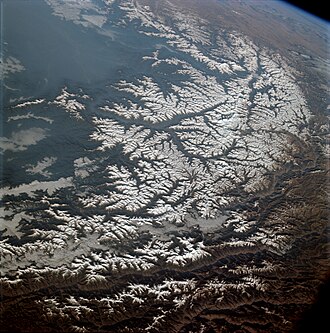
The Caucasus Mountains is a mountain range at the intersection of Asia and Europe. Stretching between the Black Sea and the Caspian Sea, they are surrounded by the Caucasus region and are home to Mount Elbrus, the highest peak in Europe at 5,642 metres (18,510 ft) above sea level.
The Caucasus Mountains include the Greater Caucasus in the north and the Lesser Caucasus in the south. The Greater Caucasus runs west-northwest to east-southeast, from the Western Caucasus on the northeastern shore of the Black Sea to close to Baku on the Caspian Sea, in Azerbaijan. The Lesser Caucasus runs parallel to the Greater about 100 km (62 mi) south. These ranges are connected by several smaller mountain chains, forming a vast and beautiful landscape.
Geology
The Caucasus Mountains are part of a large system called the Alpide belt, which stretches from southeastern Europe into Asia. The Greater Caucasus Mountains are made mostly of rocks from the time of the Cretaceous and Jurassic periods, with older rocks in the higher areas. The Lesser Caucasus Mountains are mainly made of rocks from the Paleogene period.
These mountains formed when the Arabian plate moved north and crashed into the Eurasian plate. This movement folded the rocks and created the mountains we see today. The area still experiences strong earthquakes because of this activity.
Notable peaks
Mount Elbrus is a very tall mountain in the Caucasus Mountains. It is 5,642 metres (18,510 feet) high, which makes it one of the highest peaks in Europe. It is even taller than Mont Blanc, the highest mountain in the Alps. But some people debate whether Mount Elbrus is truly in Europe or if it is in Asia.
The Caucasus Mountains have many tall peaks. Below is a list of some of the highest ones, mostly taken from old maps made by Soviet scientists. The list includes very tall mountains and those that stand out strongly from the land around them.
| Peak name | Elevation (metres) | Prominence (metres) | Country |
|---|---|---|---|
| Elbrus | 5,642 | 4,741 | Russia |
| Dykh-Tau | 5,205 | 2,002 | Russia |
| Shkhara | 5,193 | 1,365 | Georgia / Russia |
| Koshtan-Tau | 5,152 | 822 | Russia |
| Pushkin peak | 5,100 | 110 | Russia |
| Janga (Dzhangi-Tau) | 5,085 | 300 | Georgia / Russia |
| Mizhirgi | 5,047 | 10 | Russia |
| Kazbek | 5,034 | 2,353 | Georgia / Russia |
| Katyn-Tau | 4,979 | 240 | Georgia / Russia |
| Kukurtlu Dome | 4,978 | 18 | Russia |
| Gistola | 4,860 | 320 | Georgia / Russia |
| Shota Rustaveli | 4,860 | c. 50 | Georgia / Russia |
| Tetnuldi | 4,858 | 672 | Georgia |
| Jimara (Jimari) | 4,780 | 840 | Georgia / Russia |
| Ushba | 4,710 | 1,143 | Georgia |
| Dumala-Tau | 4,682 | 332 | Russia |
| Gora Uilpata | 4,649 | 1300 | Russia |
| Tikhtengen | 4,618 | 768 | Georgia / Russia |
| Ailama | 4,547 | 1,067 | Georgia / Russia |
| Tiutiun-Tau | 4,540 | 380 | Russia |
| Jailik | 4,533 | 926 | Russia |
| Salinan | 4,508 | 621 | Russia |
| Tebulosmta | 4,499 | 2,145 | Georgia / Russia |
| Mount Bazardüzü | 4,466 | 2,454 | Azerbaijan / Russia |
| Mount Shan | 4,451 | 1,775 | Georgia / Russia |
| Tepli | 4,431 | 1,144 | Russia |
| Diklo | 4,285 | 843 | Georgia / Russia |
| Mount Shahdagh | 4,243 | 1,102 | Azerbaijan |
| Gora Addala Shukgelmezr | 4,152 | 1,792 | Russia |
| Gora Dyultydag | 4,127 | 1,834 | Russia |
| Aragats | 4,090 | 2,143 | Armenia |
| Deavgay | 4,016 | 1,251 | Russia |
Climate
The climate in the Caucasus Mountains changes with height and location. As you go higher up the mountains, it gets colder. For example, it’s much warmer in Sokhumi and Abkhazia near sea level than it is on the slopes of Mt. Kazbek, which is much higher up.
Rain and snow are also different depending on where you are. Some places get a lot of rain, especially in the west, while others, like Dagestan, are quite dry. The mountains can get a lot of snow, especially in the southwest, where heavy snow and avalanches are common from November to April. Some areas, like the Mt. Achishkho region, can have snow as deep as 7 metres!
Landscape
The Caucasus Mountains have a diverse landscape that changes with height and distance from water. You can find many types of plants and habitats, from warm, wet forests in lower areas to icy glaciers higher up. In the south, there are dry grasslands and beautiful flower-filled meadows.
The north side of the big Caucasus Mountains has forests of oak, maple, and ash trees in lower areas, with birch and pine trees growing higher up. Some lower areas have wide-open grasslands. As you go higher, around 2,000 metres (6,600 ft) above sea level, forests turn into alpine meadows. The south side has forests of beech, oak, and other trees, with different plants appearing at higher elevations. The smaller Caucasus Mountains to the south have forests on the north and west sides and grasslands on the south side. Volcanic rocks and formations are found all through the area, including volcanoes, lava flows, and volcanic lakes. Some famous peaks here include Mount Aragats, Didi Abuli, and Samsari. Unlike the big Caucasus Mountains, the smaller ones do not have many glaciers.
History
Further information: History of the Caucasus and Russian conquest of the Caucasus
The Caucasus Mountains have been an important path for travelers and traders. One big route, the northern part of the Silk Route, went through these mountains. For thousands of years, shepherds in Georgia have moved their animals to different places for food and shelter, a practice called transhumance. There are several ways to cross the mountains, like the pass at Derbent, also called the Caspian Gates or Gates of Alexander. Other paths include the Jvari Pass, the Darial Gorge on the Georgian Military Road, the Mamison Pass on the Ossetian Military Road, and the Roki Tunnel.
Image gallery
Here are some beautiful views from the Caucasus Mountains:
- Mount Elbrus viewed from the south in Kabardino-Balkaria
- Komito Mountain in Chechnya
- Caucasus Mountains in Svaneti, Georgia
- Chaukhi mountain in Khevi, Georgia
- A gorge in Dagestan, Russia
- Twin-peaked Ushba in Georgia
- Mount Shkhara in Georgia
- Mount Ararat in Turkey, as viewed from Yerevan, Armenia
- Asbestnaya Mount and Acheshbok Mount, Russia
- Bolshoy Tkhach Park, Russia
Pictures
Keep exploring



This article is a child-friendly adaptation of the Wikipedia article on Caucasus Mountains, available under CC BY-SA 4.0.
Images from Wikimedia Commons. Tap any image to view credits and license.