 Safekipedia
Greco-Persian Wars
Adapted from Wikipedia · Discoverer experience
The Greco-Persian Wars (also often called the Persian Wars) were a series of conflicts between the Achaemenid Empire and Greek city-states that started in 499 BC and lasted until 449 BC. These wars began when the Persians, under Cyrus the Great, took control of the Greek areas in Ionia. The Greeks there were difficult to govern, and the Persians set up rulers called tyrants to manage them, which caused tension.
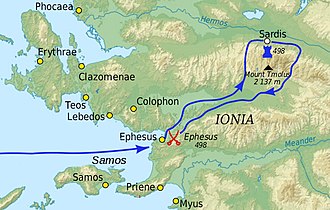
The wars truly began when a leader from Miletus, Aristagoras, tried to attack the island of Naxos with Persian help but failed. He then led a rebellion of Greek cities in Asia Minor against Persian rule, known as the Ionian Revolt. With help from Athens and Eretria, they attacked and burned the Persian city of Sardis. In response, the Persian king Darius the Great decided to punish Athens and Eretria.
The Persians tried to conquer Greece twice. The first attempt ended with a big defeat at the Battle of Marathon. Later, Darius’s son Xerxes led an even larger army. Although they won at the Battle of Thermopylae and burned Athens, the Greeks won important sea battles at the Battle of Salamis and Battle of Mycale. These victories helped the Greeks protect their lands and win their freedom.
Images
Related articles




This article is a child-friendly adaptation of the Wikipedia article on Greco-Persian Wars, available under CC BY-SA 4.0.
Images from Wikimedia Commons. Tap any image to view credits and license.