 Safekipedia
History of Bavaria
Adapted from Wikipedia · Discoverer experience
The history of Bavaria is very old, going back many hundreds of years. It started when people first began to live in the area and formed a special kind of region called a stem duchy in the 6th century. Over time, Bavaria became part of the big group of lands known as the Holy Roman Empire.
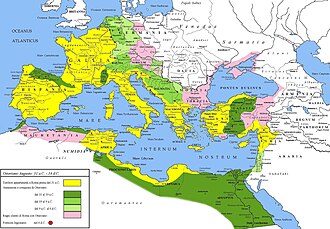
At first, the land was home to Celtic peoples, like the Boii. Later, around the 1st century BC, the Romans came and took control. They added Bavaria to their empire, calling it the provinces of Raetia and Noricum. Today, Bavaria is a large and important state, called a Bundesland, in modern Germany.
Early settlements and Roman Raetia
For the Roman history of the territory, see Vindelicia and Raetia.
There have been many old discoveries in Bavaria from ancient times. The first known people to live there were the Celts, who were part of a wide-ranging culture called the La Tène culture. The Roman Empire under Augustus used the Danube River as its northern edge. What we now call southern Bavaria was part of the Roman area known as Raetia, where people called the Vindelici lived. The biggest Roman town was Augusta Vindelicorum, which is today’s Augsburg. Other important places were Regensburg and Passau. North of the Danube River, two groups of people called the Suebian peoples, the Hermunduri and the Varisci, made their home.
Migrations and early medieval period
Main article: Baiuvarii
In the 5th century, people living in the areas of Noricum and Raetia felt pressure from groups north of the Danube. These areas were home to Suebian groups and were part of what the Romans called Germania. The name "Bavarian" comes from the Celtic Boii, who lived there long before. Over time, their name changed and added a word meaning "home" to create the name for the people living in this area.
The Bavarians were first written about around 520 AD in a list made by the Frankish people. Later writers also mentioned them when describing their travels through the region. Evidence from old settlements shows that the Bavarians were influenced by many different groups and cultures living around them. Today, historians think the Bavarian identity formed because of changes in politics and society that brought people together.
The stem duchy of Bavaria
Main article: Duchy of Bavaria
Bavaria and the Agilolfings under Frankish overlordship
The Bavarians came under the control of the Franks, likely without much fighting. The Franks saw this area as a buffer against peoples to the east and as a source of soldiers for their army. Around 550 AD, the Franks placed the region under a duke, possibly a Frankish leader or someone from the local noble families, to govern for the Frankish king. The first known duke was Garibaldi, from the powerful Agilolfing family. This began a line of Agilolfing dukes that lasted until 788 AD.
For about 150 years, these dukes defended against attacks from the Slavs to the east. By the time of Duke Theodo I, who died in 717, Bavaria had become fully independent from the weakening Frankish kings. Later, when Charles Martel became the main ruler of the Franks, he brought Bavaria back under Frankish control and removed two dukes for refusing to obey. His son Pepin the Short kept Bavaria under Frankish rule. Marriages between the Frankish royal family and the Agilolfings helped tie the two groups together. The ease with which the Franks put down uprisings suggests that many rebellions were due to family disputes rather than widespread opposition.
Bavarian law was written down between 739 AD and 748 AD, showing Frankish influence in later additions. Though the duchy belonged to the Agilolfing family, the duke was chosen by the people and had to be approved by the Frankish king. The duke had five times the normal payment for harming him, could call meetings of nobles and clergy, lead the army, judge disputes, and manage finances. Five noble families existed, possibly representing old divisions of the people. Below the nobles were freeborn people and those with fewer rights. The country was divided into areas called gaits or counties, each led by a count and supported by judges who explained the law.
Christianity
Christianity had been present in Bavaria since Roman times, but it grew stronger when Bishop Rupert of Worms arrived in 696, invited by Duke Theodo I. He and Bishop Emmeran of Poitiers founded several monasteries, leading most people to become Christian and building connections between Bavaria and Rome. In the 8th century, some people turned away from Christianity, but Saint Boniface arrived around 734 AD and helped restore the faith. He organized the Bavarian church and established or renewed bishoprics in Salzburg, Freising, Regensburg, and Passau.
Tassilo III became duke of Bavaria in 749. He recognized the Frankish king's authority in 757 AD but later refused to support a war in Aquitaine and acted independently. His control of Alpine passes, ties with the Avars, and relationship with the Lombard king made him a concern for the Frankish kingdom. Charlemagne decided to remove him.
Though Tassilo swore loyalty in 781 AD and again in 787 AD, problems continued. In 788 AD, the Franks charged him with betrayal and sentenced him to death, but the king spared him. Tassilo entered a monastery and gave up his duchy in 794.
Gerold, a relative of Charlemagne, ruled Bavaria until he died in battle against the Avars in 799. After that, Frankish counts governed Bavaria, and the land was fully merged into the Carolingian empire. Charlemagne’s efforts to improve education and welfare in his kingdom benefited Bavaria. The Bavarians did not resist this change, as their duchy was already well integrated with the Frankish domains, largely thanks to the church.
The Duchy during the Carolingian period
The history of Bavaria for the next century is tied to the Carolingian empire. After the empire was divided in 817 AD, Bavaria went to the king of the East Franks, Louis the German, and remained part of his lands after the Treaty of Verdun in 843 AD. Louis made Regensburg his capital and secured Bavaria with many campaigns against the Slavs. When he died in 876 AD, he passed Bavaria to his son Carloman, who ruled until his death in 880 AD. Then it became part of the lands of Emperor Charles the Fat. Charles was not a strong leader, so he left Bavaria’s defense to Arnulf, an illegitimate son of Carloman. With Bavarian support, Arnulf opposed Charles and was elected German king in 888 AD. In 899 AD, Bavaria passed to Louis the Child, whose time saw attacks by the Hungarians. Tradition says that in 907 AD, most of the Bavarian people died in the Battle of Pressburg against these invaders.
During Louis the Child’s rule, Luitpold, Count of Scheyern, governed the Mark of Carinthia, created to protect Bavaria’s southeast border. He died in the battle of 907 AD, but his son Arnulf rallied the remaining people, allied with the Hungarians, and became duke of Bavaria in 911 AD, uniting Bavaria and Carinthia. The German king Conrad I attacked Arnulf when he refused to recognize royal authority but was unsuccessful.
Duchy during the Ottonian and Salian periods
In 920 AD, Conrad’s successor, German king Henry the Fowler of the Ottonian dynasty, recognized Arnulf as duke, allowing him to appoint bishops, mint money, and create laws.
Similar conflict arose between Arnulf’s son Eberhard and Henry’s son Otto I the Great. Eberhard was less successful and fled Bavaria in 938 AD. Otto gave the duchy to Eberhard’s uncle Bertold but also appointed a count palatine to watch royal interests.
When Bertold died in 947 AD, Otto gave the duchy to his own brother Henry, who married Judith, daughter of Duke Arnulf. The Bavarians were unhappy with Henry, who spent most of his time arguing with his people.
Hungarian attacks ended after their defeat at the Lechfeld in 955 AD, and Bavaria gained some nearby areas in Italy.
In 955 AD, Henry’s young son Henry, called the Quarrelsome, became duke but was involved in a plot against King Otto II in 974 AD because Otto had given the Duchy of Swabia to Henry’s enemy and the Bavarian Eastern March, later known as Austria, to Leopold of Babenberg. The plot failed, and Henry lost Bavaria in 976 AD to Otto, Duke of Swabia. Carinthia became a separate duchy, the count palatine’s office was restored, and the Bavarian church came under the king instead of the duke.
Bavaria at this time included the Inn basin with Salzburg and the Salzach basin and the Danube from Donauwörth to Linz. The March of Verona briefly belonged to Bavaria before passing to Carinthia. Important Bavarian cities included Freising, Passau, Salzburg, and Regensburg.
Restored in 985 AD, Henry proved to be a strong leader, bringing order, making important laws, and reforming monasteries. In 1002 AD, his son Henry II gave Bavaria to his brother-in-law Henry of Luxembourg, who ruled until his death in 1026 AD. Then it passed to Henry III and later to another Luxembourg family member, Duke Henry VII. In 1061 AD, Empress Agnes gave the duchy to Otto of Nordheim.
Under the Welfs
In 1070 AD, King Henry IV took Bavaria away from Duke Otto and gave it to Count Welf, a leader from an influential Bavarian family.
Because Welf supported Pope Gregory VII in his dispute with Henry, he lost Bavaria but got it back later. Two of his sons followed him: Welf II from 1101 AD and Henry IX from 1120 AD. Both had significant influence among German princes.
Henry IX’s son Henry X, called the Proud, became duke in 1126 AD and also received the Duchy of Saxony in 1137 AD. Fearing his growing power, King Conrad III took Bavaria away and gave it to Leopold IV, Margrave of Austria. When Leopold died in 1141 AD, the king kept Bavaria but faced disorder. In 1143 AD, he gave it to Henry Jasomirgott, Margrave of Austria.
The fight for control continued until 1156 AD, when Emperor Frederick I gave Bavaria to Henry the Lion, duke of Saxony and son of Henry the Proud. In return, Austria became an independent duchy. Henry the Lion founded Munich.
Geographic fluctuations
After the Carolingian empire fell apart, Bavaria’s borders changed often. After 955 AD, Bavaria began to expand. To the west, the Lech River separated Bavaria from Swabia, but on other sides, Bavaria grew. However, during the Welfs’ rule, Bavaria’s size decreased.
In 1027 AD, Conrad II separated the Bishopric of Trent from the Lombard Kingdom of Italy and added it to Bavaria, then ruled by his son Henry III. From the 12th century, the counts in Castle Tyrol near Merano expanded their land and became more powerful than the bishops of Brixen, whom they nominally served. After Henry X the Proud lost Bavaria in 1138 AD, the Counts of Tyrol became more independent. When Frederick Barbarossa gave Bavaria back to the Welfs in 1154 AD, the county of Tyrol was no longer part of Bavaria.
Henry the Lion focused on Saxony more than Bavaria. After the dispute over Bavaria ended in 1156 AD, the area between the Enns and Inn rivers became part of Austria.
The growing importance of areas like the March of Styria and the county of Tyrol reduced Bavaria’s strength. Nearby regions like the Duchy of Carinthia, the lands of the Archbishopric of Salzburg, and nobles seeking more independence all limited Bavaria’s growth.
Under the Wittelsbach dynasty
A new time started when Emperor Frederick I gave Bavaria to Otto from the Wittelsbach family in 1180 after Henry the Lion lost his power. The Wittelsbach family ruled Bavaria without stopping until 1918. The Wittelsbachs also took control of the Electorate of the Palatinate in 1214.
When Otto became duke in 1180, Bavaria’s land reached from the Böhmerwald to the Inn, the Alps, and the Lech River. Otto ruled for only three years before his son Louis I took over in 1183. Louis helped shape Germany’s affairs until he died in 1231. His son Otto II kept Bavaria loyal to the Hohenstaufen emperors, even when the Church put Bavaria under a ban. Otto II grew his lands through buying more and died in 1253.
The dukes tried to make Bavaria stronger and more united, but their efforts were hurt by the family splitting the land among themselves. This happened for 250 years, causing wars and weakness.
The first split happened in 1255 when Otto II’s sons Louis II and Henry XIII divided Bavaria. Louis got the western part, called Upper Bavaria, and also the Electorate of the Palatinate. Henry got the eastern part, called Lower Bavaria.
Henry XIII often fought with his brother and others. When he died in 1290, his three sons Otto III, Louis III, and Stephen I ruled Lower Bavaria. After Otto III and Henry XV died without sons, Lower Bavaria passed to Henry XIV, and then to John I. John I died without children, and then Emperor Louis IV united Lower Bavaria with the rest of Bavaria.
Louis II, called “the Stern,” became the most powerful leader in southern Germany. He helped his nephew Conradin and supported Count Rudolph I of Habsburg when he became king in 1273. After Louis died in 1294, his sons Rudolph I and Louis ruled together but later split Upper Bavaria in 1310. This caused war between them until Louis forced Rudolph out in 1317. In 1329, Louis made a treaty giving parts of Bavaria and the Electorate of the Palatinate to Rudolph’s sons.
When Louis IV died in 1347, his six sons split Bavaria’s lands. Some parts went to Brandenburg, Holland, Hainaut, and Tirol. By 1373, Brandenburg was lost. Stephen II and Albert I ruled different parts of Bavaria. When Stephen died in 1375, his three sons shared his land. In 1392, Stephen’s sons Stephen III, Frederick, and John II divided Bavaria into Ingolstadt, Landshut, and Munich, leading to civil wars.
The government and finances were handled by a group called the Landtag. Towns grew strong and wealthy from trade, and Munich and Regensburg often stood up to the dukes.
Albert I’s part of Bavaria, Bavaria-Straubing, passed to his son William II in 1404, then to John III in 1417. When John died in 1425, Bavaria-Straubing was split among the remaining Wittelsbach branches, while Holland and Hainaut went to Burgundy.
Stephen III, duke of Bavaria-Ingolstadt, was more a soldier than a ruler. His son Louis VII took over in 1413. Louis VII got into fights with his cousin Henry XVI of Bavaria-Landshut and was later imprisoned by his son Louis VIII, who died in 1445. Louis VII died in prison in 1447.
Henry, who became duke of Bavaria-Landshut in 1393, ruled during many family fights. His son Louis IX, called the Rich, improved trade safety, justice, and money matters. He started the University of Ingolstadt in 1472. After Louis IX died in 1479, his son George took over. When George died without sons in 1503, a war started over who would get Bavaria-Landshut.
After John II died in 1397, Bavaria-Munich went to his sons Ernest and William III. They fought with other family branches and Munich citizens. William III died in 1435, and Ernest in 1438. In 1440, Ernest’s son Albert III took over. Albert tried to change the monasteries and almost became king of Bohemia. He died in 1460, leaving five sons. John IV and Sigismund ruled together until 1463, then Albert became the sole ruler in 1467.
Albert IV, called the Wise, added Abensberg to Bavaria and took part in the Landshut War of Succession after George the Rich died in 1503. Albert united most of Bavaria under his rule. In 1506, he made a law that the duchy would pass to the oldest son. Albert improved Bavaria in many ways and died in 1508, succeeded by his son William IV.
Reunited duchy
William IV had to share power with his brother Louis X in 1516. After Louis died in 1545, William made treaties with other leaders and worked hard to keep Bavaria a Catholic place. He invited teachers called Jesuits to help with education and stopped people who had different religious ideas.
Albert V, William’s son, also supported the arts and built many beautiful structures in Munich. Later, his son William V continued these traditions and helped organize the duchy. When William V retired in 1597, his son Maximilian I took over. He worked hard to fix problems and bring order to Bavaria. During the Thirty Years' War, Maximilian was able to gain more land and importance for Bavaria, even though the war caused much suffering. By the end of his rule, Bavaria was stronger and more united than before.
Electorate of Bavaria
Main article: Electorate of Bavaria
The Electorate of Bavaria was shaped by many rulers and big changes over time.
Maximilian I helped Bavaria gain importance, but his son Ferdinand Maria worked to fix problems after a big war, supporting farming and building churches. However, his next son, Maximilian II Emanuel, got Bavaria into wars that left it weak and divided.
Charles Albert tried to make Bavaria powerful again, even becoming emperor for a short time, but this brought more war and loss. His successor, Maximilian III Joseph, worked to improve farming and industries, but his time ended with the Bavarian line of rulers coming to an end.
During the time of big changes in France, Bavaria faced invasions and had to make hard decisions. Rulers like Charles Theodore and later Maximilian IV Joseph had to deal with French armies and shifting alliances. By making an alliance with France, Bavaria gained new lands but also took on new responsibilities and changes in how the country was ruled.
These years saw Bavaria change from old ways to new ideas about fairness and rights, influenced by leaders like Napoleon and local reformers. Through wars and treaties, Bavaria grew in size and importance, though always careful to balance its relationships with bigger powers around it.
Kingdom of Bavaria
Main article: Kingdom of Bavaria
After the peace in 1814, Bavaria gave some land to Austria. Later, during a big meeting of European leaders, more land was given to Austria. In return, Bavaria got other areas, including Würzburg, Aschaffenburg, and the Palatinate.
In 1817, Bavaria started a new time of changes in how the government worked. In 1818, a new rule book was made so people could have a say in what happened. This rule book said that people of different beliefs were treated equally.
King Ludwig I, who ruled after 1825, loved art and science. He moved a university to Munich and made the city very beautiful. But later, some people wanted more changes, and there were troubles. In 1848, King Ludwig had to leave, and his son Maximilian II took over.
Maximilian II worked to keep Bavaria strong and separate from other powerful countries. In 1864, his son Ludwig II became king. Ludwig II liked building grand palaces but didn’t always focus on his duties as king.
When Prussia became very strong, Bavaria had to make new agreements. In 1866, after a war, Bavaria made a treaty with Prussia. Later, during a bigger war, Bavarian soldiers fought with the Prussian army.
In 1871, Bavaria joined the new German Empire but kept some of its own ways, like its own army and postal system. King Ludwig II’s rule ended in 1886 when he was found unwell, and his uncle Luitpold took over as regent. After Luitpold’s death in 1912, his son became King Ludwig III.
Modern times
Bavaria during the Weimar Republic
Main articles: People's State of Bavaria, Bavarian Soviet Republic, and Free State of Bavaria (Weimar Republic)
After the big changes in November 1918, new leaders took over in Bavaria. On 8 November 1918, Kurt Eisner announced a new government called the People's State of Bavaria. Sadly, Eisner was killed in February 1919, which led to unrest and a short-lived government called the Bavarian Socialist Republic. This ended in May 1919 when it was stopped by parts of the German Army. Later in August 1919, a new constitution was created for the Free State of Bavaria, which was part of the Weimar Republic.
Munich became a place where strong opinions clashed. In 1919 and again in 1923, there were big political events in the city. For most of the time during the Weimar Republic, Bavaria was led by a conservative group called the Bavarian People's Party.
Bavaria during the Nazi era
With the rise of the Nazis to power in 1933, Bavaria's government changed. The old parliament was closed, and new seats were given only to Nazi supporters. Bavaria was split into several regions during this time. Many important Nazi leaders liked Bavaria, and one of the first places where people were unfairly held was Dachau, near Munich. Some people in Bavaria stood against the unfair rules, like the White Rose group. Nuremberg, another city in Bavaria, was used for big Nazi meetings. After the war, Nuremberg was chosen to hold important trials for leaders who had done wrong.
Bavaria had many Jewish families before the Nazis came to power. By 1939, their numbers had greatly decreased, and many did not survive this difficult time.
Bavaria during the Federal Republic of Germany
After World War II ended, Bavaria was taken care of by US forces, who helped restart the government in September 1945. Bavaria faced big challenges, including rebuilding after the war and welcoming many people who had to leave their homes in other parts of Europe. Over time, Bavaria grew to become a strong and important part of Germany. New laws were made, and the state developed into a modern place with many jobs and industries.
Bavaria has been led by different groups over the years. In 2008, Bavaria made a rule to stop smoking in places like bars and restaurants. This rule was changed a few times, but today there are still strong rules to keep people healthy.
Images
Related articles



This article is a child-friendly adaptation of the Wikipedia article on History of Bavaria, available under CC BY-SA 4.0.
Images from Wikimedia Commons. Tap any image to view credits and license.