 Safekipedia
Impact events on Jupiter
Adapted from Wikipedia · Discoverer experience
In modern times, many impact events on Jupiter have been seen, the most important one being the crash of Comet Shoemaker–Levy 9 in 1994. Jupiter is the biggest planet in our Solar System and has a huge area of gravitational pull, where asteroids can sometimes get caught.
Jupiter often catches comets that orbit the Sun. These comets move in uneven paths around the planet and can be changed by the Sun's gravity. Some of them go back to orbit the Sun, while others hit the planet or, more rarely, become one of its satellites.
Because of its size and position close to the inner Solar System, Jupiter helps control where smaller space objects go. Studies show that Jupiter can lower the number of impacts on Earth from objects coming from the Oort cloud, but it can increase impacts from asteroids and short-period comets.
Because of these factors, Jupiter experiences more impacts than any other planet in the Solar System. This has earned it the nickname of the "sweeper" or "cosmic vacuum cleaner" of the Solar System. Scientists believe that smaller objects, about 5 to 20 meters wide, might hit Jupiter between 10 and 65 times each year. Bigger objects that leave visible marks on Jupiter's clouds can strike once every 2 to 12 years. Even larger objects would hit Jupiter every 6 to 30 years.
About Jupiter
Main article: Jupiter
Jupiter is a gas giant planet with no solid surface. Its atmosphere changes as you go deeper into the planet. When comets and asteroids hit Jupiter, they create debris that gets blown around by strong winds. The size of the object that hits Jupiter affects how important the impact is.
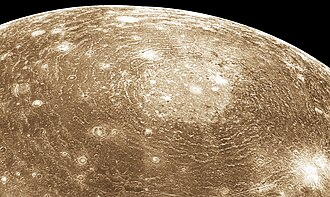
We can learn about the past by looking at Jupiter's moons. Space missions like the Voyager missions found chains of craters on moons like Callisto and Ganymede. These craters were likely made when pieces of comets hit the moons. The first known impact on Jupiter was spotted in the 1600s when an astronomer saw a dark spot on the planet.
Impact events
Main article: Comet Shoemaker–Levy 9
In 1979, a small space rock was captured hitting Jupiter by the Voyager 1 spacecraft. This was the first time scientists saw such an event up close.
The most famous event happened in 1994 when pieces of Comet Shoemaker–Levy 9 crashed into Jupiter. These pieces had broken apart two years earlier. Many telescopes and space tools watched this happen. Even though we couldn’t see it from Earth at first, the Galileo spacecraft could. Over several days, many pieces hit Jupiter, making big dark spots in its clouds. One piece made a spot as wide as Earth!
Since then, more impacts have been seen. In 2009, an amateur astronomer spotted a new dark spot on Jupiter. Other impacts were seen in 2010, 2012, and even up to 2023. These events help scientists learn about objects that fly by our planet and how Jupiter protects our solar system by pulling them in.
| Event | Date (UTC) | Rough original size (meters) | Latitude (°) | Longitude (°) | Discoverer(s) |
|---|---|---|---|---|---|
| Nov 2023 event | 2023/11/15 12:41 | ? | ? | ? | Kunihiko Suzuki |
| Aug 2023 event | 2023/08/28 16:45 | ? | +45 | 128 | OASES Survey PONCOTS Survey |
| Oct 2021 event | 2021/10/15 13:24 | ? | +20 | 201 | Ko Arimatsu |
| Sep 2021 event | 2021/09/13 22:39:30 | ? | −5.5 | 105.7 | José Luis Pereira |
| Apr 2020 event | 2020/04/10 | 1-4 | ? | ? | Juno team |
| Aug 2019 event | 2019/08/07 04:07 | ? | ? | ? | Ethan Chappel |
| May 2017 event | 2017/05/26 19:25 | 12 | +51 | ? | Sauveur Pedranghelu |
| Mar 2016 event | 2016/03/17 00:18:33 | 15 | ? | ? | John McKeon |
| Sep 2012 event | 2012/09/10 11:35:00 | 30 | +2 | 345 | Dan Peterson |
| Aug 2010 event | 2010/08/20 18:22:12 | 10 | +11 | ? | Masayuki Tachikawa Aoki Kazuo |
| Jun 2010 event | 2010/06/03 20:31:20 | 13 | ? | ? | Anthony Wesley |
| Jul 2009 event | 2009/07/19 13:30 | 200–500 | −57 | 55 | Anthony Wesley |
| Jul 1994 Comet Shoemaker–Levy 9 | 1994/07/16 20:13:16 – 1994/07/22 08:06:16 | 1800 | varies for each fragment | Carolyn Shoemaker Eugene Shoemaker David Levy | |
| Mar 1979 event | 1979/03/05 17:45:24 | ? | ? | ? | Voyager team |
Phenomena associated with the impacts
When objects hit Jupiter, they create temporary effects that depend on the size and type of the object. Small objects create bright flashes as they enter Jupiter’s atmosphere, but they don’t change the clouds much.
Larger objects, bigger than about 100 meters, can go deeper into Jupiter’s atmosphere. They release a lot of energy, causing sudden heat and bright light. This can create tall plumes that reach up to 1,000 kilometers high in just seconds. These events can also stir up materials from deep inside the planet. After the impact, dark spots may appear where the object hit. These spots can last for days or even months and sometimes form bands across the planet.
Identification of the impacting body
We can learn about objects that hit Jupiter by studying the changes they cause in the planet’s atmosphere. For example, when Comet Shoemaker–Levy 9 hit Jupiter in 1994, scientists could see the comet before it crashed. In other cases, scientists look at the effects on Jupiter’s atmosphere to guess what the object was.
By studying the chemicals left behind, scientists can tell if the object was a comet — which has lots of water and little silicon — or an asteroid. This helps us understand more about the space rocks and comets that move near Jupiter. An impact in 2009 was very important because it might change how we think about the number of space rocks that cross Jupiter’s path. However, sometimes it’s hard to know exactly what these objects are made of.
Main article: Comet Shoemaker–Levy 9
Impact frequency
Jupiter, being the largest planet in our solar system, experiences impacts from space rocks more often than smaller planets. Scientists have tried to estimate how often these impacts happen. Early guesses suggested that a comet larger than about half a mile wide might hit Jupiter every few hundred years. However, after watching Jupiter closely, we now know impacts happen much more often.
Observations show that smaller space rocks, about the size of a small building, might hit Jupiter several times a year. Even bigger objects, large enough to leave a noticeable mark in Jupiter's clouds for weeks, could strike the planet every few years. These estimates help astronomers understand how active our solar system is and how often planets like Jupiter get visited by objects from space.
Main article: Impact events on Jupiter
Search campaigns
By watching Jupiter for signs of impacts, scientists can learn about the makeup of comets and asteroids, as well as the deeper parts of Jupiter's atmosphere. When a comet or asteroid hits Jupiter, it can leave dark spots on the planet that we can see from Earth. Special cameras and telescopes help us spot these marks, even if they are very small.
Historians have looked back at old records from the 1800s to find more clues about past impacts on Jupiter. Scientists also study Jupiter's rings for hints of past collisions, using data from space probes that have visited the planet.
Jupiter as a "cosmic vacuum cleaner"
The crash of Comet Shoemaker–Levy 9 in 1994 showed how Jupiter acts like a "cosmic vacuum cleaner" for the inner Solar System. Because Jupiter is very big and has strong gravity, many small comets and asteroids crash into it. Scientists think that Jupiter helps protect Earth by pulling these objects away.
Some people think that without Jupiter, Earth might have been hit by more dangerous objects from space. This idea is part of a theory called the Rare Earth hypothesis. However, scientists are still learning exactly how Jupiter affects the space around our planet.
Collisions in mass culture
When people saw impacts happening on Jupiter, they started to worry more about what could happen if something like that hit Earth. Movies like Deep Impact and Armageddon talked about this idea and helped everyone understand it better.
We now know that these kinds of impacts happen more often than we used to think. Thanks to better and cheaper telescopes, everyday stargazers have helped find many of these events.
Images
Related articles


This article is a child-friendly adaptation of the Wikipedia article on Impact events on Jupiter, available under CC BY-SA 4.0.
Images from Wikimedia Commons. Tap any image to view credits and license.