Solar System
The Solar System is the gravitationally bound system of the Sun and the masses that orbit it, most prominently its eight planets, of which Earth is one. It is an isolated single-star planetary system, which means it is not part of a larger star system, and it lies within the Milky Way Galaxy. The system formed about 4.6 billion years ago when a dense region of a molecular cloud collapsed. This created the Sun and a protoplanetary disc, from which the orbiting bodies came together.
The Sun holds 99.86% of the Solar System's total mass. Inside the Sun's core, hydrogen is fused into helium, and the energy released is emitted through the photosphere. This creates the heliosphere and a gradient of decreasing temperature across the Solar System. The next most massive objects of the system are the eight planets, which by definition dominate the orbits they occupy. Closest to the Sun are the terrestrial planets, Mercury, Venus, Earth and Mars, which are part of the inner Solar System. Earth and Mars are the only planets in the Sun's habitable zone, where sunlight can keep surface water liquid under atmospheric pressure. Beyond the frost line, at about five astronomical units (AU), are the planets of the outer Solar System: two gas giants, Jupiter and Saturn, and two ice giants, Uranus and Neptune. Jupiter and Saturn have nearly 90% of the non-stellar mass of the Solar System.
Objects of planetary mass that do not dominate their orbit but directly orbit the Sun are called dwarf planets. The International Astronomical Union's Minor Planet Center lists Ceres, Pluto, Eris, Makemake, and Haumea as dwarf planets. Four other Solar System objects are generally identified as such: Orcus, Quaoar, Gonggong, and Sedna. Less massive still are the many small Solar System bodies, such as asteroids, comets, centaurs, meteoroids, and interplanetary dust clouds. Ceres and many of these smaller bodies lie in the asteroid belt, between the orbits of Mars and Jupiter. The other dwarf planets belong to groups of trans-Neptunian objects, which may be found in the Kuiper belt just outside Neptune or in the further scattered disc.
Many objects in the Solar System do not orbit the Sun directly. Instead, they are natural satellites, commonly called 'moons', of larger bodies. These range in size from planetary-mass moons at their largest to much less massive moonlets at their smallest. The two largest moons, Ganymede of Jupiter and Titan of Saturn, are larger, though less massive, than the smallest planet, Mercury. The seven most massive moons, which include Earth's Moon, are more massive and larger than any of the dwarf planets.
Within the heliosphere, the Solar System is constantly flooded by charged plasma particles of the solar wind. Along with interplanetary dust, gas and cosmic rays, these form an interplanetary medium between the bodies of the Solar System. At around 70–90 AU from the Sun, the solar wind is halted by the interstellar medium, creating the heliopause and the border to interstellar space. The theorized Oort cloud, the source of long-period comets, extends from somewhere beyond 2,000 AU to the outermost region of the Solar System. That region reaches the edge of the Sun's Hill sphere, at 178,000–227,000 AU (2.81–3.59 ly). The Solar System currently moves through a cloud of interstellar medium called the Local Cloud. The closest star to the Solar System, Proxima Centauri, is 269,000 AU (4.25 ly) away. Both are within the Local Bubble, a relatively small region of the Milky Way about 1,000 light-years (ly) wide.
Definition
The Solar System includes the Sun and all objects that are held by its gravity and orbit it.
The International Astronomical Union describes the Solar System as all objects bound by the Sun's gravity, including the Sun itself, its eight planets, and the other bodies that orbit it. NASA describes the solar system as including the Sun and its planetary system.
Capitalization of the name varies. When it is not a proper noun and is written in lowercase, "solar system" may mean the Solar System itself or any planetary system similar to it. The International Astronomical Union, which guides astronomical nomenclature, says the names of all individual astronomical objects should be capitalized. Its naming guidelines, however, use both "Solar System" and "solar system."
Formation and evolution
Main article: Formation and evolution of the Solar System
The Solar System formed at least 4.568 billion years ago, when a region of a large molecular cloud collapsed under its own gravity. The cloud was mostly hydrogen, with some helium and small amounts of heavier elements that earlier generations of stars had fused. As the pre-solar nebula collapsed, conservation of angular momentum made it spin faster, and it flattened into a protoplanetary disc with a hot, dense protostar at its center. Planets formed by accretion, as dust and gas pulled together into bigger and bigger bodies. Many protoplanets may have existed, but they merged, were destroyed, or were thrown out, leaving the planets, dwarf planets, and leftover minor bodies. Close to the Sun, only refractory materials like metals and silicates could stay solid, so the rocky planets Mercury, Venus, Earth, and Mars formed there. The giant planets formed farther out, where volatile icy compounds could stay solid, and they grew large enough to capture thick atmospheres of helium and hydrogen. Within 50 million years, the Sun's center became hot enough for thermonuclear fusion. Its reaction rate and pressure rose until hydrostatic equilibrium was reached, and the Sun became a main-sequence star. Solar wind created the heliosphere and swept the leftover gas and dust out into interstellar space. After the protoplanetary disk dissipated, the Nice model proposes that gravitational encounters caused the giant planets to migrate into different orbits, and the grand tack hypothesis suggests this led to the Late Heavy Bombardment of the inner planets.
The Solar System remains in a fairly stable, slowly changing state, with planets following gravitationally bound orbits around the Sun. It is technically chaotic and may eventually be disrupted, but the chance that another star will pass through it in the next few billion years is small, and it would most likely leave the Solar System much as it is today. The Sun's main-sequence phase will last about 10 billion years, compared with about two billion years for all its later phases before it becomes a remnant. In roughly 5 billion years, the hydrogen in the Sun's core will be used up and turned into helium, ending its main-sequence life. The Sun will then swell into a red giant about 260 times its current width, with a cooler surface (2,600 K (4,220 °F) at its coolest). Its expansion is expected to destroy Mercury and Venus and make Earth and Mars uninhabitable, possibly destroying Earth too. Later, the Sun will burn helium for a much shorter time, but it is not massive enough to fuse heavier elements. Its outer layers will drift off into space, leaving a dense white dwarf about half the Sun's original mass but the size of Earth. These layers may form a planetary nebula, returning material enriched with heavier elements like carbon to the interstellar medium.
General characteristics
Astronomers sometimes split the Solar System into regions. The inner Solar System holds Mercury, Venus, Earth, Mars, and the bodies in the asteroid belt, while the outer Solar System holds Jupiter, Saturn, Uranus, Neptune, and the bodies in the Kuiper belt. The farthest parts are seen as their own region, made of the objects beyond Neptune. The Sun, a G-type main-sequence star, holds 99.86% of the known mass, and the four giant planets hold 99% of what remains. Everything else, including asteroids and comets, adds up to less than 0.002%. Heat and light pressure from the early Sun shaped the system, so objects near the Sun are made of materials with high melting points, while those farther away are made of materials with lower melting points. The frost line marks the boundary beyond which those lower-melting substances could gather, at about five times Earth's distance from the Sun.
Further information: List of Solar System objects and List of interstellar and circumstellar molecules
Most large objects orbit near the invariable plane of the Solar System, close to Earth's path, the ecliptic, and most planets have moons. The largest moons are in synchronous rotation, so one face always points toward their planet. As a result of the formation of the Solar System, most planets and objects orbit in the same direction the Sun turns, with exceptions such as Halley's Comet. Most large moons also move in the prograde direction, but Triton, a moon of Neptune, goes the other way. Kepler's laws of planetary motion describe these paths as ellipses with the Sun at one focus, with the closest point called perihelion and the farthest called aphelion. Those laws ignore the pulls objects have on each other, which numerical models can account for. The angular momentum of the system, its total orbital and rotational momentum, comes mostly from the planets, led by Jupiter. Planets are spaced unevenly, and earlier ideas about their spacing, the Titius–Bode law and Johannes Kepler's model based on Platonic solids, have been overturned by new discoveries. Some Solar System models show these sizes and distances in human terms, from small orreries to the large Sweden Solar System, which uses Avicii Arena in Stockholm as its Sun and places Jupiter at Stockholm Arlanda Airport. In that model, the most distant object, Sedna, is placed in Luleå, and Earth's diameter would be smaller than a flea.
Main article: Planetary habitability in the Solar System
The zone of habitability is in the inner Solar System around Earth, where water can be liquid on planet surfaces. The Sun's interplanetary magnetic field and planetary magnetic fields help partly shield planets from cosmic rays from the interstellar medium. Habitability may also exist in subsurface oceans of some bodies, or in cloud layers, particularly on Venus. Comparisons with TRAPPIST-1, a ultra-cool dwarf star with seven terrestrial planets, and with habitable zones around an F-type main-sequence star, a yellow dwarf, an orange dwarf, and a red dwarf show how these zones differ. Studies of Kepler data place the Solar System among ordered systems, though most observed systems are similar. Unlike many other systems, the Solar System has no super-Earths, and Planet Nine, if it exists, might be one at the system's edge. The Sun is a flare star with weaker flares than similar stars. The Solar System's planets have nearly circular orbits, with low orbital eccentricity, and the causes remain undetermined, though collisions may have shaped early planets. The radial-velocity detection method is one possible factor.
| Planet | Orbital period | Orbital velocity | |
|---|---|---|---|
| (Earth days) | (Earth years) | ||
| Mercury | 87.969 | 0.241 | 47.9 km/s (29.8 mi/s) |
| Venus | 224.701 | 0.615 | 35.0 km/s (21.7 mi/s) |
| Earth | 365.256 | 1.000 | 29.8 km/s (18.5 mi/s) |
| Mars | 686.980 | 1.881 | 24.1 km/s (15.0 mi/s) |
| Jupiter | 4,332.589 | 11.862 | 13.1 km/s (8.1 mi/s) |
| Saturn | 10,759.22 | 29.457 | 9.7 km/s (6.0 mi/s) |
| Uranus | 30,688.5 | 84.020 | 6.8 km/s (4.2 mi/s) |
| Neptune | 60,182 | 164.8 | 5.4 km/s (3.4 mi/s) |
Sun
Main article: Sun
The Sun is the star of the Solar System and by far its most massive part. It has a mass of 332,900 Earth masses, which makes up 99.86% of all the mass in the Solar System. Its core is hot and dense enough for hydrogen to fuse into helium, which releases a huge amount of energy. Most of this energy is radiated into space as electromagnetic radiation, and it peaks in visible light. Because the Sun fuses hydrogen, it is a main-sequence star, and more exactly a G2-type main-sequence star. The "G2" part describes its effective temperature. Hotter stars of this kind are brighter but do not live as long. The Sun's temperature falls between that of the hottest stars and the coolest ones. Stars that are brighter and hotter than the Sun are rare. Much more common are red dwarfs, which are dimmer and cooler and make up about 75% of the stars in the Milky Way.
The Sun is a population I star that formed in one of the galaxy's spiral arms. It contains more "metals," the name astronomers give to elements heavier than hydrogen and helium, than the older stars in the galactic bulge and halo. These heavier elements were made inside ancient stars, so the universe needed earlier stars to die before it could get them. The region shaped by the Sun's magnetosphere is the heliosphere, which covers much of the Solar System. The Sun sends out a steady stream of charged particles, called a plasma and known as the solar wind. This stream fills the space between the planets and creates a thin, dusty layer called the interplanetary medium, which reaches at least 100 AU. Solar flares and coronal mass ejections disturb the heliosphere and cause space weather and geomagnetic storms. When these particles reach Earth's upper atmosphere, they create aurorae near the magnetic poles. The largest stable structure in the heliosphere is the heliospheric current sheet, a spiral shape formed by the Sun's rotating magnetic field.
Inner Solar System
The inner Solar System is the region with the terrestrial planets and the asteroids. It is made mostly of silicates and metals. Its objects are relatively close to the Sun, and the whole region is smaller than the distance between the orbits of Jupiter and Saturn. It lies within the frost line, which is a little less than 5 AU from the Sun.
Inner planets
Main article: Terrestrial planet
The four inner planets are dense and rocky, have few or no moons, and have no ring systems. Venus, Earth, and Mars have atmospheres thick enough to produce weather. Earth is the only place known to have life and surface liquid water. Mercury is the smallest planet, and it has no natural moons. Earth has one natural satellite, the Moon. Mars has two tiny moons, Phobos and Deimos.
Asteroids
Main article: Asteroid
Asteroids, except for the largest, Ceres, are classified as small Solar System bodies. They are made mainly of rock and metal minerals, with some ice. Some asteroids are grouped into asteroid groups and families based on how they orbit.
Asteroid belt
Main article: Asteroid belt
The asteroid belt lies between the orbits of Mars and Jupiter. It is thought to be leftover material from the Solar System's formation that did not join together because of Jupiter's gravity. Spacecraft routinely pass through it without incident.
The three largest bodies in the asteroid belt are Ceres, the only dwarf planet in the belt, Vesta, and Pallas. Ceres is the largest object in the belt, and Vesta is the second largest.
Outer Solar System
The outer region of the Solar System is home to the giant planets and their large moons. The centaurs and many short-period comets also orbit here. Because they are farther from the Sun, solid objects in this region contain more volatiles, such as water, ammonia, and methane, than the planets of the inner Solar System. Their lower temperatures let these compounds stay solid without much sublimation.
Outer planets
Main article: Giant planet
The four outer planets, called giant planets or Jovian planets, make up 99% of the mass orbiting the Sun. All four have several moons and a ring system, though only Saturn's rings are easily seen from Earth. Jupiter and Saturn are made mostly of gases such as hydrogen, helium, and neon, which is why they are called gas giants. Uranus and Neptune are ice giants, made largely of 'ice' in the astronomical sense. These are compounds such as water, methane, ammonia, hydrogen sulfide, and carbon dioxide, which have melting points of up to a few hundred kelvins. Jupiter is the biggest and most massive planet in the Solar System and has 115 confirmed satellites as of 2026. Saturn has a ring system and 293 confirmed satellites. Uranus has 29 confirmed satellites, and Neptune has 16 confirmed satellites. Neptune's largest moon, Triton, is geologically active.
Centaurs
Main article: Centaur (small Solar System body)
The centaurs are icy, comet-like bodies that orbit between Jupiter and Neptune. They are former scattered disc objects and Kuiper belt objects that the outer planets pulled closer to the Sun. Most centaurs are inactive and look like asteroids, but some act like comets, such as 2060 Chiron. The largest known centaur, 10199 Chariklo, is about 250 km (160 mi) across.
Trans-Neptunian region
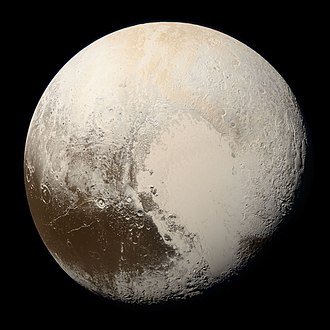
Beyond the orbit of Neptune lies the trans-Neptunian region. It includes the doughnut-shaped Kuiper belt, home to Pluto and several other dwarf planets, and an overlapping disc of scattered objects. The scattered disc is tilted toward the plane of the Solar System and reaches much further out. The whole region is still largely unexplored. It seems to be made of many thousands of small worlds, mostly rock and ice, and the largest has a diameter only a fifth that of Earth. Some call this the "third zone of the Solar System." The Kuiper belt is a great ring of icy debris, similar to the asteroid belt, that lies 30 to 50 AU from the Sun. It can be divided into the "classical" belt and the resonant trans-Neptunian objects. Pluto is the largest known object there and has five moons: Charon, Styx, Nix, Kerberos, and Hydra. Charon is sometimes described as part of a binary system with Pluto, since the two orbit a barycenter of gravity above their surfaces. Five Kuiper belt objects are considered dwarf planets, including Orcus, Haumea, Makemake, and Quaoar.
The scattered disc overlaps the Kuiper belt but reaches out to near 500 AU, and it is thought to be the source of short-period comets. Two of its bodies are dwarf planets: Eris, which is the largest known scattered disc object, and Gonggong. Some objects have very large orbits and are called extreme trans-Neptunian objects, or ETNOs. The first one discovered was Sedna, which Mike Brown found in 2003. Some astronomers have suggested that a large planet beyond Neptune, called Planet Nine, may explain some patterns in these orbits, while others credit them to coincidence. The Oort cloud is a theorized spherical shell of up to a trillion icy objects that may be the source of all long-period comets. No direct observation of it is possible with present imaging technology, and the Voyager 1 probe is expected to reach it in 300 years.
Main article: Kuiper belt
Main article: Scattered disc
Main article: Extreme trans-Neptunian object
Gravitationally unstable populations
Main articles: Meteoroid, Interplanetary dust cloud, and Cosmic dust
Small solid objects in space, up to about one meter across, are usually called meteoroids. Even smaller grains are often called micrometeoroids, but since 2017 the IAU has used the name "dust particles" for anything smaller than about 30 micrometers. Most meteoroids are made of rock-like materials called silicates and heavy metals such as nickel and iron. When a meteoroid crosses an atmosphere, it makes a bright streak in the sky called a meteor. When many meteoroids enter the atmosphere along parallel paths, the meteors seem to come from one point in the sky, creating a meteor shower. The inner Solar System has a hazy zodiacal dust cloud, which can be seen as zodiacal light in dark skies. The outer Solar System has a cosmic dust cloud that stretches from about 10 to 40 AU from the Sun.
Main article: Comet
Comets are small bodies in the Solar System, usually only a few kilometers across, made mostly of icy material that holds gas and dust. Their orbits are very stretched out. When a comet comes close to the Sun, its icy surface turns straight into gas and becomes charged particles, forming a coma, a long tail that can often be seen with the naked eye. Short-period comets take less than two hundred years to orbit the Sun, while long-period comets take thousands of years. Comets such as Hale–Bopp are thought to come from the Oort cloud, and groups like the Kreutz sungrazers formed when a single comet broke apart. Some comets follow unusual open paths and may come from outside the Solar System.
Boundary region and uncertainties
See also: List of Solar System objects by greatest aphelion
Much of the outer Solar System is still unknown. The region beyond 100 AU is almost unexplored, and it is hard to study. Scientists learn about it mainly from the few objects whose orbits are changed so that they come closer to the Sun. Even then, these objects have often been found only when they became bright enough to be seen as comets. Many objects in the outer region have yet to be discovered. The Sun's Hill sphere is thought to reach out to about 230,000 AU from the Sun, and it is believed to include the Oort cloud. The outer edges of the Solar System meet the galaxy at the boundaries of the heliosphere and the Hill sphere, where they touch the interstellar medium.
Edge of the heliosphere
The Sun's stellar-wind bubble, called the heliosphere, is a region of space dominated by the Sun. Its edge is the termination shock. Because of the Sun's peculiar motion relative to the local standard of rest, this edge is about 80–100 AU from the Sun on the upwind side and about 200 AU on the downwind side. Here the solar wind meets the interstellar medium, slows down, becomes denser, and becomes more turbulent, forming a large oval structure known as the heliosheath. The heliosheath may look like a comet's tail, and Cassini and Interstellar Boundary Explorer data suggest it is pushed into a bubble shape, though its actual shape is still unknown. The outer edge is likely shaped by fluid dynamics and by solar magnetic fields, so the northern side reaches 9 AU farther than the southern side. The heliopause is considered the start of the interstellar medium, and beyond it, at about 230 AU, lies the bow shock.
Celestial neighborhood
Main articles: List of nearest stars, List of nearest exoplanets, and List of nearby stellar associations and moving groups
Within 10 light-years of the Sun, there are only a few stars. The closest is the triple star system Alpha Centauri, about 4.4 light-years away, which may be in the G-Cloud of the Local Bubble. Alpha Centauri A and B are a closely tied pair of Sun-like stars. The closest star to the Sun is the small red dwarf Proxima Centauri, which orbits the pair at a distance of 0.2 light-years. In 2016, a possibly habitable exoplanet called Proxima Centauri b was found orbiting Proxima Centauri. It is the closest confirmed exoplanet to the Sun. The Solar System is surrounded by the Local Interstellar Cloud, though it is not clear whether it is inside the cloud or just outside its edge. Many other interstellar clouds are found within 300 light-years of the Sun, in the region known as the Local Bubble. The Local Bubble is an hourglass-shaped superbubble about 300 light-years across, filled with very hot gas that may have come from several recent exploding stars.
The Local Bubble is small compared with the nearby Radcliffe Wave and the Split structures (formerly the Gould Belt), which are each thousands of light-years long. All of these are part of the Orion Arm, which holds most of the stars in the Milky Way that can be seen with the naked eye. Stars form in groups called star clusters and later spread out into looser groups that move together. A well-known group visible to the naked eye is the Ursa Major moving group, about 80 light-years away within the Local Bubble. The nearest star cluster is the Hyades, at the edge of the Local Bubble. The closest star-forming regions are the Corona Australis Molecular Cloud, the Rho Ophiuchi cloud complex, and the Taurus molecular cloud, which lies just beyond the Local Bubble and is part of the Radcliffe Wave. Stars passing within 0.8 light-years of the Sun happen about once every 100,000 years. The closest well-measured approach was by Scholz's Star, which came to about 50,000 AU of the Sun around 70,000 years ago, likely passing through the outer Oort cloud. There is a 1% chance every billion years that a star will pass within 100 AU of the Sun, which could disrupt the Solar System.
Galactic position
See also: Location of Earth, Galactic year, and Orbit of the Sun
The Solar System is located in the Milky Way, a barred spiral galaxy about 100,000 light-years across that contains more than 100 billion stars. The Sun is part of one of the outer spiral arms, known as the Orion–Cygnus Arm or Local Spur, and it is a member of the thin disk group of stars that orbit close to the galactic plane. The Sun travels around the center of the Milky Way at about 220 km/s, so it completes one trip every 240 million years. This trip is called a galactic year. The Sun moves toward the solar apex, near the constellation Hercules in the direction of the bright star Vega. The plane of the ecliptic is tilted at about 60° to the galactic plane.
The Sun follows a nearly circular orbit around the Galactic Center, where the supermassive black hole Sagittarius A* is found, at a distance of 26,660 light-years. If the Sun orbited closer to the center, gravity from nearby stars could send many comets from the Oort cloud into the inner Solar System, and the intense radiation there could make it harder for complex life to develop. The Solar System's location also affects the evolutionary history of life on Earth. Spiral arms have far more supernovae, but Earth stays in the Local Spur, which has given it long periods of stability for life to evolve. The controversial Shiva hypothesis suggests that the changing position of the Solar System could explain periodic extinction events on Earth.
Discovery and exploration
Main article: Discovery and exploration of the Solar System
Humanity's knowledge of the Solar System has grown step by step over the centuries. The ancient Greek philosopher Aristarchus of Samos had guessed that the Sun might be at the center, but from the Late Middle Ages–Renaissance, astronomers from Europe to India believed Earth was stationary at the center of the universe. Nicolaus Copernicus was the first person known to have developed a mathematically predictive heliocentric system, a model with the Sun at the center. His idea did not win over everyone at once, but he had supporters, especially Johannes Kepler. Kepler used a Sun-centered model, improved by making orbits oval-shaped, together with the careful measurements of Tycho Brahe, to produce the Rudolphine Tables, which allowed accurate calculations of where the known planets would be. Pierre Gassendi used them to predict a transit of Mercury in 1631, and Jeremiah Horrocks did the same for a transit of Venus in 1639. These predictions strongly supported the Sun-centered idea and Kepler's oval orbits. In the 1600s, Galileo helped bring the telescope into astronomy, and he and Simon Marius each found that Jupiter had four moons. Christiaan Huygens found Saturn's moon Titan and the shape of the rings of Saturn. In 1677, Edmond Halley saw Mercury cross the Sun, and he realized that the solar parallax of a planet, best measured with a transit of Venus, could be used to trigonometrically find the distances between Earth, Venus, and the Sun. Halley's friend Isaac Newton, in his great book Principia Mathematica of 1687, showed that the heavens are not fundamentally different from Earth, because the same laws of motion and gravity apply both here and in the skies.: 142
The term "Solar System" entered the English language by 1704, when John Locke used it for the Sun, planets, and comets. In 1705, Halley realized that sightings of a comet over the years were of the same object, which returned about every 75–76 years. This was the first evidence that something other than the planets orbited the Sun again and again, although Seneca had suggested this about comets in the 1st century. Careful observations of the 1769 transit of Venus helped astronomers calculate the average Earth–Sun distance as 93,726,900 miles (150,838,800 km), only 0.8% more than today's value. Uranus had been seen now and then since 1690, and possibly even in ancient times, and by 1783 it was recognized as a planet beyond Saturn. In 1838, Friedrich Bessel measured a stellar parallax, a small shift in a star's apparent position caused by Earth's movement around the Sun, which gave the first direct proof of heliocentrism. Neptune was identified as a planet in 1846, because its pull caused a small but measurable change in Uranus's orbit. Mercury's orbital anomaly led scientists to search for Vulcan, a planet inside Mercury's orbit, but these searches ended when Albert Einstein's theory of general relativity appeared in 1915. In the 20th century, humans began exploring the Solar System, starting with telescopes in space in the 1960s. By 1989, all eight planets had been visited by space probes. Probes have returned samples from comets and asteroids, flown through the Sun's corona, and visited two dwarf planets, Pluto and Ceres. To save fuel, some missions use gravity assist maneuvers, such as the two Voyager probes, which sped up when flying past planets in the outer Solar System, and the Parker Solar Probe, which slowed down closer to the Sun after its flyby of Venus. Humans landed on the Moon during the Apollo program in the 1960s and 1970s and are planning to return in the 2020s with the Artemis program. Discoveries in the 20th and 21st centuries led to a redefinition of the term planet in 2006, which reclassified Pluto as a dwarf planet, and to more interest in trans-Neptunian objects.

Quiz time!
5 questions about Solar System
Which part of the Solar System holds most of its mass?
Pictures
Keep exploring



This article is a child-friendly adaptation of the Wikipedia article on Solar System, available under CC BY-SA 4.0.
Images from Wikimedia Commons. Tap any image to view credits and license.