International Mercantile Marine Company
The International Mercantile Marine Company, first called the International Navigation Company, was a trust formed in the early 1900s. J.P. Morgan created it as an attempt to monopolize the shipping trade.
Several shipping leaders founded the company. They were Clement Griscom of the American Line and Red Star Line, Bernard N. Baker of the Atlantic Transport Line, J. Bruce Ismay of the White Star Line, and John Ellerman of the Leyland Line. The Dominion Line was also combined into the company. The project was paid for by J.P. Morgan & Co., which was led by the financier J. P. Morgan. The company also had profit-sharing partnerships with the German Hamburg-Amerika and North German Lloyd lines. The trust worried the British shipping industry. It also led directly to the British government giving a subsidy to the Cunard Line's new ships, RMS Lusitania and RMS Mauretania, so they could compete.
IMM was a holding company, which means it controlled other companies that had their own subsidiaries. Morgan hoped to dominate transatlantic shipping through interlocking directorates and agreements with the railroads. This proved impossible because of the nature of sea transport, American antitrust laws, and an agreement with the British government. One of IMM's subsidiaries was the White Star Line, which owned the RMS Titanic.
A proposed subsidy bill in the United States Congress failed, and this became widely clear by April 1902. The company was never truly successful. Analysis of financial records shows that IMM was overleveraged and had inadequate cash flow, which caused it to miss bond interest payments in late 1914. As a result, a "friendly" receivership was put in place in 1915, which allowed IMM to reorganize its finances. It came out of receivership in 1916.
IMM was saved by World War I. After a merger with the Roosevelt Steamship Company, it eventually re-emerged as the United States Lines, which itself went bankrupt in 1986.
History
As the shipping business grew in the late 1800s, some people wanted to form a trust that would control U.S. shipping companies, but talks in the 1890s did not succeed. The involvement of John Pierpont Morgan, one of the richest men in the world, changed that. In December 1900, the Atlantic Transport Line joined the International Navigation Company, which ran the Red Star Line and the American Line under Clement Griscom. In 1902, J. P. Morgan & Co. announced the founding of the International Mercantile Marine Company, usually called IMM, which was incorporated in New Jersey. Morgan could not directly own British ships, but he could own the company that owned them. Rivalry with British and German companies grew, and in 1908 Harland & Wolff was authorized to build the White Star Line's Olympic-class ocean liner trio: RMS Olympic, RMS Titanic, and HMHS Britannic. Lord Pirrie of Harland & Wolff had an agreement with IMM that the company's ships would be built there. In 1904, Joseph Bruce Ismay replaced Griscom as president. Ismay was also president of the White Star Line.
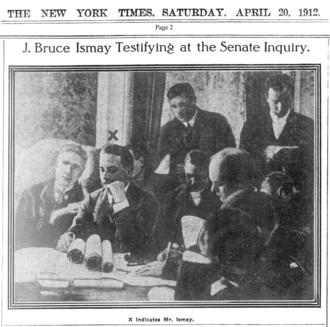
On 15 April 1912, the Titanic, the flagship of the fleet, sank during her maiden voyage. The sinking caused large financial and human losses and changed how the trust was organized. During the American commission of inquiry, Senator William Alden Smith openly criticized the company and Morgan. Ismay retired as president in 1913, as had been arranged before the sinking, and was succeeded by Harold Sanderson. Morgan died on 31 March 1913. The company went into receivership in 1915, and Philip Franklin managed to save it. In 1926, IMM sold the White Star Line to the Royal Mail Steam Packet Company. In 1931, IMM merged with the Roosevelt Steamship Company to form Roosevelt International Mercantile Marine Company, and later that year it acquired the troubled United States Lines. The Atlantic Transport Line was dissolved in 1931, and other companies were merged, sold, or dissolved through the 1930s. In 1943, the company was renamed United States Lines Inc. and focused on transatlantic routes.
Presidents
Several people led the company over the years. Clement A. Griscom was president from 1902 to 1904, followed by J. Bruce Ismay from 1904 to 1913, and Harold Sanderson from 1913 to 1915. From 1915 to 1916 the company was in receivership. Philip Albright Small Franklin then served as president from 1916 to 1936, and John A. Franklin served from 1936 to 1943.
In 1943, the company became United States Lines Inc.
Companies owned by IMM
- American Line: 1873–1932
- Inman Line: 1886–1893
- American Merchant Line: 1924–1938
- Holland America Line: 51% share owned 1902–1917
- Atlantic Transport Line: 1901–1931
- Baltimore Mail Line: 1930–1937
- Dominion Line: 1902–1926
- Leyland Line: 1902–1927
- Panama Pacific Line: 1915–1938
- Red Star Line: 1871–1934
- Roosevelt Steamship Company: 1931–1940
- United States Lines: 1931–1943 (continued as IMM's successor company)
- White Star Line: 1902–1927

Quiz time!
5 questions about International Mercantile Marine Company
Why did J.P. Morgan create the International Mercantile Marine Company?
Pictures
Keep exploring


This article is a child-friendly adaptation of the Wikipedia article on International Mercantile Marine Company, available under CC BY-SA 4.0.
Images from Wikimedia Commons. Tap any image to view credits and license.