Kalanos
Kalanos, also spelled Calanus (Ancient Greek: Καλανός) (c. 398 – 323 BCE), was an ancient Indian gymnosophist, sage, and philosopher from Taxila. He accompanied Alexander the Great and was his teacher. He traveled with Alexander to Persis. Diodorus Siculus called him Caranus (Ancient Greek: Κάρανος).
Kalanos communicated to Alexander that he would meet him in Babylon. Alexander died exactly a year later in Babylon.
It was from Kalanos that Alexander learned of Dandamis, the leader of their group, whom Alexander later went to meet in the forest.
Early life
Plutarch indicates that his real name was Sphínēs and that he was from Taxila. Because he greeted people with the word "Kalē!", perhaps related to kalya (कल्य) meaning "Greetings," the Greeks called him Kalanos.
Most sources and scholars refer to Kalanos as a Brahmin sage. Some scholars have claimed that he was a Jain, but modern scholarship rejects this idea. Considering the dominant Brahmanical presence in Taxila, it is likely that the ascetics Alexander met, including Kalanos, were Brahmanical. Johannes Bronkhorst states that it is highly unlikely that Buddhists and Jains were present in the areas Alexander visited.
Meeting Alexander
Plutarch wrote that when Kalanos was first invited to meet Alexander, he roughly ordered Alexander to take off his clothes and listen to him naked, or he would not speak a word to him, even though Alexander came from Jupiter himself. Kalanos refused the rich gifts Alexander offered, saying that such gifts could not satisfy a person's desires. The gymnosophists believed that even if Alexander killed them, they would be freed from their aging bodies and move on to a better and purer life. Alexander's representative Onesicritus talked with several gymnosophists. Alexander liked their ideas about Greek philosophy, which they mostly approved of, but they criticized the Greeks for valuing custom over nature and for refusing to give up clothing.
Alexander asked Kalanos to travel with him to Persis and stay as one of his teachers. Alexander even hinted that he might use force to take Kalanos to his country. Kalanos calmly replied that he would be of little use to Alexander as a display for the Greeks if he was forced to do what he did not want to do. Kalanos lived as a teacher to Alexander and represented "eastern honesty and freedom".
Death and prophecy
Kalanos was seventy-three years old when he died. Alexander's admirals, Nearchus and Chares of Mytilene, also mention him. He gave his horse to one of his Greek pupils, Lysimachus. His last words to Alexander were "We shall meet in Babylon." He is said to have prophesied Alexander's death in Babylon, even though Alexander had no plans to go to Babylon at the time of Kalanos' death.
A drinking contest was held after his death. According to Plutarch's account, citing Chares of Mytilene, Promachus of Macedon drank the equivalent of 13 litres of unmixed wine and won first prize, a golden crown worth a talent. He died three days later, and forty-one other contestants allegedly died of alcohol poisoning as well.
Legacy
A letter written by Kalanos to Alexander is preserved by Philo.
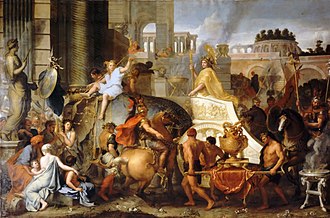
A painting from around 1672 by Jean Baptiste de Champaigne shows Alexander the Great receiving news of the death of the sage Calanus. It is displayed at the Chateau de Versailles et de Trianon in Versailles.

Quiz time!
5 questions about Kalanos
Where was Kalanos from?
Keep exploring




This article is a child-friendly adaptation of the Wikipedia article on Kalanos, available under CC BY-SA 4.0.