 Safekipedia
Kerala
Adapted from Wikipedia · Discoverer experience
Kerala is a beautiful state located on the Malabar Coast of southern India. It was officially created on 1 November 1956, bringing together areas where people speak the Malayalam language. The state covers an area of 38,863 square kilometers and shares borders with Karnataka to the north and northeast, Tamil Nadu to the east and south, and the Laccadive Sea to the west. With about 33 million people, Kerala is the 13th most populous state in India and has Thiruvananthapuram as its capital city.
For thousands of years, Kerala has been known for its spices, trading with people from faraway lands since 3000 BCE. Many famous travelers and traders, including the Portuguese, visited its shores. Today, Kerala is famous for its beautiful beaches, peaceful backwaters, and green hill stations, making it a popular place for visitors. The state also grows important crops like coconut, tea, coffee, and black pepper, and many people rely on fishing along its long coastline. Kerala is also known for having a high standard of living, with good education, health care, and a strong sense of community among its people.
Name
The word Kerala was first written as Keralaputo meaning 'son of Chera' in an old rock writing from the time of Emperor Ashoka. Back then, one of the three areas in the region was called Cheralam. The word Cheral comes from an old Tamil word for 'lake'.
People have wanted to change the name to Keralam, which is what the state is called in the local Malayalam language. In June 2024, everyone in the Kerala Legislative Assembly agreed to change the name to Keralam. If this change happens, the state's name will officially become Keralam after approval from India’s Parliament.
History
Main article: History of Kerala
Legend
In old stories from Hindu tales, the lands of Kerala were said to have been made from the sea by a wise warrior named Parashurama. He is known as the sixth hero of Vishnu. According to the story, Parashurama used his axe to push back the sea and create new land. This land was salty and hard to live on, so he asked a snake king named Vasuki to help. Vasuki spit holy poison on the land, making it fertile and good for growing food. Because of this, snakes are respected in Kerala as protectors of the land.
Another important hero in these stories is Mahabali, a fair king who ruled the earth from Kerala. He was a very good ruler, but he fought with the gods and was sent to live far underground. People believe that Mahabali returns to Kerala once a year, and this is celebrated as the Onam festival.
Pre-history
Long ago, much of what is now Kerala was under the sea. Fossils found near Changanassery suggest this. Early people lived in Kerala during very old times, as shown by special stones and drawings found in places like Marayur and Wayanad. These discoveries show that people have lived in Kerala since the very early days, and they had contact with other places far away.
Ancient history
Kerala has been a place where valuable spices grew for thousands of years. These spices were wanted by people from far away, like those from Babylon, Assyria, and Egypt. Arab and Phoenician traders also came to Kerala to buy spices. The land was known as Keralaputra, and it was one of the four kingdoms in southern India at the time of a famous ruler named Emperor Ashoka. The main rulers were the Cheras, who were based in Kerala. The southern part was controlled by the Pandyas. The coast became a busy place for trade with Greece, Rome, and China. Important ports like Muziris were places where ships from Rome came to buy pepper with gold.
People from West Asia and Southern Europe set up small towns along the coast. Jews have been in Kerala since around 573 BCE. Arab traders came to Kerala from at least the 4th century BCE. In the 4th century CE, some Christians from Persia also came and joined the early Syrian Christian community. These groups became known as Mappilas.
Medieval period
A new Chera kingdom began around 800 and lasted until 1102. It was also called the Kulasekhara dynasty. During this time, Kerala grew in art, writing, trade, and religion. The kingdom was divided into areas ruled by local leaders. In the 11th century, fights between the Cheras and Cholas hurt trade. Buddhism and Jainism, which were once there, mostly disappeared. Social groups became more separated. The Chera kingdom ended in 1102 after attacks by the Pandyas and Cholas. Later, small kingdoms like Samuthiri, Venad, and Kochi became powerful. In the 18th century, King Marthanda Varma of Travancore brought many lands together under his rule. The British took control of some areas, and by the end of the 18th century, all of Kerala was either ruled by the British or under their influence.
Colonial rule
For many years, Arab traders controlled the spice trade in the Indian Ocean. This changed when Europeans began looking for new trade routes. In 1498, a Portuguese sailor named Vasco Da Gama arrived in Kerala. The ruler of Kozhikode allowed the Portuguese to trade, but later they fought with local traders. The Portuguese then made an alliance with Kochi. They built forts and faced battles with local naval forces. The Portuguese were later replaced by the Dutch, who also had to fight local rulers. In 1741, the Dutch lost a big battle and had to leave. Marthanda Varma of Travancore became a strong ruler.
In the late 1700s, rulers from Mysore tried to take over parts of Kerala, leading to wars with the British. By the early 1790s, the British took control of some areas. In the 20th century, Kerala was part of movements for India’s independence. In 1936, a rule was made that allowed all Hindus to enter temples, no matter their social group.
State of India
After India became independent in 1947, the states of Travancore and Kochi joined India. On 1 November 1956, several areas came together to form the state of Kerala. In 1957, Kerala had one of the world’s first elected governments led by people who believed in sharing power equally.
Geography
Main article: Geography of Kerala
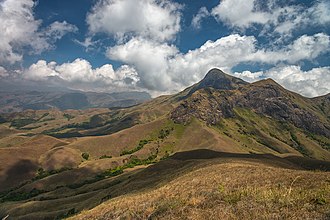
Kerala is a state on the southern coast of India, bordered by the Laccadive Sea to the west and the Western Ghats to the east. It lies between latitudes 8°18' and 12°48' and longitudes 74°52' and 77°22'. The land includes highlands, midlands, and coastal plains. The highest peak is Anamudi, standing tall in the Western Ghats.
The state has many rivers and lakes, including the long Vembanad lake. Kerala's coast has beautiful beaches and areas with natural resources like gold and minerals. The land is also home to rich forests and many different kinds of plants and animals, with parts protected to keep them safe.
Climate
Kerala has a wet climate with many rainy days each year, mostly from the southwest summer monsoon and northeast winter monsoon. The rains bring plenty of water, especially from June to August. Some areas get more rain, especially in the mountains, while others are drier. The temperature stays warm, ranging from about 20°C to 37°C.
Flora and fauna
Main article: Flora and fauna of Kerala
Kerala's forests are home to many plants and animals. The Western Ghats protect much of this richness. The state has thousands of plant species, many of which grow only here. Animals include mammals like Indian elephant and Bengal tiger, birds such as the Malabar trogon, and many fish and insects. These species face threats from habitat loss, so many areas are protected to help them survive.
Regions, districts and cities
Main articles: Administrative divisions of Kerala, Districts of Kerala, List of revenue divisions of Kerala, List of taluks of Kerala, and List of cities and towns in Kerala
See also: Local government in Kerala
Kerala has 14 districts grouped into six regions: North Malabar, South Malabar, Kochi, Northern Travancore, Central Travancore and Southern Travancore. These districts are divided into smaller areas called revenue divisions and taluks, which help manage local areas and keep records.
Kerala also has local governments that help manage towns and villages. Some important cities in Kerala include Thiruvananthapuram, Kozhikode, Kochi, Kollam, Thrissur, and Kannur. These cities are known for having good health, education, and public services.
Government and administration
See also: Politics of Kerala, Political parties in Kerala, and Elections in Kerala
Kerala is governed by a system where people choose their leaders. The state has one main group of elected leaders called the Kerala Legislative Assembly, with 140 members who serve for five years. Kerala also sends leaders to the national government in New Delhi.
The government of Kerala is led by a chief minister, who is chosen by the elected leaders. The chief minister and other leaders work together to make and carry out laws. There are many departments that help with different areas like health, education, and roads. Each department is led by a minister and supported by experienced workers.
Local government
Main article: Local government in Kerala
Local leaders in towns and villages help manage everyday matters like cleaning streets and organizing schools. These local leaders are chosen by people living in the area. Kerala has many local groups that work to support their communities.
Politics
Kerala has two main groups of political leaders. One group is led by the Indian National Congress, and the other is led by the Communist Party of India (Marxist). People in Kerala choose which group they want to lead the state.
Economy
Main article: Economy of Kerala
After India gained independence, Kerala was managed with a focus on social and welfare programs. This led to what is called the "Kerala model" of development, where the state has very high human development but lower economic growth compared to others. This is largely because its economy relies heavily on services.
In 2019–2020, Kerala had the 8th-largest economy in India, with a total value of about US$90 billion. About 63% of the state’s economy came from services, 28% from industry, and 8% from farming. During the years 1960 to 2020, Kerala’s economy changed from mainly farming to one based more on services.
The service sector includes tourism, healthcare, education, technology, and transportation. Major industrial efforts include shipbuilding, oil refining, and food processing. Kerala grows a lot of important crops like coconut, tea, coffee, and spices.
Kerala’s economy also depends on people who work in other countries, mostly in the Arab states of the Persian Gulf. Their money sent home makes up more than a fifth of the state’s economy. This has been important since the 1970s and 1980s.
Industries
Traditional industries such as coir, handlooms, and handicrafts employ many people. Kerala makes 60% of the world’s white coir fibre. There are many small and medium businesses that employ thousands. Other important sectors include tourism, healthcare, education, banking, shipbuilding, oil refining, and business services.
Agriculture
The big change in farming in Kerala happened in the 1970s when rice farming dropped because rice was more available across India and there were fewer workers. Because of this, land was used more for growing trees and seasonal crops instead of rice.
Today, Kerala grows a lot of important crops. It makes 97% of India’s black pepper and 85% of its natural rubber. Coconut, tea, coffee, and spices like cardamom and cinnamon are also major products. Coconut farming is very important, and Kerala leads in growing coconuts. Most of India’s cardamom comes from Kerala as well. Rice is still grown in many fields, and home gardens are a big part of farming.
Fisheries
With a long coastline and many fishing villages, Kerala is a top fish producer in India. Thousands of people work in fishing and related jobs. The fishing industry helps about 3% of the state’s economy. During the southwest monsoon, special conditions make fishing very good. Fishermen catch many kinds of fish, including pelagic species, demersal species, crustaceans, and molluscs.
Transportation
Roads
Main article: Roads in Kerala
See also: Kerala State Road Transport Corporation
Kerala has many roads, covering a total of 331,904 kilometres. This is about 5.6% of all roads in India. The roads in Kerala include national highways, state highways, district roads, urban roads, and rural roads. The state’s largest checkpoint is on NH 544, connecting many important places.
Railways
Main article: List of Railway Stations in Kerala
See also: Kochi Metro
The Southern Railway zone operates all railway lines in Kerala, connecting most major towns and cities. Thiruvananthapuram Central is the busiest railway station in the state. Some of the major railway stations include Ernakulam Junction, Kozhikode, Kollam Junction, and Thrissur.
Airports
Main article: List of airports in Kerala state
Kerala has four international airports: Thiruvananthapuram International Airport, Cochin International Airport, Calicut International Airport, and Kannur International Airport. Cochin International Airport is the busiest in the state and is powered by solar energy.
Water transport
Main article: Ports in Kerala
See also: Kochi Water Metro
Kerala has two major ports, several intermediate ports, and many minor ports. The major port is at Kochi. The state also has a network of inland waterways and the first water metro in India, called Kochi water metro, which connects islands with electric ferries. The West-Coast Canal is the longest waterway in the state, stretching from Kasaragod to Poovar.
Demographics
Main article: Demographics of Kerala
See also: Ethnic groups in Kerala and List of people from Kerala
Kerala is home to a large portion of India's population. It is very crowded, with many people living close together. Thiruvananthapuram is the biggest city in Kerala. The state has one of the lowest rates of population growth in India. Many people in Kerala live near the coast, while the hill areas have fewer people. Kerala is among the most urbanized states in India, with many people living in cities.
Gender
In Kerala, there is a tradition where the mother is often the head of the family. This has helped women in Kerala have more influence and opportunities, such as education and jobs. These opportunities lead to smaller families, which in turn helps women and children even more. Kerala has one of the highest rates of women living longer and being healthier. However, women still do not have full equal rights, and there are attitudes that suggest women need to be protected.
Human Development Index
See also: Kerala Model
Kerala has made great progress in areas like education, health, and reducing poverty. It has one of the highest Human Development Index scores in India, meaning people there live long, healthy lives with good education. Kerala has the highest literacy rate in India, with most people able to read and write. The state also works hard to care for its people, providing health services and helping reduce poverty. Kerala is known for being one of the cleanest and healthiest states in India.
Language
Malayalam is the main language spoken in Kerala. There are also many people who speak Tamil, Tulu, and Kannada, especially in certain areas.
Religion
Main article: Religion in Kerala
Kerala has many different religions, including Hinduism, Islam, and Christianity. The state is known for its religious diversity and harmony. Hinduism is the most practiced religion, but Islam and Christianity also have many followers. Kerala has a long history of different religious groups living together peacefully.
Education
Main article: Education in Kerala
The Kerala school of astronomy and mathematics made important discoveries in math between the 14th and 16th centuries. In the 1800s, missionaries began helping people learn to read and write. Leaders helped everyone, no matter their background, get access to education.
By 1991, Kerala was the first state in India where everyone could read and write. By 2016, all children in Kerala could finish their first years of school. Students usually study for 10 years, split into three parts, before choosing to study arts, commerce, or science. Most schools follow rules set by the Kerala Board of Public Examination, but some use other sets of rules too.
University of Kerala at Thiruvananthapuram
Culture
Main article: Culture of Kerala
The culture of Kerala is rich and unique. It mixes ideas from many places, including Aryan, Dravidian, Arab, and European traditions. This mix created a special way of life, art, building styles, language, books, and social habits in Kerala. Over 10,000 festivals happen in Kerala each year. The Malayalam calendar helps people plan farming and religious events. Malayalam is the main language spoken here.
Festivals
Main articles: Temple Festivals of Kerala and Onam
Many temples in Kerala celebrate festivals on certain days. During these festivals, a special holy flag is raised and later taken down. One famous festival is the Thrissur Pooram, known for elephants, fireworks, and big crowds. Other festivals include Makaravilakku, Chinakkathoor Pooram, Attukal Pongala, and Nenmara Vallangi Vela.
Onam is a big harvest festival in Kerala. It lasts ten days and is celebrated with many fun activities like Vallam Kali, Pulikali, making floral designs called pookkalam, and more.
Music and dance
Main articles: Arts of Kerala and Music of Kerala
Kerala has many traditional dances and music styles. Five classical dances started in old temple theaters. Other dances include Oppana and Margamkali. Music in Kerala often comes from temple traditions. Carnatic music is very popular here.
Cinema
Main article: Malayalam cinema
Malayalam films often show important social issues. Many famous directors and actors come from Kerala, contributing to Indian cinema. The industry has received many awards for acting, films, and directing.
Literature
Main article: Malayalam Literature
Malayalam literature began long ago and includes ancient ballads and modern books. Important writers helped shape the language and its stories. Today, Malayalam books often talk about social and political topics.
Cuisine
Main article: Cuisine of Kerala
Kerala food uses many spices and includes both vegetarian and non-vegetarian dishes. Rice is a main part of meals. Breakfast might include idli, dosa, or puttu. Lunch often has rice with curries like rasam and sambar. Popular snacks include banana chips and tapioca chips. Seafood is also a big part of Kerala’s cooking.
Media
Main article: Media in Kerala
Kerala has a lot of newspapers, television channels, and internet services. The Telecom Regulatory Authority of India makes sure everything runs smoothly. Kerala has more newspapers and TV channels than any other state in India. Popular newspapers are written in Malayalam and English, and some well-known ones are Malayala Manorama, Mathrubhumi, and Deshabhimani.
There are many TV channels too, like DD Malayalam, Asianet, and Surya TV. With lots of internet users, people in Kerala also enjoy watching shows and movies online through Digital media, social media, and OTT services. Big companies like BSNL, Airtel, and Jio provide cell phone service across the state.
Sports
Main article: Sports in Kerala
Many traditional games from Kerala have become art forms shown at festivals. One exception is Kalaripayattu, a martial art that is still practiced today. Another popular sport is boat racing, especially with big snake boats.
Cricket and football became popular in Kerala during British rule in the 1800s. Many players from Kerala have joined the national cricket and football teams. Kerala also has its own football clubs that many people support. The state has produced many famous athletes in different sports, including track and field, volleyball, badminton, basketball, and kabaddi. Some of these athletes have won important awards for their achievements. Kerala's stadiums have hosted big international matches, such as games in the 2017 FIFA U-17 World Cup.
Tourism
Main article: Tourism in Kerala
Kerala is a very popular place for people to visit in India. Its beautiful beaches, calm backwaters, lakes, mountains, waterfalls, old ports, palaces, special places for different religions, and wildlife areas attract many tourists from India and other countries. The city of Kochi is the top place in Kerala for both international and local visitors.
In the past, Kerala was not as well known as other places in India. But in 1986, the government made tourism very important. They started advertising campaigns that called Kerala Kerala, God's Own Country. These efforts helped make Kerala famous around the world. Today, Kerala is known for its natural beauty and peaceful places to visit. Many people also come to Kerala for special health treatments and to enjoy activities like climbing mountains and watching birds. Tourism helps bring money to the state and provides jobs for many people.
Some of the famous places to visit in Kerala include Muzhappilangad Beach, Idukki Dam, Kovalam, Varkala, Kozhikode, Fort Kochi, Cherai, Alappuzha, and many beautiful hill stations like Munnar. There are also many wildlife sanctuaries and national parks where visitors can see animals and plants. The backwaters of Kerala are a special network of rivers, lakes, and canals that are very popular with tourists.
Images
Related articles




This article is a child-friendly adaptation of the Wikipedia article on Kerala, available under CC BY-SA 4.0.
Images from Wikimedia Commons. Tap any image to view credits and license.