Same-sex adoption in the United States
Until 2017, the laws about same-sex couples adopting children varied from state to state. Some states gave full adoption rights to same-sex couples. Others banned same-sex adoption, or only allowed one partner in a same-sex relationship to adopt the other partner's biological child.
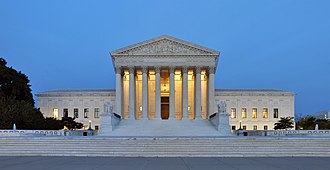
On 31 March 2016, a Federal District Court struck down the ban on same-sex couple adoptions in Mississippi. On June 26, 2017, the United States Supreme Court reversed an Arkansas Supreme Court ruling that had allowed a law listing parents by gender on birth certificates to stand. The new SCOTUS ruling allowed both same-sex spouses to be listed on birth certificates. Together, these court rulings made adoption by same-sex couples legal in all 50 states.
In 2022, Congress passed the Respect for Marriage Act. This law requires states to respect the marriage licenses of same-sex couples, as long as the marriage was valid in the state where it took place. It repeals the 1996 Defense of Marriage Act, which had defined marriage as the union of one man and one woman and had allowed states to refuse to recognize same-sex marriages performed in other states.
Attitudes toward same-sex parenting have improved as the number of same-sex couples and same-sex parents in the United States has grown. From 2007 to 2011, public condemnation of same-sex parenting dropped from 50% to 35%, while acceptance stayed relatively steady. In 2023, same-sex couples were more likely to raise an adopted child: 4% of adopted children and 3% of foster children were being raised by LGBTQ+ couples.
Studies have found that same-sex couples often prefer adoption as a way to start a family. They place much less emphasis on biological methods of having a child than heterosexual families do. LGBTQ families are up to 10 times more likely to adopt than heterosexual couples. An organization called Creating A Family reported that 60% of adoptions by LGBTQ families are transracial. Some people argue that these numbers are partly due to discriminatory practices that make it harder for LGBTQ families to adopt and that treat minority children as less "ideal" adoptees.
Background
In 1999, the American Civil Liberties Union (ACLU) published a report on lesbian and gay parenting, adoption, and foster care. It found no evidence that lesbian and gay people are less fit to be parents than straight couples. Children of lesbian and gay parents were found to grow up as happy and healthy as other children. Good parenting depends on creating a loving home, not on whether a parent is gay or straight. Some researchers have written that these children are sometimes teased and harassed by their peers, and that they are often questioned about their families more than other children. In the past, many children of same-sex parents were born in an earlier relationship between one parent and an opposite-sex partner. Because of this, many legal disputes were about custody after divorce, and courts often favored the parent who was not in a same-sex relationship.
Methods such as intrauterine insemination using a sperm donor and in vitro fertilization later allowed lesbian couples to have children who were not born from an earlier opposite-sex relationship. These methods led to debates about co-parent adoption and custody when lesbian couples separated. For male same-sex couples, having a biological child is more costly, because surrogacy is the only way for them to do so. Adoption is generally the more affordable choice. The average cost of adoption is around $30,000, while surrogacy starts around $100,000 and can be more than $150,000.
Statistics
In 2020, the United States Census Bureau found that same-sex couples (3.1%) were three times more likely to have adopted children than opposite-sex couples (1.1%). Data from 2019 showed that 43.3% of same-sex couples' children were adopted or stepchildren. About 20.9% of same-sex couples had adopted children, compared with 2.9% of opposite-sex couples.
According to the Williams Institute, as of 2009, "an estimated 20,000 same-sex couples are raising nearly 30,000 adopted children." As of 2011, about two million children in the U.S. were being raised by LGBT parents but could not establish a legal relationship with both parents. In 2019, the American Community Survey found that female same-sex households were more likely to have children under 18 in their care (22.5%) than male same-sex households (6.6%).
Professional assessment
Main article: LGBT parenting
Medical, psychological, and social welfare experts agree that children raised by gay and lesbian parents are just as likely to be well-adjusted as children raised by heterosexual parents. In 2010, the Third District Court of Appeals of the State of Florida said the evidence on this is so strong that it would be unreasonable to think otherwise, and that banning adoption by gay people does not protect children's best interests. A child's well-being depends more on family income and social status than on the gender or sexuality of the parents. Problems can come from outside factors, such as discrimination or parents not being able to get married. Some people worry that children raised by gay or lesbian parents will become gay or lesbian themselves, but the data does not support this.
A study by Goldberg, Kinkler, Richardson, and Downing looked at same-sex and heterosexual couples who had adopted children through open adoption, a area that had received little research before. The study included 90 people, and it found that gay and lesbian couples tended to be open about their sexual orientation and wanted to adopt without hiding it. The birth mother was the family member who most consistently stayed in touch with the adoptive family and had a strong influence on how these open adoption relationships developed.
Public opinion
A 2007 poll by CNN and Opinion Research Corporation found that 57% of people believed same-sex couples should have the right to adopt, while 40% did not. A Gallup poll from May 2014 found that 63% believed same-sex couples should have the legal right to adopt a child. From 1994 to 2012, support for same-sex adoption grew, from 28% to 50%. Most Democrats supported it (85%), while far fewer Republicans did (23%).
A YouGov poll from June 2018 found that over half of Americans (55%) believed gay and straight couples would be equally good parents. Still, most respondents (57%) also believed a child should be raised by a mother and a father. Researchers Andrew L. Whitehead and Samuel L. Perry found that support for same-sex adoption was higher among people who believed the Bible may contain human error, and lower among those who attended religious services and read sacred texts more often.
Professional organizations
Several professional groups support gay and lesbian families adopting children. These include the Child Welfare League of America, the American Psychiatric Association, the American Psychological Association, the American Academy of Pediatrics, and the National Association of Social Workers (NASW). The Child Welfare League of America says that "lesbian, gay, and bisexual parents are as well suited to raise children as their heterosexual counterparts." The American Psychiatric Association says that same-sex marriage is "advantageous to the mental health of same-sex couples" and supports the right of same-sex couples to marry, adopt, and co-parent. After the government made same-sex adoption legal in all fifty states in 2016, each of these organizations released similar statements in support.
Many adoption agencies, lawyers, and social workers also work to help LGBTQ+ parents. They include AdoptUSKids, the American Academy of Pediatrics, the Human Rights Campaign Foundation, LifeLong Adoptions, A is 4 Adoption, the International Lesbian and Gay Organization, the National Center for Lesbian Rights, and the National Gay and Lesbian Task Force. The US Department of State offers these resources and more to people looking for state and federal adoption information. Foundations such as the Dave Thomas Foundation for Adoption and the National Adoption Foundation have also funded grants for same-sex couples and other groups that support LGBTQ+ people in adoption.
Politics
In 1999, U.S. Representative Steve Largent proposed an amendment that would have banned joint adoption by people who were not related by blood or marriage in Washington, D.C. The amendment failed, with 213 votes in favor and 215 against. In 2004, Jeb Bush, then the Governor of Florida, said that adopted children are best placed in a home with both a father and a mother. In 2012, Republican presidential candidate Mitt Romney said that same-sex couples who want to adopt a child have a right to do so, and he later said that gay adoption was legal in all states but one.
Right now, there are legal appeals in several states to allow second-parent adoption. This would let one parent adopt the biological child of their same-sex partner, so the child has two legal parents even when the couple is not in a relationship the state recognizes. In most states that allow same-sex couples to adopt, the adoptive couple must be married. In states without specific laws on this issue, the decision is based on the best interest of the child under the Adoption and Safe Families Act of 1997.
Legal status
Main article: V.L. v. E.L.
See also: LGBT rights in Indiana § Adoption and parenting
In 2013, a bill called the Every Child Deserves a Family Act was brought to Congress, but it did not become law. Supreme Court cases such as Baker v. State (1999) and Varnum v. Brien (2009) sided with same-sex parents of adopted children, but each state still makes its own laws. As of 2021, many states still allowed discrimination in foster care and adoption, and many did not allow second-parent adoptions for same-sex couples. Most states also did not require foster parents to be trained about LGBTQ youth.
Many laws changed through court cases. Florida's 1977 law banning adoption by gay people was repealed in 2015. On March 31, 2016, a federal judge struck down Mississippi's ban on adoption by same-sex couples. In Indiana, a 2016 ruling said that both partners in a same-sex couple could be listed on their child's birth certificate. In the case of V.L. v. E.L., the U.S. Supreme Court unanimously reversed the Alabama Supreme Court in 2016, so an adoption from Georgia was recognized in Alabama and the parental rights of V.L. were restored.
| State | Second Parent Adoption | Foster Care Non-Discrimination Laws | Foster Care Parent Training Required | Parental Presumption for Same-Sex Couples | Laws Permitting Discrimination in Adoption/Foster Placement |
|---|---|---|---|---|---|
| Alabama | No | No | No | No | Yes |
| Alaska | No | No | No | Yes | No |
| Arizona | No | No | No | Yes | Yes |
| Arkansas | No | No | No | No | No |
| California | Yes | Yes | Yes | Yes | No |
| Colorado | Yes | Yes | No | Yes | No |
| Connecticut | Yes | Yes | No | Yes | No |
| Delaware | Yes | No | No | Yes | No |
| District of Columbia | Yes | Yes | Yes | Yes | No |
| Florida | No | No | No | Yes | No |
| Georgia | No | No | No | No | No |
| Hawaii | No | No | No | Yes | No |
| Idaho | Yes | No | No | No | No |
| Illinois | Yes | Yes | No | Yes | No |
| Indiana | No | No | No | Yes | No |
| Iowa | No | Yes | No | Yes | No |
| Kansas | No | No | No | No | No |
| Kentucky | No | No | No | No | No |
| Louisiana | No | No | No | No | No |
| Maine | Yes | No | No | Yes | No |
| Maryland | Yes | No | No | No | No |
| Massachusetts | Yes | Yes | Yes | Yes | No |
| Michigan | No | No | No | No | Yes |
| Minnesota | No | Yes | Yes | Yes | No |
| Mississippi | No | No | No | No | Yes |
| Missouri | No | No | No | No | No |
| Montana | Yes | No | No | No | Yes |
| Nebraska | No | No | No | No | No |
| Nevada | No | No | Yes | Yes | No |
| New Hampshire | Yes | Yes | No | Yes | No |
| New Jersey | Yes | Yes | No | Yes | No |
| New Mexico | No | Yes | Yes | Yes | No |
| New York | Yes | Yes | No | Yes | No |
| North Carolina | No | No | No | Yes | No |
| North Dakota | No | No | No | No | Yes |
| Ohio | No | Yes | No | No | No |
| Oklahoma | No | No | No | No | Yes |
| Oregon | Yes | Yes | No | Yes | No |
| Pennsylvania | Yes | No | No | No | No |
| Rhode Island | Yes | Yes | No | Yes | No |
| South Carolina | No | No | No | No | Yes |
| South Dakota | Yes | No | No | No | Yes |
| Tennessee | No | No | No | No | Yes |
| Texas | No | No | No | Yes | Yes |
| Utah | No | No | Yes | Yes | No |
| Vermont | Yes | Yes | No | Yes | No |
| Virginia | No | No | No | No | Yes |
| Washington | No | No | No | Yes | No |
| West Virginia | No | No | No | No | No |
| Wisconsin | No | Yes | No | Yes | No |
| Wyoming | No | No | No | No | No |

Quiz time!
5 questions about Same-sex adoption in the United States
How did same-sex couples end up with the right to adopt in all 50 states?
Keep exploring


This article is a child-friendly adaptation of the Wikipedia article on Same-sex adoption in the United States, available under CC BY-SA 4.0.