Light
Light, visible light, or visible radiation is electromagnetic radiation that can be perceived by the human eye. Visible light spans the visible spectrum and is usually defined as having wavelengths in the range of 400–700 nanometers (nm), which match frequencies of 750–420 terahertz. The visible band sits next to the infrared, which has longer wavelengths and lower frequencies, and the ultraviolet, which has shorter wavelengths and higher frequencies. Together, these are called optical radiation.
In physics, the word "light" can refer more broadly to electromagnetic radiation of any wavelength, whether we can see it or not. In this wider sense, gamma rays, X-rays, microwaves and radio waves are also light. This is why visible radiation is commonly called visible light.
Light has a few main properties. These are intensity, the direction it travels, its frequency or wavelength spectrum, and polarization. The speed in vacuum of light, 299,792,458 metres per second, is one of the basic constants of nature. All electromagnetic radiation shows some properties of both particles and waves. Tiny particles of light called quanta, or photons, can be detected with special equipment, while other effects, such as interference, are described by waves. Most everyday interactions with light can be explained using geometrical optics. Quantum optics is an important area of research in modern physics.
The main natural source of light on Earth is the Sun. In the past, another important source of light for people was fire, from ancient campfires to modern kerosene lamps. With the development of electric lights and power systems, electric lighting has largely replaced firelight.
Main article: Electromagnetic spectrum
Electromagnetic radiation (EMR) is sorted by wavelength into radio waves, microwaves, infrared, the visible spectrum that we see as light, ultraviolet, X-rays and gamma rays. Radiation does not include static electric fields, magnetic fields, or near fields. Higher frequencies have shorter wavelengths, and lower frequencies have longer wavelengths. Visible light is made of tiny packets of energy called photons, which are also known as quanta. Near the lower end of visible light, photons no longer have enough energy to change the retinal molecule in the human eye, so infrared becomes invisible to people. Some animals, such as snakes, use infrared sensing in snakes, which works through thermal imaging rather than this molecular change.
Ultraviolet light is invisible to humans because the cornea absorbs wavelengths shorter than 360 nm, and the lens absorbs wavelengths shorter than 400 nm. The rods and cones in the eye cannot detect the very short ultraviolet wavelengths, and those wavelengths can damage them. Insects and shrimp can detect ultraviolet light. Sources define visible light anywhere from 420–680 nm to 380–800 nm. Under ideal laboratory conditions, people can see infrared up to at least 1,050 nm, and children and young adults may see ultraviolet down to about 310–313 nm. The color of light also affects plant growth, a process known as photomorphogenesis.
Speed of light
Main article: Speed of light
Light moves through vacuum at exactly 299792458 m/s, which is about 186,282 miles per second. This speed is fixed because the meter is now defined using the speed of light. All forms of electromagnetic radiation travel at this same speed in a vacuum. Many physicists have tried to measure it over time. Galileo tried in the seventeenth century. In 1676, Ole Rømer, a Danish physicist, made an early attempt. Using a telescope, he watched Jupiter and one of its moons, Io. He calculated that light takes about 22 minutes to cross the diameter of Earth's orbit, but that size was not known at the time. In 1849, Hippolyte Fizeau measured the speed as 313000000 m/s using a beam of light, a mirror several kilometers away, and a spinning cog wheel. In 1862, Léon Foucault got a value of 298000000 m/s using rotating mirrors. Albert A. Michelson ran experiments from 1877 until his death in 1931. In 1926, he used improved rotating mirrors to time light traveling between Mount Wilson and Mount San Antonio in California, and got a speed of 299796000 m/s.
Light moves more slowly through transparent materials that contain ordinary matter. For example, light in water travels at about 3/4 of its speed in a vacuum. In two separate experiments, teams of physicists slowed light down so much that it was described as coming to a "complete standstill." They passed light through a Bose–Einstein condensate made of the element rubidium. One team worked at Harvard University and the Rowland Institute for Science in Cambridge, Massachusetts, and the other at the Harvard–Smithsonian Center for Astrophysics, also in Cambridge. The popular idea that light was "stopped" only meant that light was stored in the excited states of atoms and then released later when a second laser pulse triggered it. While it was "stopped," it was no longer light.
Optics
Main article: Optics
The study of light and how it interacts with matter is called optics. There are different forms of optics for different situations. Geometrical optics helps explain things like eyes, lenses, cameras, fiber optics, and mirrors. Physical optics uses the wave nature of light to explain effects like diffraction and interference. Quantum optics is used when studying single particles of light, called photons, as they interact with matter. A transparent object lets light transmit through it. An opaque object does not let light through and instead reflects or absorbs it. Most objects do not reflect light perfectly smoothly (specularly). Instead, they scatter light to some degree, which is called glossiness. This scattering comes from the surface roughness of the surface. Translucent objects let light pass through like transparent objects, but they also scatter some colors of light inside them.
Main article: Refraction
Refraction is the bending of light rays when they pass from one transparent material into another. When light crosses the boundary between two materials, its wavelength changes but its frequency stays the same. If the light does not hit the boundary straight on, this change in wavelength makes the light change direction. Lenses use this bending of light to change how large images appear. Magnifying glasses, spectacles, contact lenses, microscopes, and refracting telescopes all work this way.
Further information: List of light sources
Many things give off light. A body at a certain temperature gives off a pattern of black-body radiation that depends on how hot it is. The Sun is a simple natural example. Its sunlight comes from the chromosphere, the Sun's outer layer, at around 6,000 K (5,730 °C; 10,340 °F). About 44% of the sunlight that reaches the ground is visible. An incandescent light bulb gives off only about 10% of its energy as visible light, and the rest is infrared. Flames give off light from glowing solid particles, but most of that is also infrared. Cool objects, such as human beings, glow mainly in the deep infrared, at about 10 micrometer wavelength. As things get hotter, they glow red, then white, then blue-white. Metal heated to "red hot" or "white hot" shows these colors. Blue-white thermal emission is rarely seen, except in stars. The pure blue flame of a gas flame or a welder's torch comes from molecules rather than heat alone.
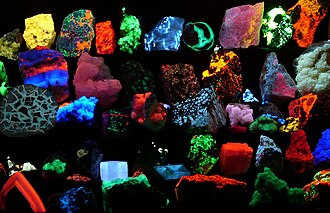
Atoms give off and absorb light at set energies, which creates "emission lines". Light can be given off spontaneously, as in light-emitting diodes, gas discharge lamps such as neon lamps, neon signs, and mercury-vapor lamps, and flames, where sodium gives off a yellow light. Light can also be stimulated, as in a laser or a microwave maser. Moving particles such as an electron can produce light, and Cherenkov radiation is another example. Some chemicals glow through chemoluminescence. In living things, this is called bioluminescence, as seen in fireflies. Some substances glow when more energetic radiation shines on them, which is called fluorescence. Others glow slowly afterward, which is called phosphorescence. Cathodoluminescence is used in cathode-ray tube television sets and computer monitors.
Certain other mechanisms can produce light:
When the concept of light includes very-high-energy photons (gamma rays), additional generation mechanisms include:
- Particle–antiparticle annihilation
- Radioactive decay
Measurement
Main articles: Photometry (optics) and Radiometry
Light is measured in two main ways. radiometry measures the power of light at all wavelengths. photometry measures light in a way that matches how bright it looks to people. Photometry is useful, for example, for Illumination (lighting) meant for human use.
Photometry units take into account how the human eye responds to light. cone cells in the eye come in three types that respond differently across the visible spectrum, and their combined response peaks at about 555 nm. So two lights with the same amount of visible light do not always look equally bright. Photometry units give a better picture of how bright a light appears than raw intensity does. They connect to raw power through luminous efficacy, and they help people decide how to get enough light for tasks indoors and outdoors. A photocell sensor does not always match what the human eye sees. Without filters, which can be costly, charge-coupled devices (CCD) and photocells often respond to some infrared, ultraviolet, or both.
Main article: Radiation pressure
Light pushes on objects in its path. This can be explained by thinking of light as tiny particles called photons that strike objects and transfer their motion. The push is equal to the power of the light beam divided by c, the speed of light. Because c is so large, the push is too small to notice on everyday objects. A one-milliwatt laser pointer, for example, pushes with about 3.3 piconewtons. You would need about 30 billion of these laser pointers to lift a US penny. At the nanometer scale, in tiny machines such as nanoelectromechanical systems (NEMS), light pressure has a bigger effect, and scientists are studying how to use it. On a larger scale, light pressure can make asteroids spin faster, acting on their uneven shapes like the blades of a windmill. Scientists are also looking into solar sails, which could push spaceships through space.
The spinning of the Crookes radiometer was first thought to be caused by light pressure, but this idea is wrong. Its spin is caused by a partial vacuum. This is different from the Nichols radiometer, where the small movement is directly caused by light pressure. In 1909, Einstein predicted a "radiation friction" that would oppose the movement of matter. Light's momentum usually points in the direction the light is travelling, but in evanescent waves, it is sideways to that direction.
Historical theories about light, in chronological order
Long ago, people tried to explain light. In the fifth century BC, Empedocles taught that everything was made of four elements: fire, air, earth and water. He believed the goddess Aphrodite lit a fire in the eye that made sight possible. Around 300 BC, Euclid wrote Optica and said light travelled in straight lines. In 55 BC, Lucretius, a Roman who followed earlier Greek atomists, wrote that sunlight is made of tiny atoms. Around the second century, Ptolemy wrote about refraction of light. In ancient India, the Hindu schools of Samkhya and Vaisheshika developed theories about light, and the Vishnu Purana called sunlight "the seven rays of the sun." Indian Buddhists, such as Dignāga and Dharmakirti, saw light as an atomic entity equal to energy. In the 1600s, René Descartes said light was a mechanical property of glowing objects. In 1637 he published a theory of refraction that wrongly assumed light travelled faster in denser materials, but he was right that light behaved like a wave. Pierre Gassendi proposed a particle theory of light, and Isaac Newton later described light as corpuscles, tiny particles sent out in all directions. Newton explained diffraction, which Francesco Grimaldi had observed, by suggesting a light particle could create a small wave in the aether. His theory could predict reflection, but he wrongly explained refraction by saying light sped up in a denser medium because of gravitational pull. His book Opticks appeared in 1704, and his fame helped the particle theory of light remain popular in the 1700s. Pierre-Simon Laplace used this theory to suggest that a very massive body could stop light escaping, creating what is now called a black hole, though he later withdrew the idea. Étienne-Louis Malus built a mathematical particle theory of how light becomes polarized in 1810, and Jean-Baptiste Biot showed in 1812 that it explained all known polarization effects. A translation of Newton's essay on light appears in a book by Stephen Hawking and George F. R. Ellis.
Main article: Corpuscular theory of light
Robert Hooke developed a "pulse theory" of colours in 1665, comparing light to waves in water in his book Micrographia. In 1672 he suggested light's vibrations could be perpendicular to the direction it travels. Christiaan Huygens worked out a mathematical wave theory of light in 1678, published in his Treatise on Light in 1690. He proposed that light travelled as waves through a medium called the luminiferous aether. Leonhard Euler also supported the wave theory. Thomas Young showed through experiments that light behaved like waves, and he proposed that different colours came from different wavelengths. André-Marie Ampère gave Augustin-Jean Fresnel the idea that polarization could be explained if light were a transverse wave. Fresnel presented his own wave theory to the Académie des Sciences in 1817. Siméon Denis Poisson challenged it, but Dominique-François-Jean Arago showed the predicted bright spot existed, which supported the wave theory. The wave theory's weakness was that waves need a medium, and the Michelson–Morley experiment cast strong doubt on the aether in the late nineteenth century. In 1850 Léon Foucault measured the speed of light accurately, and his result supported the wave theory over the corpuscular theory. Particle ideas later returned as photons in quantum theory.
Main article: Electromagnetic radiation
In 1845 Michael Faraday found that the polarization of light rotates in a magnetic field through a dielectric, now known as Faraday rotation. This was the first evidence that light is related to electromagnetism. James Clerk Maxwell concluded that light is a form of electromagnetic radiation, and his work is summed up in A Treatise on Electricity and Magnetism (1873), which includes Maxwell's equations. Heinrich Hertz confirmed this by producing radio waves that behaved like visible light, showing interference and other properties. In 1900 Max Planck, studying black-body radiation, suggested light gains or loses energy only in amounts called quanta. In 1905 Albert Einstein used light quanta to explain the photoelectric effect. In 1923 Arthur Holly Compton showed that Compton scattering could be explained by a particle theory of X-rays. In 1926 Gilbert N. Lewis named these particles photons. Satyendra Nath Bose and Einstein generalized the statistics for bosons, which follow Bose–Einstein statistics. Paul Dirac quantized the electromagnetic field in 1927, and Pascual Jordan and Vladimir Fock extended the process, called second quantization. By the end of the 1940s, Julian Schwinger, Richard Feynman, Freeman Dyson, and Shinichiro Tomonaga had developed quantum electrodynamics.
Main article: Quantum optics
In the 1950s and 1960s, John R. Klauder, George Sudarshan, Roy J. Glauber, and Leonard Mandel applied quantum theory to light, studying degree of coherence and the coherent state. In 1977 H. Jeff Kimble demonstrated a single atom emitting one photon at a time. Later, researchers discovered squeezed light. Short and ultrashort laser pulses, made with Q switching and modelocking, opened new ways to study fast processes, such as Raman spectroscopy. Laser light could also hold small samples in an optical trap or optical tweezers, and combined with Doppler cooling and Sisyphus cooling, helped achieve Bose–Einstein condensation. Other results include quantum entanglement, quantum teleportation, and quantum logic gates, which are important to quantum information theory and computer science.
Use for light on Earth
Sunlight provides the energy that green plants use to make sugars, mostly in the form of starches. These starches release energy into the living things that eat them. This process, called photosynthesis, provides almost all the energy used by living things.
Some animals can make their own light, a process called bioluminescence. For example, fireflies use light to find mates, and vampire squid use it to hide from their prey.

Quiz time!
5 questions about Light
Why can't humans see ultraviolet light?
Pictures
Keep exploring




This article is a child-friendly adaptation of the Wikipedia article on Light, available under CC BY-SA 4.0.
Images from Wikimedia Commons. Tap any image to view credits and license.