
List of exceptional asteroids
Asteroids are special rocks that orbit the Sun, mostly found between the planets Mars and Jupiter. They come in many sizes, from tiny pieces to very large objects. One famous asteroid is Ceres, which is so big that it is called a dwarf planet.
This list talks about asteroids that are unusual in some way, like being very large or having a strange path around the Sun. Some of these asteroids are close to the planet Jupiter, called Jupiter trojans, and others are between the orbits of Jupiter and Neptune, called centaurs. These special asteroids help scientists learn more about how our Solar System formed.
Each asteroid gets a number once scientists know exactly where it will go. Before that, they have a temporary name, like 1950 DA. Studying these rocks helps us understand the space around us and the history of our Solar System.
Physical characteristics
Estimating the sizes of asteroids is tricky because of their shapes, how reflective they are, and how big they appear from far away. Big telescopes helped measure most large asteroids between 2019 and 2021.
There are about 140 big asteroids in the main belt that are larger than 120 kilometers across. The inner part of the asteroid belt has fewer large asteroids. Only a few, like Vesta, Fortuna, Hebe, Iris, and Metis, are found there.
Ceres is the heaviest asteroid, almost half the weight of all the asteroids in the belt together. Vesta is the next heaviest, followed by Pallas and Hygiea. Some asteroids, like Ceres and Vesta, have been studied up close by spacecraft, so their weights are known very well.
Only Vesta gets bright enough to sometimes be seen without a telescope. Under very dark skies, Ceres, Pallas, and Iris might also be seen, but only very rarely.
Some asteroids spin very slowly, taking more than 1,000 hours to turn once. Most asteroids spin much faster, between 2 and 20 hours. Others spin extremely fast, some in less than 100 seconds, though these are usually very small and close to Earth.
| Name | Picture | Diameter (km) (geometric mean) | Dimensions (km) | Mean distance from Sun (in AU) | Inclination (°) | Date discovered | Discoverer | Class |
|---|---|---|---|---|---|---|---|---|
| 1 Ceres | 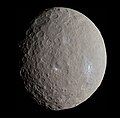 | 939.4±0.2 | 964.4 × 964.2 × 891.8 | 2.766 | 10.6 | January 1, 1801 | Piazzi, G. | G |
| 4 Vesta | 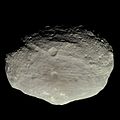 | 525.4±0.2 | 572.6 × 557.2 × 446.4 ± 0.2 | 2.362 | 7.14 | March 29, 1807 | Olbers, H. W. | V |
| 2 Pallas |  | 511±4 | 568×530×450 | 2.773 | 34.9 | March 28, 1802 | Olbers, H. W. | B |
| 10 Hygiea |  | 433±8 | 450×430×424 | 3.139 | 5.1 | April 12, 1849 | de Gasparis, A. | C |
| 704 Interamnia |  | 332±5 | 362×348×310 | 3.062 | 17.3 | October 2, 1910 | Cerulli, V. | F |
| 52 Europa |  | 319±4 | 378×336×255 | 3.095 | 7.48 | February 4, 1858 | Goldschmidt, H. | C |
| 511 Davida |  | 298±4 | 359×293×253 | 3.168 | 15.9 | May 30, 1903 | Dugan, R. S. | C |
| 87 Sylvia |  | 271±5 | 363×249×191 or 374×248×194 | 3.485 | 10.9 | May 16, 1866 | Pogson, N. R. | X |
| 15 Eunomia | 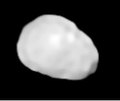 | 270±3 | 357×255×212 | 2.643 | 11.75 | July 29, 1851 | de Gasparis, A. | S |
| 31 Euphrosyne | 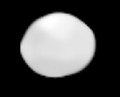 | 268±4 | 294×280×248 | 3.149 | 26.3 | September 1, 1854 | Ferguson, J. | C |
| 65 Cybele |  | 263±3 | 297 × 291 × 213 | 3.439 | 3.56 | March 8, 1861 | Tempel, E. W. | C |
| 624 Hektor |  | 256±12 (if bilobe) | 403 × 201 | 5.235 | 18.66 | February 10, 1907 | Kopff, A. | D |
| 3 Juno |  | 254±2 | 288×250×225 | 2.672 | 12.98 | September 1, 1804 | Harding, K. L. | S |
| 451 Patientia | 254±3 | 3.059 | 15.2 | December 4, 1899 | Charlois, A. | |||
| 107 Camilla |  | 254±12 | 3.476 | 10 | November 17, 1868 | Pogson, N. R. | C | |
| 324 Bamberga | 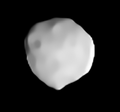 | 227±3 | 234×224×225 | 2.684 | 11.1 | February 25, 1892 | Palisa, J. | C |
| 16 Psyche | 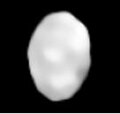 | 223±3 | 279×232×189 ± 10% | 2.924 | 3.1 | March 17, 1852 | de Gasparis, A. | M |
| 88 Thisbe | 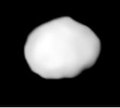 | 218±3 | 255×232×193 | 2.769 | 5.22 | June 15, 1866 | Peters, C. H. F. | B |
| 48 Doris | 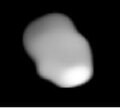 | 215±3 | 257×211×185 | 3.108 | 6.55 | September 19, 1857 | Goldschmidt, H. | C |
| 19 Fortuna | 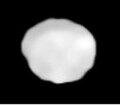 | 211±2 | 225×205×195 | 2.442 | 1.57 | August 22, 1852 | Hind, J. R. | G |
| 121 Hermione |  | 209±5? | 3.457 | 7.6 | May 12, 1872 | Watson, J. C. | C | |
| 24 Themis | 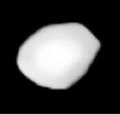 | 208±3 | 232×220×176 | 3.136 | 0.76 | April 5, 1853 | de Gasparis, A. | C |
| 94 Aurora |  | 205±4 ? ( | 225×173 | 3.160 | 7.97 | September 6, 1867 | Watson, J. C. | C |
| 29 Amphitrite |  | 204±2 | 222×209×183 | 2.554 | 6.08 | March 1, 1854 | Marth, A. | S |
| 13 Egeria | 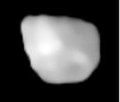 | 202±3 | 238×199×182 | 2.576 | 16.54 | November 2, 1850 | de Gasparis, A. | G |
| 130 Elektra | 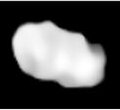 | 199±2 | 262×205×164 | 3.127 | 22.78 | February 17, 1873 | C. H. F. Peters | C |
| 7 Iris |  | 199±10 | 268×234×180 | 2.386 | 5.52 | August 13, 1847 | Hind, J. R. | S |
| 6 Hebe |  | 195±3 | 205x185x170 | 2.426 | 14.75 | July 1, 1847 | Hencke, K. L. | S |
| 375 Ursula | 192±4 | 3.126 | 15.94 | September 18, 1893 | Charlois, A. | C | ||
| 702 Alauda | 191±2 | 3.195 | 20.59 | July 16, 1910 | Helffrich, J. | C/B | ||
| 45 Eugenia | 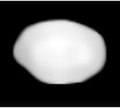 | 188±2 | 252×191×138 | 2.720 | 6.61 | June 27, 1857 | Goldschmidt, H. | F |
| 41 Daphne |  | 187±13 | 235×183×153 | 2.765 | 15.77 | May 22, 1856 | Goldschmidt, H. | C |
| 154 Bertha |  | 186±2 | 3.195 | 20.972 | November 4, 1875 | Henry, P. M. | C | |
| 423 Diotima |  | 176±4 | 3.065 | 11.23 | December 7, 1896 | Charlois, A. | C | |
| 259 Aletheia | 174±1 | 3.135 | 10.81 | June 28, 1886 | Peters, C. H. F. | C/P/X | ||
| 372 Palma |  | 174±3 | 3.149 | 23.83 | August 19, 1893 | Charlois, A. | B | |
| 9 Metis |  | 173±2 | 222×182×130 | 2.385 | 5.58 | April 25, 1848 | Graham, A. | S |
| 532 Herculina |  | 168±1 | 2.772 | 16.31 | April 20, 1904 | Wolf, M. | S | |
| 354 Eleonora |  | 165±3 | 191×162×144 | 2.798 | 18.4 | January 17, 1893 | Auguste Charlois | S |
| 128 Nemesis |  | 163±5 | 178×163×147 | 2.751 | 6.25 | November 25, 1872 | Watson, J. C. | C |
| (4:1 resonance) [sort by 'Mean Distance from Sun' to place in table] | 2.06 | (defines inner edge of main belt) | ||||||
| (3:1 resonance) | 2.50 | (separates inner from middle belt) | ||||||
| (5:2 resonance) | 2.82 | (separates middle from outer belt) | ||||||
| (7:3 resonance) | 2.95 | |||||||
| (2:1 resonance) | 3.27 | (defines outermost belt) | ||||||
| (1:1 resonance) | 5.20 | (Trojan asteroids – defines outer edge of main belt) | ||||||
| Name | Mass (×1018 kg) | Precision | Approx. proportion of all asteroids |
|---|---|---|---|
| 1 Ceres | 938.35 | 0.001% (938.34–938.36) | 39.2% |
| 4 Vesta | 259.076 | 0.0004% (259.075–259.077) | 10.8% |
| 2 Pallas | 204 | 1.5% (201–207) | 8.5% |
| 10 Hygiea | 87 | 8% (80–94) | 3.6% |
| 704 Interamnia | 35 | 14% (30–40) | 1.5% |
| 15 Eunomia | 30 | 6% (29–32) | 1.3% |
| 3 Juno | 27 | 9% (25–29) | 1.1% |
| 511 Davida | 27 | 27% (19–34) | 1.1% |
| 52 Europa | 24 | 16% (20–28) | 1.0% |
| 16 Psyche | 23 | 13% (20–26) | 1.0% |
| 532 Herculina | ≈ 23 | ? | ≈ 1% |
| 31 Euphrosyne | 17 | 18% (14–19) | 0.7% |
| 65 Cybele | 15 | 12% (13–17) | 0.6% |
| 87 Sylvia | 14.76 | 0.4% (14.70–14.82) | 0.6% |
| 7 Iris | 14 | 17% (11–16) | 0.6% |
| 29 Amphitrite | 13 | 16% (11–15) | 0.5% |
| 6 Hebe | 12 | 20% (10–15) | 0.5% |
| 88 Thisbe | 12 | 20% (9–14) | 0.5% |
| 107 Camilla | 11.2 | 1% (11.1–11.3) | 0.5% |
| 324 Bamberga | 10 | 9% (9–11) | 0.4% |
| Total | 1781 | NA | 75% |
| Asteroid | Magnitude when brightest | Semi- major axis (AU) | Eccentricity of orbit | Diameter (km) | Year of discovery |
|---|---|---|---|---|---|
| 99942 Apophis | 3.4* | 0.922 | 0.191 | 0.32 | 2004 |
| 4 Vesta | 5.20 | 2.361 | 0.089172 | 529 | 1807 |
| 2 Pallas | 6.49 | 2.773 | 0.230725 | 544 | 1802 |
| 1 Ceres | 6.65 | 2.766 | 0.079905 | 952 | 1801 |
| 7 Iris | 6.73 | 2.385 | 0.231422 | 200 | 1847 |
| 433 Eros | 6.8 | 1.458 | 0.222725 | 34 × 11 × 11 | 1898 |
| (153814) 2001 WN5 | 6.85 | 1.711 | 0.467207 | 0.93 | 2001 |
| 367943 Duende | 7.04 | 0.910 | 0.089319 | 0.04 × 0.02 | 2012 |
| 6 Hebe | 7.5 | 2.425 | 0.201726 | 186 | 1847 |
| 3 Juno | 7.5 | 2.668 | 0.258194 | 233 | 1804 |
| 18 Melpomene | 7.5 | 2.296 | 0.218708 | 141 | 1852 |
| (152680) 1998 KJ9 | 7.74 | 1.448 | 0.639770 | 0.5 | 1998 |
| 15 Eunomia | 7.9 | 2.643 | 0.187181 | 268 | 1851 |
| 8 Flora | 7.9 | 2.202 | 0.156207 | 128 | 1847 |
| 324 Bamberga | 8.0 | 2.682 | 0.338252 | 229 | 1892 |
| 1036 Ganymed | 8.1 | 2.6657 | 0.533710 | 32 | 1924 |
| 9 Metis | 8.1 | 2.387 | 0.121441 | 190 | 1848 |
| 192 Nausikaa | 8.2 | 2.404 | 0.246216 | 103 | 1879 |
| 20 Massalia | 8.3 | 2.409 | 0.142880 | 145 | 1852 |
| # | Minor planet designation | Rotation period | Δmag | Quality (U) | Orbit or family | Spectral type | Diameter (km) | Abs. mag (H) | |
|---|---|---|---|---|---|---|---|---|---|
| (seconds) | (hours) | ||||||||
| 1. | 2014 RC | 16 | 0.004389 | 0.10 | n.a. | NEO | S | 0.012 | 26.80 |
| 2. | 2015 SV6 | 18 | 0.00490 | 0.74 | 2 | NEO | S | 0.009 | 27.70 |
| 3. | 2010 JL88 | 25 | 0.0068295 | 0.52 | 3 | NEO | S | 0.013 | 26.80 |
| 4. | 2017 EK | 30 | 0.0083 | 0.30 | 2 | NEO | S | 0.045 | 24.10 |
| 5. | 2010 WA | 31 | 0.0085799 | 0.22 | 3 | NEO | S | 0.003 | 30.00 |
| 6. | 2017 UK8 | 31 | 0.0086309 | 1.30 | 3 | NEO | S | 0.007 | 28.20 |
| 7. | 2016 GE1 | 34 | 0.009438 | 0.13 | 2 | NEO | S | 0.014 | 26.60 |
| 8. | 2008 HJ | 43 | 0.01185 | 0.80 | 3− | NEO | S | 0.021 | 25.80 |
| 9. | 2009 TM8 | 43 | 0.012 | – | n.a. | NEO | S | 0.006 | 28.40 |
| 10. | 2015 SU | 46 | 0.0127 | 0.20 | 2− | NEO | S | 0.025 | 25.40 |
| 11. | 2010 SK13 | 52 | 0.0144 | – | n.a. | NEO | S | 0.01 | 27.40 |
| 12. | 2009 BF2 | 57 | 0.01593 | 0.80 | 3 | NEO | S | 0.02 | 25.90 |
| 13. | 2016 GS2 | 66 | 0.0182725 | 0.06 | 1 | NEO | S | 0.075 | 23.00 |
| 14. | 2010 TG19 | 70 | 0.0193935 | 1.10 | 3 | NEO | S | 0.049 | 23.90 |
| 15. | 2008 WA14 | 70 | 0.0195 | – | n.a. | NEO | S | 0.075 | 23.00 |
| 16. | 2007 KE4 | 77 | 0.021408 | 0.38 | 3− | NEO | S | 0.027 | 25.20 |
| 17. | 2000 DO8 | 78 | 0.0217 | 1.39 | 3 | NEO | S | 0.037 | 24.54 |
| 18. | 2014 GQ17 | 78 | 0.0217 | 0.08 | 2− | NEO | S | 0.011 | 27.10 |
| 19. | 2014 TV | 79 | 0.02190 | 0.32 | 2 | NEO | S | 0.039 | 24.40 |
| 20. | 2000 WH10 | 80 | 0.02221 | 0.66 | 3− | NEO | S | 0.094 | 22.50 |
| 21. | 2012 HG2 | 82 | 0.0227 | – | n.a. | NEO | S | 0.012 | 27.00 |
| 22. | 2010 TD54 | 83 | 0.0229317 | 0.92 | 3 | NEO | S | 0.005 | 28.90 |
| 23. | 2010 TS19 | 83 | 0.023 | – | n.a. | NEO | S | 0.022 | 25.70 |
| 24. | 2009 UD | 84 | 0.023246 | 0.66 | 2+ | NEO | S | 0.011 | 27.20 |
| 25. | 2014 WB366 | 86 | 0.0238 | 0.46 | 2+ | NEO | S | 0.033 | 24.80 |
| 26. | 2015 RF36 | 90 | 0.025 | 0.15 | 2 | NEO | S | 0.062 | 23.40 |
| 27. | 2015 AK45 | 93 | 0.0258 | 0.24 | 2 | NEO | S | 0.016 | 26.40 |
| 28. | 2010 XE11 | 96 | 0.0265846 | 0.50 | 3 | NEO | S | 0.075 | 23.00 |
| 29. | 2000 UK11 | 96 | 0.026599 | 0.28 | 2 | NEO | S | 0.026 | 25.30 |
| 30. | 2016 RB1 | 96 | 0.02674 | 0.18 | 2+ | NEO | S | 0.007 | 28.30 |
| 31. | 2015 CM | 96 | 0.0268 | 0.53 | 3− | NEO | S | 0.018 | 26.10 |
| 32. | 2008 TC3 | 97 | 0.0269409 | 1.02 | 3 | NEO | F | 0.004 | 30.90 |
Orbital characteristics
Some asteroids have special paths around the Sun. One special group moves in the opposite direction compared to most planets. As of March 2018, there were only 99 known asteroids that move this way, which is very rare.
There are also asteroids that share their paths with planets. For example, some follow close to Earth, Mars, and Jupiter.
Main article: List of asteroid close approaches to Earth
| Minor planet designation | Inclination (°) | First observed/ Discovery date | Condition code | Obs. × arc | Comment |
|---|---|---|---|---|---|
| 2024 TF3 | 89.1° | March 8, 2010 | 40 | Extremely high-inclined trans-Neptunian object. | |
| 2017 UX51 | 90.5° | October 27, 2017 | 0 | 79254 | — |
| 2018 SQ13 | 90.9° | September 21, 2018 | 17407 | — | |
| 2015 TN178 | 91.0° | October 8, 2015 | 0 | 38805 | — |
| 2005 SB223 | 91.2° | September 30, 2005 | 1 | 12200 | Has a well-determined orbit |
| 2014 MH55 | 91.4° | June 29, 2014 | 6 | 96 | — |
| 2010 EQ169 | 91.6° | March 8, 2010 | ? | 15 | Most highly inclined known main-belt asteroid (orbit is not well-known) |
| 2015 RK245 | 91.6° | September 13, 2015 | 0 | 184680 | — |
| 2016 TK2 | 92.3° | July 13, 2016 | 2 | 6075 | — |
| (518151) 2016 FH13 | 93.5° | March 29, 2016 | 0 | 91561 | — |
| 2014 PP69 | 93.6° | August 5, 2014 | 1 | 8085 | — |
| 2015 BH311 | 94.1° | January 20, 2015 | ? | 39 | — |
| 2017 OX68 | 94.7° | July 26, 2017 | 8720 | — | |
| 2014 JJ57 | 95.9° | May 9, 2014 | 0 | 95710 | — |
| 2013 HS150 | 97.4° | April 16, 2013 | 220 | — | |
| (709487) 2013 BL76 | 98.5° | January 20, 2013 | 46716 | Has a semi-major axis of 1254 AU, giving it the third largest semi-major axis of any known minor planet | |
| 2010 GW147 | 99.8° | April 14, 2010 | 0 | 97888 | — |
| 2011 MM4 | 100.4° | June 24, 2011 | 0 | 364936 | — |
| 2017 NM2 | 101.2° | July 6, 2017 | 1 | 28014 | — |
| 2014 XS3 | 101.3° | December 8, 2014 | 0 | 23544 | — |
| 2013 BN27 | 101.8° | January 17, 2013 | 1400 | — | |
| (528219) 2008 KV42 | 103.3° | May 31, 2008 | 1 | 198550 | — |
| (342842) 2008 YB3 | 105.0° | December 18, 2008 | 0 | 1608789 | — |
| 2016 PN66 | 105.1° | August 14, 2016 | 0 | 63879 | — |
| 2010 GW64 | 105.2° | April 6, 2010 | 0 | 9072 | — |
| 2012 YO6 | 106.8° | December 22, 2012 | 3 | 6674 | — |
| 2009 DD47 | 107.4° | February 27, 2009 | ? | 1584 | — |
| 2017 UR52 | 108.2° | October 29, 2017 | 1638 | — | |
| 2007 VW266 | 108.3° | November 12, 2007 | 5 | 2204 | — |
| 2011 SP25 | 109.0° | September 20, 2011 | 3 | 3654 | — |
| 471325 Taowu | 110.1° | May 31, 2011 | 1 | 234828 | — |
| 2005 TJ50 | 110.2° | October 5, 2005 | 5 | 1488 | — |
| 2011 OR17 | 110.5° | May 21, 2010 | 71808 | — | |
| 2005 VX3 | 112.2° | November 1, 2005 | 4212 | Semi-major axis of 837AU, but has a somewhat short 81-day observation arc for such a large orbit | |
| 2017 SV13 | 113.2° | September 17, 2017 | 4 | 2160 | — |
| 2016 LS | 114.3° | June 27, 2015 | 0 | 26688 | — |
| 2015 YY18 | 118.2° | December 29, 2015 | 0 | 33454 | — |
| 2010 OM101 | 118.7° | July 28, 2010 | 2 | 3535 | — |
| (65407) 2002 RP120 | 118.9° | September 4, 2002 | 0 | 648554 | This outer-planet crosser is a damocloid and SDO. |
| 2010 PO58 | 121.1° | August 5, 2010 | 8 | 120 | — |
| 2010 LG61 | 123.8° | June 2, 2010 | 7 | 935 | — |
| (468861) 2013 LU28 | 125.3° | June 8, 2013 | 0 | 238336 | — |
| 2014 SQ339 | 128.5° | September 29, 2014 | 4 | 1334 | — |
| 2000 DG8 | 129.2° | February 25, 2000 | 2 | 42408 | A damocloid and SDO. Crosses all the outer planets except Neptune. Came within 0.03 AU of Ceres in 1930. |
| 2016 CO264 | 129.8° | February 14, 2016 | 0 | 23800 | — |
| 2013 NS11 | 130.3° | July 5, 2013 | 0 | 143510 | — |
| 2005 NP82 | 130.5° | July 6, 2005 | 1 | 662673 | — |
| 2006 RG1 | 133.4° | September 1, 2006 | 4 | 750 | Has an orbit with a data arc of 25 days |
| 2012 YE8 | 136.0° | December 21, 2012 | 5 | 1066 | — |
| 2017 AX13 | 137.2° | January 2, 2017 | 3 | 1785 | — |
| 2009 QY6 | 137.6° | August 17, 2009 | 1 | 43990 | — |
| 2016 TP93 | 138.3° | October 9, 2016 | ? | 704 | — |
| 2016 YB13 | 139.6° | December 23, 2016 | 1 | 50718 | — |
| 2019 EJ3 | 139.7° | March 4, 2019 | ? | 576 | — |
| 2015 AO44 | 139.9° | November 27, 2014 | 0 | 115821 | — |
| (336756) 2010 NV1 | 140.7° | July 1, 2010 | 0 | 330022 | Perihelion at 9.4 AU, only 2008 KV42 has perihelion further out (154-day data arc) |
| 2011 WS41 | 141.6° | November 24, 2011 | ? | 108 | — |
| 2010 OR1 | 143.9° | January 25, 2010 | 1 | 35032 | — |
| 2010 BK118 | 143.9° | January 30, 2010 | 374596 | Semi-major axis of 408 AU with perihelion at 6.1 AU in April 2012 (1 year data arc) | |
| (523797) 2016 NM56 | 144.0° | November 1, 2012 | 0 | 227052 | — |
| 2017 UW51 | 144.2° | October 23, 2017 | 68442 | — | |
| 2010 CG55 | 146.2° | February 15, 2010 | 0 | 129000 | — |
| 2012 HD2 | 146.8° | April 18, 2012 | 0 | 31408 | — |
| 2009 YS6 | 147.7° | December 17, 2009 | 0 | 195734 | — |
| 2016 VY17 | 148.4° | November 5, 2016 | 0 | 108624 | — |
| 2017 QO33 | 148.8° | August 16, 2017 | 1 | 45360 | — |
| 2006 EX52 | 150.1° | March 5, 2006 | 0 | 62310 | q=2.58 AU and period=274 yr |
| (612093) 1999 LE31 | 151.8° | June 12, 1999 | 2 | 905838 | A damocloid, Jupiter- and Saturn-crossing minor planet. |
| 2017 SN33 | 152.0° | September 19, 2017 | 7590 | — | |
| 2018 WB1 | 152.1° | November 19, 2018 | 7 | 351 | — |
| 2016 JK24 | 152.3° | March 3, 2016 | 0 | 181965 | — |
| 2017 CW32 | 152.4° | February 2, 2017 | 51500 | — | |
| 343158 Marsyas | 154.3° | April 29, 2009 | 0 | 771834 | NEO that sometimes has the highest relative velocity to Earth (79 km/s) of known objects that come within 0.5 AU of Earth. However, the relative velocity at 1 AU from the sun is less than 72 km/s. |
| 2013 LD16 | 154.7° | June 6, 2013 | 0 | 14148 | — |
| 2021 TH165 | 154.9° | October 11, 2021 | 3 | 2510 | Retrograde trans-Neptunian object close to a 3:–2 mean-motion orbital resonance with Neptune. |
| 2015 FK37 | 155.8° | March 20, 2015 | ? | 748 | — |
| 2010 EB46 | 156.3° | March 12, 2010 | 4 | 2460 | — |
| 2015 XR384 | 157.5° | December 9, 2015 | 2 | 5580 | — |
| 2000 HE46 | 158.5° | April 29, 2000 | 2 | 25960 | — |
| 2015 XX351 | 159.0° | December 9, 2015 | 0 | 21120 | — |
| 2012 TL139 | 160.0° | October 9, 2012 | 3 | 900 | — |
| 2019 CR | 160.3° | February 4, 2019 | 1 | 36993 | — |
| 20461 Dioretsa | 160.4° | June 8, 1999 | 0 | 256779 | most highly inclined known minor planet from June 8, 1999, to July 13, 2004 |
| 2018 DO4 | 160.4° | February 25, 2018 | 0 | 261726 | — |
| 2017 JB6 | 160.7° | May 4, 2017 | ? | 6844 | — |
| (523800) 2017 KZ31 | 161.6° | June 23, 2015 | 0 | 119280 | — |
| 514107 Kaʻepaokaʻāwela | 163.0° | November 26, 2014 | 0 | 74898 | A Jupiter co-orbital. First known example of a retrograde co-orbital asteroid with any of the planets. Might have an interstellar origin. |
| 2006 RJ2 | 164.6° | September 14, 2006 | 5 | 2849 | — |
| 2006 BZ8 | 165.3° | January 23, 2006 | 0 | 207459 | — |
| 2004 NN8 | 165.5° | July 13, 2004 | 23944 | Came within 0.80 AU of Saturn on 2007-Jun-05, most highly inclined known minor planet from 2004/07/13-2005/11/01 | |
| (459870) 2014 AT28 | 165.5° | November 26, 2013 | 0 | 186598 | — |
| 2016 DF2 | 167.0° | February 28, 2016 | ? | 26 | — |
| (330759) 2008 SO218 | 170.3° | September 30, 2008 | 0 | 1058616 | — |
| 2014 UV114 | 170.5° | October 26, 2014 | ? | 34 | — |
| 2014 CW14 | 170.7° | February 10, 2014 | 4 | 1938 | — |
| 2018 TL6 | 170.9° | October 5, 2018 | 7 | 270 | — |
| 2016 EJ203 | 170.9° | March 11, 2016 | 0 | 18081 | — |
| 2006 LM1 | 172.1° | June 3, 2006 | ? | 48 | Has a data arc of only 2 days, but has a very high inclination |
| (434620) 2005 VD | 172.8° | November 1, 2005 | 0 | 228965 | most highly inclined known minor planet from November 1, 2005, to June 1, 2013 |
| 2015 FR561 | 174.3° | March 18, 2015 | 9 | 165 | Has a short data arc of 11 days and is now lost, but has a very high inclination. Thought to be Uranus- and Neptune-crossing. |
| 2013 LA2 | 175.0° | June 1, 2013 | 6 | 1075 | Has the highest inclination of any known minor planet |
| Minor planet designation | Inclination | Discovery date | Comment |
|---|---|---|---|
| 1 Ceres | 10.593° | January 1, 1801 | most highly inclined known minor planet from January 1, 1801, to March 28, 1802 |
| 2 Pallas | 34.841° | March 28, 1802 | most highly inclined known minor planet from March 28, 1802, to October 31, 1920 |
| 944 Hidalgo | 42.525° | October 31, 1920 | most highly inclined known minor planet from October 31, 1920, to May 22, 1950 |
| 1373 Cincinnati | 38.949° | August 30, 1935 | First main-belt asteroid discovered to have an inclination greater than 2 Pallas. Most highly inclined known main-belt asteroid from August 30, 1935, to June 14, 1980 |
| 1580 Betulia | 52.083° | May 22, 1950 | most highly inclined known minor planet from May 22, 1950, to July 4, 1973 |
| 2938 Hopi | 41.436° | June 14, 1980 | Most highly inclined known main-belt asteroid from June 14, 1980, to September 20, 2000 |
| (5496) 1973 NA | 67.999° | July 4, 1973 | An Apollo asteroid, Mars-crosser and +1 km NEO; most highly inclined known minor planet from 4 July 1973 to 8 August 1999. |
| (22653) 1998 QW2 | 45.794° | August 17, 1998 | Most highly inclined known main-belt asteroid from August 17, 1998, to October 19, 1998 |
| (88043) 2000 UE110 | 51.998° | October 29, 2000 | First main-belt asteroid discovered and numbered to have an inclination greater than 50°. |
| (138925) 2001 AU43 | 72.132° | January 4, 2001 | A Mars-crosser and near-Earth object. |
| (127546) 2002 XU93 | 77.904° | December 4, 2002 | A damocloid and SDO. It is almost a Uranus outer-grazer. |
| (196256) 2003 EH1 | 70.790° | March 6, 2003 | A Mars-crosser, near-Earth object and Jupiter inner-grazer. |
| 1998 UQ1 | 64.281° | October 19, 1998 | Most highly inclined known main-belt asteroid from 1998/10/19-2007/11/01 |
| (467372) 2004 LG | 70.725° | June 9, 2004 | A Mercury- through Mars-crosser and near-Earth object. |
| 2007 VR6 | 68.659° | November 1, 2007 | Most highly inclined known main-belt asteroid from November 1, 2007, to September 26, 2008 |
| 2008 SB85 | 74.247° | September 26, 2008 | Most highly inclined known main-belt asteroid from September 26, 2008, to March 8, 2010 |
Viewed in detail
Spacecraft targets
See also: List of minor planets and comets visited by spacecraft
Surface resolved by telescope or lightcurve
- 1 Ceres
- 2 Pallas
- 3 Juno
- 4 Vesta
- 5 Astraea
- 6 Hebe
- 7 Iris
- 8 Flora
- 9 Metis
- 10 Hygiea
- 12 Victoria
- 13 Egeria
- 14 Irene
- 15 Eunomia
- 16 Psyche
- 18 Melpomene
- 26 Proserpina
- 29 Amphitrite
- 35 Leukothea
- 37 Fides
- 51 Nemausa
- 52 Europa
- 65 Cybele
- 87 Sylvia
- 89 Julia
- 121 Hermione
- 130 Elektra
- 201 Penelope
- 216 Kleopatra
- 324 Bamberga
- 511 Davida
- 925 Alphonsina
- 1140 Crimea
- 9969 Braille
- (33342) 1998 WT24
- 66391 Moshup
- (136617) 1994 CC
- (285263) 1998 QE2
- (357439) 2004 BL86
Multiple systems resolved by telescope
Main article: Minor-planet moon
Comet-like activity
Main article: Active asteroid
Disintegration
| Name | Diameter (km) | Discovered | Spacecraft | Year(s) | Closest approach (km) | Closest approach (asteroid radii) | Landmark(s) |
|---|---|---|---|---|---|---|---|
| 1 Ceres | 939.4 | January 1, 1801 | Dawn | 2014–2018 | 375 | 0.80 | First likely dwarf planet visited by a spacecraft, largest asteroid visited by a spacecraft |
| 4 Vesta | 525.4 | March 29, 1807 | Dawn | 2011–2012 | 210 | 0.76 | First "big four" asteroid visited by a spacecraft, largest asteroid visited by a spacecraft at the time |
| 21 Lutetia | 120×100×80 | November 15, 1852 | Rosetta | 2010 | 3,162 | 64.9 | Largest asteroid visited by a spacecraft at the time |
| 243 Ida | 56×24×21 | September 29, 1884 | Galileo | 1993 | 2,390 | 152 | First asteroid with a moon visited by a spacecraft, largest asteroid visited by spacecraft at the time |
| 253 Mathilde | 66×48×46 | November 12, 1885 | NEAR Shoemaker | 1997 | 1,212 | 49.5 | Largest asteroid visited by a spacecraft at the time |
| 433 Eros | 13×13×33 | August 13, 1898 | NEAR Shoemaker | 1998–2001 | 0 | 0 | First asteroid landing, first asteroid orbited by a spacecraft, first near-Earth asteroid (NEA) visited by a spacecraft |
| 951 Gaspra | 18.2×10.5×8.9 | July 30, 1916 | Galileo | 1991 | 1,600 | 262 | First asteroid visited by a spacecraft |
| 2867 Šteins | 4.6 | November 4, 1969 | Rosetta | 2008 | 800 | 302 | First asteroid visited by the ESA |
| 4179 Toutatis | 4.5×~2 | February 10, 1934 | Chang'e 2 | 2012 | 3.2 | 0.70 | Closest asteroid flyby, first asteroid visited by China |
| 5535 Annefrank | 4.0 | March 23, 1942 | Stardust | 2002 | 3,079 | 1230 | |
| 9969 Braille | 2.2×0.6 | May 27, 1992 | Deep Space 1 | 1999 | 26 | 12.7 | |
| 25143 Itokawa | 0.5×0.3×0.2 | September 26, 1998 | Hayabusa | 2005 | 0 | 0 | First asteroid with returned samples, smallest asteroid visited by a spacecraft, first asteroid visited by a non-NASA spacecraft |
| 162173 Ryugu | 1.0 | May 10, 1999 | Hayabusa2 | 2018–2019 | 0 | 0 | First rovers on an asteroid |
| 101955 Bennu | 0.492 | September 11, 1999 | OSIRIS-REx | 2018–2021 | 0 | 0 | Smallest asteroid orbited, potentially hazardous object |
| 65803 Didymos | 0.492 | September 11, 1999 | DART/LICIACube | 2022 | 1.2 | 3.2 | Moon Dimorphos impacted by DART spacecraft, flown by LICIACube |
| 152830 Dinkinesh | 0.790 | October 15, 1999 | Lucy | 2023 | 425 | 1076 | Smallest main-belt asteroid visited to date; discovered first contact binary satellite Selam |
| 52246 Donaldjohanson | 3.9 | March 2, 1981 | Lucy | 2025 | 960 | 240 |
Timeline
The table above shows special asteroids that are also comets. There are also some minor planets that were thought to be asteroids but turned out to be comets, like C/2001 OG108 (LONEOS), which was temporarily called 2001 OG108.
In the past, before there were strict rules for naming asteroids, they were sometimes given numbers and names before their paths around the Sun were fully understood. This led to a few cases where asteroids had to change their names.
Asteroids were first named after female figures from myths. Over time, the rules changed.
The first asteroid named after something that was not from old stories or Latin was 64 Angelina, named for a research station.
The first asteroid with a name that was not a woman's name was either 139 Juewa or 141 Lumen.
The first asteroid named after a man was 433 Eros.
As of 2024, the lowest-numbered asteroid without a permanent name is (4596) 1981 QB.
| Name | Diameter (km) | Discovered | Comment |
|---|---|---|---|
| 1 Ceres | 939 | January 1, 1801 | First asteroid discovered |
| 5 Astraea | 117 | December 8, 1845 | First asteroid discovered after original four (38 years later) |
| 20 Massalia | 136 | September 19, 1852 | First asteroid named after a city (Marseille) |
| 45 Eugenia | 202 | June 27, 1857 | First asteroid named after living person |
| 87 Sylvia | 261 | May 16, 1866 | First asteroid known to have more than one moon (determined in 2005) |
| 90 Antiope | 80×80 | October 1, 1866 | Double asteroid with two nearly equal components; its double nature was discovered using adaptive optics in 2000 |
| 216 Kleopatra | 217×94 | April 10, 1880 | Metallic asteroid with "ham-bone" shape and 2 satellites |
| 243 Ida | 56×24×21 | September 29, 1884 | First asteroid known to have a moon (determined in 1994) |
| 243 Ida I Dactyl | 1.4 | February 17, 1994 | Moon of 243 Ida, first confirmed satellite of an asteroid |
| 279 Thule | 127 | October 25, 1888 | Orbits in the asteroid belt's outermost edge in a 3:4 orbital resonance with Jupiter |
| 288 Glauke | 32 | February 20, 1890 | Exceptionally slow rotation period of about 1200 hours (2 months) |
| 323 Brucia | 36 | December 22, 1891 | First asteroid discovered by means of astrophotography rather than visual observation |
| 433 Eros | 13×13×33 | August 13, 1898 | First near-Earth asteroid discovered and the second largest; first asteroid to be detected by radar; first asteroid orbited and landed upon |
| 482 Petrina | 23.3 | March 3, 1902 | First asteroid named after dog |
| 490 Veritas | 115 | September 3, 1902 | Created in one of the largest asteroid-on-asteroid collisions of the past 100 million years |
| 588 Achilles | 135.5 | February 22, 1906 | First Jupiter trojan discovered |
| 624 Hektor | 370×195 | February 10, 1907 | Largest Jupiter trojan discovered |
| 719 Albert | 2.4 | October 3, 1911 | Last numbered asteroid to be lost then recovered |
| 935 Clivia | 6.4 | September 7, 1920 | First asteroid named after flower |
| 1090 Sumida | 13 | February 20, 1928 | Lowest numbered asteroid with no English Wikipedia entry |
| 1125 China | 27 | October 30, 1957 | First asteroid discovery to be credited to an institution rather than a person |
| 1566 Icarus | 1.4 | June 27, 1949 | First Mercury crosser discovered |
| 2309 Mr. Spock | 21.3 | August 16, 1971 | First asteroid named after cat |
| 3200 Phaethon | 5 | October 11, 1983 | First asteroid discovered from space; source of Geminids meteor shower. |
| 3753 Cruithne | 5 | October 10, 1986 | Unusual Earth-associated orbit |
| 4179 Toutatis | 4.5×2.4×1.9 | January 4, 1989 | Closely approached Earth on September 29, 2004 |
| 4769 Castalia | 1.8×0.8 | August 9, 1989 | First asteroid to be radar-imaged in sufficient detail for 3D modeling |
| 5261 Eureka | ~2–4 | June 20, 1990 | First Mars trojan (Lagrangian point L5) discovered |
| 11885 Summanus | 1.3 | September 25, 1990 | First automated discovery of a near-Earth object (NEO) |
| (29075) 1950 DA | 1.1 | February 23, 1950 | Small chance to collide with Earth in 2880 (1 in 2,600 or 0.039%) |
| 69230 Hermes | 0.3 | October 28, 1937 | Named but not numbered until its recovery in 2003 (65 years later) |
| 99942 Apophis | 0.3 | June 19, 2004 | First asteroid to rank greater than one on the Torino Scale (it was ranked at 2, then 4; now down to 0). Previously better known by its provisional designation 2004 MN4. |
| 152830 Dinkinesh I Selam | 0.22 | November 1, 2023 | First satellite discovered to be a contact-binary |
| (433953) 1997 XR2 | 0.23 | December 4, 1997 | First asteroid to rank greater than zero on the impact-risk Torino Scale (it was ranked 1; now at 0) |
| 1998 KY26 | 0.030 | June 2, 1998 | Approached within 800,000 km of Earth |
| 2002 AA29 | 0.1 | January 9, 2002 | Unusual Earth-associated orbit |
| 2004 FH | 0.030 | March 15, 2004 | Discovered before it approached within 43,000 km of Earth on March 18, 2004. |
| 2008 TC3 | ~0.003 | October 6, 2008 | First Earth-impactor to be spotted before impact (on October 7, 2008) |
| (706765) 2010 TK7 | ~0.3 | October 2010 | First Earth trojan to be discovered |
| 2014 RC | ~0.017 | September 1, 2014 | Asteroid with fastest rotation: 16.2 seconds |
| Name | Cometary name | Comment |
|---|---|---|
| 2060 Chiron | 95P/Chiron | First centaur discovered in 1977, later identified to exhibit cometary behaviour. Also one of two minor planets (excluding dwarf planets) known to have a ring system |
| 4015 Wilson–Harrington | 107P/Wilson–Harrington | In 1992, it was realized that asteroid 1979 VA's orbit matched it with the positions of the lost comet Wilson–Harrington (1949 III) |
| 7968 Elst–Pizarro | 133P/Elst–Pizarro | Discovered in 1996 as a comet, but orbitally matched to asteroid 1979 OW7 |
| 60558 Echeclus | 174P/Echeclus | Centaur discovered in 2000, comet designation assigned in 2006 |
| 118401 LINEAR | 176P/LINEAR (LINEAR 52) | Main-belt comet–asteroid discovered to have a coma on November 26, 2005 |
| Minor planet name | Description |
|---|---|
| 330 Adalberta | An object discovered March 18, 1892, by Max Wolf with provisional designation "1892 X" was named 330 Adalberta, but was lost and never recovered. In 1982 it was determined that the observations leading to the designation of 1892 X were stars, and the object never existed. The name and number 330 Adalberta was then reused for another asteroid discovered by Max Wolf on February 2, 1910, which had the provisional designation A910 CB. |
| 525 Adelaide and 1171 Rusthawelia | The object A904 EB discovered March 14, 1904, by Max Wolf was named 525 Adelaide and was subsequently lost. Later, the object 1930 TA discovered October 3, 1930, by Sylvain Arend was named 1171 Rusthawelia. In those pre-computer days, it was not realized until 1958 that these were one and the same object. The name Rusthawelia was kept (and discovery credited to Arend); the name 525 Adelaide was reused for the object 1908 EKa discovered October 21, 1908, by Joel Hastings Metcalf. |
| 715 Transvaalia and 933 Susi | The object 1911 LX discovered April 22, 1911, by H. E. Wood was named 715 Transvaalia. On April 23, 1920, the object 1920 GZ was discovered and named 933 Susi. In 1928 it was realized that these were one and the same object. The name Transvaalia was kept, and the name and number 933 Susi was reused for the object 1927 CH discovered February 10, 1927, by Karl Reinmuth. |
| 864 Aase and 1078 Mentha | The object A917 CB discovered February 13, 1917, by Max Wolf was named 864 Aase, and the object 1926 XB discovered December 7, 1926, by Karl Reinmuth was named 1078 Mentha. In 1958 it was discovered that these were one and the same object. In 1974, this was resolved by keeping the name 1078 Mentha and reusing the name and number 864 Aase for the object 1921 KE, discovered September 30, 1921, by Karl Reinmuth. |
| 1095 Tulipa and 1449 Virtanen | The object 1928 DC discovered February 24, 1928, by Karl Reinmuth was named 1095 Tulipa, and the object 1938 DO discovered February 20, 1938, by Yrjö Väisälä was named 1449 Virtanen. In 1966 it was discovered that these were one and the same object. The name 1449 Virtanen was kept and the name and number 1095 Tulipa was reused for the object 1926 GS discovered April 14, 1926, by Karl Reinmuth. |
| 1125 China and 3789 Zhongguo | The object 1928 UF discovered October 25, 1928, by Zhang Yuzhe (Y. C. Chang) was named 1125 China, and was later lost. Later, the object 1957 UN1 was discovered on October 30, 1957, at Purple Mountain Observatory and was initially incorrectly believed to be the rediscovery of the object 1928 UF. The name and number 1125 China were then reused for the object 1957 UN1, and 1928 UF remained lost. In 1986, the object 1986 QK1 was discovered and proved to be the real rediscovery of 1928 UF. This object was given the new number and name 3789 Zhongguo. Note Zhongguo is the Mandarin Chinese word for "China", in pinyin transliteration. |
| Asteroid 1317 and 787 Moskva | The object 1914 UQ discovered April 20, 1914, by G. N. Neujmin was named 787 Moskva (and retains that name to this day). The object 1934 FD discovered on March 19, 1934, by C. Jackson was given the sequence number 1317. In 1938, G. N. Neujmin found that asteroid 1317 and 787 Moskva were one and the same object. The sequence number 1317 was later reused for the object 1935 RC discovered on September 1, 1935, by Karl Reinmuth; that object is now known as 1317 Silvretta. |
Landmark numbers
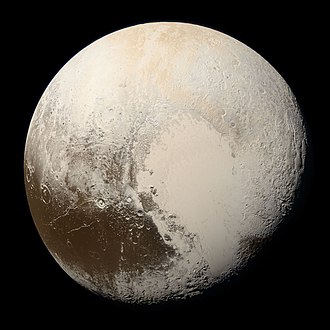
Some special numbers were chosen for naming asteroids, and there was discussion about whether Pluto should have been number 10000. This list includes a few objects that are not asteroids.
Keep exploring



This article is a child-friendly adaptation of the Wikipedia article on List of exceptional asteroids, available under CC BY-SA 4.0.
Images from Wikimedia Commons. Tap any image to view credits and license.