
List of most massive black holes
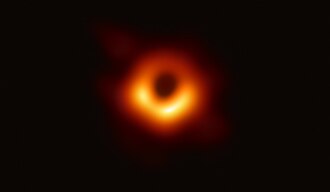
This page is an ordered list of the most massive black holes that scientists have found so far, along with some probable candidates. A black hole is a place in space where matter is packed very tightly.
Black hole sizes are measured in solar masses, written as M☉. One solar mass is about 2×1030 kilograms, which is roughly the mass of our Sun.
Because the list is put in order, it shows the black holes ranked by their mass.
Introduction
A supermassive black hole (SMBH) is an extremely large black hole, with a mass of at least hundreds of thousands of solar masses (M☉). It is thought to exist at the center of almost all massive galaxies, and some galaxies even have pairs of SMBHs, such as the OJ 287 system. Clear evidence for SMBHs has been found in only a few galaxies, including the Milky Way, the Local Group galaxies M31 and M32, and NGC 4395. In these galaxies, the root mean square speed of stars or gas rises near the center, which points to a point mass there. Scientists widely accept that nearly every galaxy has a supermassive black hole at its center, because of the M–sigma relation. This is a close connection between the mass of the black hole and the velocity dispersion of stars in the galaxy's bulge, and it suggests that the black hole and its galaxy formed together.
Massive black holes are rare, and only fewer than several dozen are known. Their masses are very hard to measure, so this remains an area of active research. Accurate masses are known only for galaxies in the Laniakea Supercluster and for active galactic nuclei. Methods such as reverberation mapping, Doppler measurements, and velocity dispersion are not yet well established, and their results often disagree. This list includes black holes whose masses are known at least to the nearest power of ten. The Sloan Digital Sky Survey (SDSS) has found 200,000 quasars, which may contain black holes of about 109 solar masses, so the list is far from complete. Still, most well-known black holes above 109 M☉ are shown, along with all Messier galaxies with precisely known black holes. Some black holes, called "stupendously large," may be more than 1011 or even 1012 M☉.
List
Masses are shown in scientific notation, a short way of writing very large numbers. When possible, the uncertainty, or how close the measurement might be, is written in parentheses.
Each black hole in this list was measured in a different way, so some masses are more certain than others. The notes explain how each mass was found.
| Host or black hole name | Mass (M☉) |
|---|---|
| (Maximal Theoretical Limit) | 2.7×10¹¹ |
| Phoenix A | 1×10¹¹, ~1.26×10¹⁰ |
| IC 1101 | 9.77 +17.14 −6.22 × 10¹⁰ |
| 4C +74.13 | 5.13+9.66 −3.35×10¹⁰ |
| (Typical Theoretical Limit) | 5×10¹⁰ |
| TON 618 | 4.07×10¹⁰ |
| SDSS J143148.09+053558 | 3.64×10¹⁰ |
| SDSS J114833.14+193003.2 | 3.631+0.550 −0.625×10¹⁰ |
| NGC 3842 | 3.46+6.30 −2.24×10¹⁰ |
| SMSS J215728.21-360215.1 | 3.4±0.6 × 10¹⁰ |
| SDSS J102325.31+514251.0 | 3.31+0.67 −0.56×10¹⁰ |
| Abell 1201 BCG | 3.27±0.71 × 10¹⁰ |
| H1821+643 | 3×10¹⁰ |
| NGC 6166 | 2.84+0.27 −0.18×10¹⁰ |
| 4C +37.11 | 2.8+0.8 −0.8×10¹⁰ |
| ESO 383-76 | 2.75+4.66 −1.73×10¹⁰ |
| 2MASS J13260399+7023462 | 2.7±0.4 × 10¹⁰ |
| ESO 444-46 | 2.69×10¹⁰(5.01×10⁸–7.76×10¹⁰) |
| UGC 10143 | 2.63×10¹⁰ |
| APM 08279+5255 | 2.3×10¹⁰, 1.0+0.17 −0.13×10¹⁰ |
| Holmberg 15A | 2.16+0.23 −0.28 × 10¹⁰ |
| NGC 4889 | 2.1±1.6 × 10¹⁰ |
| SDSS J074521.78+734336.1 | 1.95±0.05 × 10¹⁰ |
| OJ 287 primary | 1.835×10¹⁰ |
| NGC 1600 | 1.7±0.15 × 10¹⁰ |
| SDSS J010013.02+280225.8 | 5.0×10⁹ – 1.58×10¹⁰ |
| SDSS J08019.69+373047.3 | (1.51±0.31)×1010 |
| SDSS J115954.33+201921.1 | (1.41±0.10)×1010 |
| SDSS J075303.34+423130.8 | (1.38±0.03)×1010 |
| SDSS J080430.56+542041.1 | (1.35±0.22)×1010 |
| SDSS J081855.77+095848.0 | (1.20±0.06)×1010 |
| NGC 1270 | 1.2×10¹⁰ |
| SDSS J082535.19+512706.3 | (1.12±0.20)×1010 |
| S5 0014+81 | (1.1–1.38)×1010 |
| SDSS J013127.34-032100.1 | (1.1±0.2)×1010 |
| ICRF J131043.3-555211 | 1.05+0.02 −0.05×10¹⁰ |
| PSO J334.2028+01.4075 | 1×10¹⁰ |
| RX J1532.9+3021 | 1×10¹⁰ |
| QSO B2126-158 | 1×10¹⁰–4.9+1.13 −1.01×10¹⁰ |
| NGC 1281 | 1×10¹⁰ |
| SDSS J015741.57-010629.6 | (9.8±1.4)×109 |
| SDSS J230301.45-093930.7 | (9.12±0.88)×109 |
| SDSS J140821.67+025733.2 | 8×10⁹ |
| SDSS J075819.70+202300.9 | (7.8±3.9)×109 |
| CID-947 | 6.9+0.8 −1.2×10⁹ |
| SDSS J080956.02+502000.9 | (6.46±0.45)×109 |
| SDSS J014214.75+002324.2 | (6.31±1.16)×109 |
| Messier 87 | 7.22+0.34 −0.40×10⁹ 6.3×10⁹ |
| NGC 5419 | 7.2+2.7 −1.9×10⁹ |
| SDSS J025905.63+001121.9 | (5.25±0.73)×109 |
| SDSS J094202.04+042244.5 | (5.13±0.71)×109 |
| QSO B0746+254 | 5×10⁹ |
| QSO B2149-306 | 5×10⁹ |
| SDSS J090033.50+421547.0 | (4.7±0.2)×109 |
| Messier 60 | (4.5±1.0)×109 |
| SDSS J011521.20+152453.3 | (4.1±2.4)×109 |
| QSO B0222+185 | 4×10⁹ |
| Hercules A (3C 348) | 4×10⁹ |
| SDSS J075403.60+481428.0 | 3.89×10⁹ |
| SDSS J150752.66+133844.5 | 3.681×10⁹ |
| Abell 1836-BCG | 3.61+0.41 −0.50×10⁹ |
| SDSS J213023.61+122252.0 | (3.5±0.2)×109 |
| SDSS J173352.23+540030.4 | (3.4±0.4)×109 |
| WISE J104222.11+164115.3 | 3.24×10⁹ |
| SDSS J025021.76-075749.9 | (3.1±0.6)×109 |
| NGC 1271 | 3.0+1.0 −1.1×10⁹ |
| SDSS J030341.04-002321.9 | (3.0±0.4)×109 |
| QSO B0836+710 | 3×10⁹ |
| SDSS J162752.18+541912.5 | 2.75×10⁹ |
| SDSS J224956.08+000218.0 | (2.63±1.21)×109 |
| SDSS J030449.85-000813.4 | (2.4±0.50)×109 |
| SDSS J234625.66-001600.4 | (2.24±0.15)×109 |
| ULAS J1120+0641 | 2×10⁹ |
| QSO 0537-286 | 2×10⁹ |
| NGC 3115 | 2×10⁹ |
| Q0906+6930 | 2×10⁹ |
| SDSS J025231.19+034112.7 | 1.51×10⁹ |
| QSO B0805+614 | 1.5×10⁹ |
| Messier 84 | 1.5×10⁹ |
| Pōniuāʻena (J100758.264+211529.207) | (1.5±0.2)×109 |
| PKS 2059+034 | 1.36×10⁹ |
| Abell 3565-BCG | 1.34+0.21 −0.19×10⁹ |
| NGC 7768 | 1.3+0.5 −0.4×10⁹ |
| NGC 1277 | 1.2×10⁹ |
| SDSS J233254.46+151305.5 | 1.094×10⁹ |
| QSO B225155+2217 | 1×10⁹ |
| QSO B1210+330 | 1×10⁹ |
| Cygnus A | 1×10⁹ |
| Sombrero Galaxy | 1×10⁹ |
| Markarian 501 | 9×10⁸–3.4×10⁹ |
| PG 1426+015 | (1.298±0.385)×109 467740000 |
| 3C 109 | 9.3×10⁸ |
| 3C 273 | (8.86±1.87)×108 550000000 |
| ULAS J1342+0928 | 8×10⁸ |
| SDSS J155053.16+052112.1 | 7.94×10⁸ |
| Messier 49 | 5.6×10⁸ |
| NGC 1399 | 5×10⁸ |
| PG 0804+761 | (6.93±0.83)×108 190550000 |
| PG 1617+175 | (5.94±1.38)×108 275420000 |
| PG 1700+518 | 7.81+1.82 −1.65×10⁸ 60260000 |
| UGC 12591 | (6.18±2.61)×108 |
| SDSS J214611.58-070449.2 | 2.75×10⁹ |
| SDSS J020151.65+012902.5 | 5.37×10⁸ |
| SDSS J113029.48+634620.4 | 4.90×10⁸ |
| NGC 4261 | 4×10⁸ |
| PG 1307+085 | 4.4±1.23 × 10⁸, 281 840 000 |
| SDSS J134617.54+622045.5 | 3.98×10⁸ |
| SAGE0536AGN | 3.5±0.8 × 10⁸ |
| NGC 1275 | 3.4×10⁸ |
| 3C 390.3 | 2.87±0.64 × 10⁸ 338840000 |
| II Zwicky 136 | (4.57±0.55)×108 144540000 |
| PG 0052+251 | (3.69±0.76)×108 218780000 |
| Messier 59 | 2.7×10⁸ |
| PG 1411+442 | (4.43±1.46)×108 79430000 |
| Markarian 876 | (2.79±1.29)×108 240000000 |
| PG 0953+414 | (2.76±0.59)×108 182000000 |
| PG 0026+129 | (3.93±0.96)×108 53700000 |
| Fairall 9 | (2.55±0.56)×108 79430000 |
| NGC 7727 | 1.54+0.18 −0.15×10⁸ |
| Markarian 1095 | (1.5±0.19)×108 182000000 |
| Andromeda Galaxy (Messier 31) | 1.41+0.63 −4.4×10⁸, 6.22+3.19 −2.11×10⁷, 9.4+8.1 −4.35×10⁷, 6.98+7.88 −3.29×10⁷, 3.74+11.43 −1.39×10⁷, 1.19+2.41 −0.8×10⁸, 4.36+3.57 −1.96×10⁷, 2.96+3.08 −1.51×10⁷ |
| OJ 287 secondary | 1.5×10⁸ |
| PG 1211+143 | 1.46±0.44 × 10⁸, 40740000 |
| Messier 105 | 1.4×10⁸–2×10⁸ |
| Markarian 509 | 1.43±0.12 × 10⁸, 57550000 |
| RX J124236.9-111935 | 1×10⁸ |
| Messier 85 | 1×10⁸ |
| NGC 5548 | 6.71±0.26 × 10⁷ 123000000 |
| Messier 88 | 8×10⁷ |
| Messier 81 (Bode's Galaxy) | 7×10⁷ |
| Markarian 771 | 7.32±3.52 × 10⁷ 7.586×10⁷ |
| Messier 58 | 7×10⁷ |
| PG 0844+349 | 9.24±3.81 × 10⁷ 2.138×10⁷ |
| Centaurus A | 5.5×10⁷ |
| Markarian 79 | 5.24±1.44 × 10⁷ 5.25×10⁷ |
| Messier 96 | 4.8×10⁷ (48000000) |
| Markarian 817 | 4.94±0.77 × 10⁷ 4.365×10⁷ |
| NGC 3227 | 4.22±2.14 × 10⁷ 3.89×10⁷ |
| NGC 4151 primary | 4×10⁷ |
| 3C 120 | 5.55+3.14 −2.25×10⁷ 2.29×10⁷ |
| Markarian 279 | 3.49±0.92 × 10⁷ 4.17×10⁷ |
| NGC 3516 | 4.27±1.46 × 10⁷ 2.3×10⁷ |
| NGC 863 | 4.75±0.74 × 10⁷ 1.77×10⁷ |
| Messier 82 (Cigar Galaxy) | 3×10⁷ |
| Messier 108 | 2.4×10⁷ |
| M60-UCD1 | 2×10⁷ |
| NGC 3783 | 2.98±0.54 × 10⁷ 9300000 |
| Markarian 110 | 2.51±0.61 × 10⁷ 5620000 |
| Markarian 335 | 1.42±0.37 × 10⁷ 6310000 |
| NGC 4151 secondary | 10×106 (10000000) |
| NGC 7469 | 12.2±1.4 × 10⁶, 6460000 |
| IC 4329A | 9.90+17.88 −11.88×10⁶, 5010000 |
| NGC 4593 | 5.36+9.37 −6.95×10⁶, 8130000 |
| Messier 61 | 5×10⁶ |
| Sagittarius A* | 4.3×10⁶ (8.54×1036 kg) |
| Messier 32 | 1.5×10⁶ – 5×10⁶ |
| NGC 4395 | 3.599×10⁵ (1.7±0.3)×104 1×10⁴ (8±4)×103 |
Pictures
Keep exploring



This article is a child-friendly adaptation of the Wikipedia article on List of most massive black holes, available under CC BY-SA 4.0.
Images from Wikimedia Commons. Tap any image to view credits and license.