
Louisiana (New France)
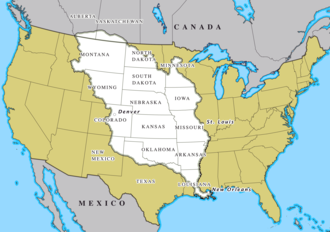
Louisiana, also known as French Louisiana, was a district of New France. In 1682, the French explorer René-Robert Cavelier, Sieur de la Salle erected a cross near the mouth of the Mississippi River and claimed the whole drainage basin of the Mississippi River in the name of King Louis XIV, naming it "Louisiana". This land area stretched from near the Great Lakes to the Gulf of Mexico and from the Appalachian Mountains to the Rocky Mountains.
The area was under French control from 1682 to 1762 and in part from 1801 to 1803. Louisiana included two regions: Upper Louisiana, which began north of the Arkansas River, and Lower Louisiana. The U.S. state of Louisiana is named for this historical region, though it is only a small part of the vast lands claimed by France.
French exploration of the area began during the reign of Louis XIV, but the vast French Louisiana was not widely developed due to a lack of human and financial resources. After its defeat in the Seven Years' War, France ceded the east part of the territory in 1763 to the victorious British, and the west part to Spain. France later regained control of the western territory in 1800 but sold it to the United States in the Louisiana Purchase of 1803, ending France's presence. Today, remnants of France's time in the region can still be found, especially in New Orleans and along the Mississippi River.
Boundaries, settlement and geography
In the 1700s, the area called Louisiana was a huge part of North America. It stretched from near the Great Lakes down to the Gulf of Mexico, and from the Appalachian Mountains out to the Rocky Mountains. Most of this land was part of the Mississippi River watershed.
Only two main areas saw many French settlers. The first was Upper Louisiana, also called the Illinois Country, which included parts of today’s Missouri, Illinois, and Indiana. The second was Lower Louisiana, covering parts of today’s Louisiana, Arkansas, Mississippi, and Alabama.
Both areas had many Native American tribes living there. At times, there were only a few hundred French soldiers in the whole colony, but the Native American population was much larger, with over 35,000 people in the mid-1720s. The land was mostly flat, making it easy to travel, though it became more hilly toward the west.
Lower Louisiana included lands along the lower Mississippi River. French explorers first visited in the 1660s and set up trading posts. Real settlement began in 1686 at Arkansas Post and grew with Fort Maurepas near today’s Biloxi, Mississippi in 1699. The capital moved from Mobile to Biloxi and finally to New Orleans in 1722.
Upper Louisiana, or the Illinois Country, was explored in 1673 by Louis Joliet and Jacques Marquette. Settlers from French Canada came here and mixed with local Illinois peoples. They liked the farmland and the forests for hunting and trapping.
Important settlements in Upper Louisiana included Cahokia, Kaskaskia, Fort de Chartres, Saint Philippe, Prairie du Rocher, and Ste. Genevieve. The area was first governed from Canada but became part of Louisiana in 1712. By the 1720s, it had its own leaders.
The borders of Upper Louisiana were not always clear. Over time, the area came to mean the land southwest of the Great Lakes. By 1745, the boundary with Canada was set along rivers leading to Vincennes and Peoria.
After France lost control of the area, many French settlers moved to places like St. Louis, which became a center for fur trading. Even after France sold Louisiana to the United States in 1803, French culture continued in areas like the Missouri Ozarks, where communities such as Mine à Breton and Old Mines formed.
A special way of speaking French, called Missouri French, developed in this area. It was different from other French dialects and was spoken in the Midwest until the 20th century, though very few people speak it today.
History
From 1718 to 1763, Louisiana was part of the French Empire. Later, it became part of the Spanish Empire until 1802, then the French Republic, and finally the United States of America from 1803 onward. During the American Civil War (1861–1865), it was briefly part of the Confederate States of America before rejoining the United States.
In the 1600s, France began exploring North America. French explorers wanted to find a route to China, use the land's natural resources like fur, and spread their religion. In 1682, René-Robert Cavelier, Sieur de La Salle, traveled down the Mississippi River to its mouth. He claimed the entire area for France and named it “Louisiana” after the French king, Louis XIV. He built forts and made friends with local Native American tribes.
Later, La Salle tried to start a colony but faced many problems and never found the Mississippi River’s mouth again. Despite these challenges, French settlers continued to explore and build communities in the region. Over time, Louisiana changed hands between France, Spain, and the United States.
Political and administrative organization
It was challenging for Louis XIV and his successors to manage Louisiana, a land much bigger than European France. They wanted to control the colony but often didn’t give it enough money to work properly.
Louis XIV and his team wanted to grow New France and keep it safe from other European countries, especially Britain. They didn’t want local groups to have too much power, so they kept control tightly. Over time, Louisiana changed rulers, from being under a rich businessman to being controlled again by the king. The colony used laws from Metropolitan France, like the Custom of Paris, which helped keep things fair for a while.
Louisiana was part of New France, which also included parts of modern-day Canada. It was ruled by a governor-general and a commissaire-ordonnateur, who handled many jobs like managing money and keeping order. Because Louisiana was so big and far from Quebec, different areas often managed themselves. The main city moved from Mobile to Biloxi and finally to New Orleans in 1722.
Religious establishment
The French lands in North America were led by one Catholic church area based in Quebec. The church leader was chosen and paid by the king. Because there wasn’t much close watching, people in Louisiana didn’t follow their faith as closely as people in France or Canada did. The money the church collected from people was also less than in France.
Even so, the church was very important in exploring French Louisiana. It sent groups, mostly led by the Jesuits, to teach Native American people about their beliefs. The church also started schools and hospitals. By 1720, the Ursulines were running a hospital in New Orleans. Church workers met with many Native American tribes. Some priests, like Father Marquette in the 1600s, joined exploring trips. The Jesuits translated prayers into many Native American languages to help teach them. They also tried to connect Native traditions with Christian teachings. A mixed belief system grew among some new followers of the church. True and lasting changes in belief were few; many people who learned about the church mixed its ideas, like the Holy Trinity, with their own beliefs about spirits or didn’t accept them at all.
Colonial society
It is hard to know exactly how many people lived in France's colonies in North America. While we have good records about the colonists and enslaved Africans, it is difficult to know about the Native American peoples. During the 1700s, the society of Louisiana became very mixed.
Language
Colonial French was a special way of speaking French used in Louisiana. It was spoken by many people, including Creoles and Cajuns. After many Acadians came to Louisiana, their way of speaking also changed the language.
Native Americans
In the year 1500, about seven million Native Americans lived in North America. But many died from new diseases brought by Europeans. By the late 1600s, there were probably only 100,000 to 200,000 Native Americans left in Lower Louisiana. Some were forced to work for French colonists.
Enslaved Africans
In 1717, French leaders decided to bring enslaved Africans to Louisiana to work on plantations. By 1730, most people in the colony were enslaved. Life was very hard for them, but they also brought their own traditions, like the vegetable okra, which is used in gumbo.
Colonists
Many French people came to Louisiana, but it was difficult. The climate was very different, and diseases were common. Some settlers were young men who had to work for a time to pay for their journey. Others were women sent to marry soldiers. Over time, people from many places, including Switzerland, Germany, Spain, and Acadia, came to live there.
Creoles
Creoles were people born in Louisiana to European parents. Louisiana did not get as many French settlers as other places. Life was tough, with storms, floods, and diseases.
Peasants, artisans, and merchants
Life was easier for some people in Louisiana than in France. Some traders became wealthy, and large planters lived in a fancy way, copying styles from Paris.
French soldiers
The King sent soldiers to protect the colony. Some soldiers ran away to live with Native American tribes.
Coureurs des bois
Coureurs des bois were adventurers who explored the forests and rivers of North America. They traded furs with Native Americans and sometimes married into their tribes. One famous coureur des bois was Toussaint Charbonneau, husband of Sacagawea, who helped the Lewis and Clark Expedition.
French and the Native Americans
France wanted the Native Americans to become part of the French kingdom and follow the Christian faith. However, because France was far away and there were not many French settlers, the Native Americans mostly lived independently. Local leaders and officers could not always enforce rules, so they often worked out agreements with the tribes.
The Native Americans were very important to the French settlers. They helped the settlers survive, joined them in trading furs, and acted as guides during journeys. Their help was also crucial in battles against other tribes and rival European colonies.
The two groups learned from each other in many ways. The French learned Native American languages, and the Native Americans bought items like cloth, alcohol, and guns from the French. Sometimes, they even shared their religious beliefs. French trappers and soldiers used canoes and moccasins, and they ate foods like wild rice, bear, and dog. Even today, some foods like jambalaya have roots in these shared traditions. Native American healers sometimes helped French settlers using natural remedies.
While many settlers respected the Native Americans, others did not always agree with their customs. There were occasional conflicts, but overall, the relationship was mostly peaceful and built on discussion and compromise.
Economy of French Louisiana
See also: Mississippi Company and Bank of France § Central banking before the Bank of France
Illinois Country
Main article: Illinois Country
The northern part of French Louisiana, called the Illinois Country, was not very crowded. It used to be part of French Canada but was given to Louisiana in 1717. This area was mostly used for farming grain and cereals. French farmers lived in villages near places like Fort de Chartres, Kaskaskia, Prairie du Rocher, and Sainte-Geneviève. They grew corn and wheat, and also raised animals like horses, cows, and pigs. They also grew small amounts of tobacco, hemp, flax, and grapes, though most wine came from France.
Trading posts in the Illinois Country were important for the fur trade. They traded animal skins for things like weapons and cloth. These posts were often fortified and sometimes made of stone, like Fort de Chartres. The Illinois Country also made salt and lead and provided food to New Orleans.
Lower Louisiana
In Lower Louisiana, large farms called plantations used workers to grow many different crops. The farm owners lived in New Orleans but had others manage the farms for them.
The crops grown there were chosen to suit the weather and land. Some crops, like corn, vegetables, rice, and livestock, were used by people living there. Other crops, like tobacco and indigo, were sent to France.
Economic role of New Orleans
New Orleans was the main city for trade in Louisiana, even though it was still small for many years. The people there built things to help with trade, like a canal in 1723. Shops along the Mississippi River were also used for storing goods. New Orleans sent animal skins and farm products to other places. It also received supplies from France, such as food, alcohol, weapons, tools, and clothes. New Orleans sold wood, rice, and corn to French islands in the West Indies.
End of French Louisiana
Seven Years' War and its consequences
Main article: Louisiana (New Spain)
Tensions between the French and British grew again two years before the start of the Seven Years' War in Europe. In North America, this conflict was called the French and Indian War. After some early wins from 1754 to 1757, with help from Native American friends, the French faced big losses in Canada from 1758 to 1760, ending with the surrender of the capital city Quebec. Without Canada, defending Louisiana became too hard.
The Treaty of Paris, signed on February 10, 1763, officially removed the French from North America. Canada and the east side of the Mississippi River went to Great Britain (Province of Quebec (1763–1791)). New Orleans and the west side of the river were secretly given to Spain the year before. This caused some settlers to leave, but Spain took control of these areas, calling them Luisiana, though they did so late, in 1769, and didn’t bring many new people. To the east, the United States planned to expand west, and in 1795, they were allowed to use the Mississippi River for trade.
Ephemeral renewal of French Louisiana
Main articles: Third Treaty of San Ildefonso and Treaty of Aranjuez (1801)
See also: Louisiana Purchase
During the French Revolution, Louisiana, under Spanish control, saw unrest. Some French-speaking colonists sent requests to their leaders, and slaves tried to escape in 1791 and 1795.
The Third Treaty of San Ildefonso, signed in secret on October 1, 1800, planned to give Western Louisiana and New Orleans back to France in return for the Duchy of Parma. This was confirmed by the Treaty of Aranjuez on March 21, 1801. However, Napoleon Bonaparte changed his mind about keeping the large territory. The soldiers he sent to take control of Louisiana were first sent to restore French control over Saint-Domingue, but they failed. Because of this and worsening relations with Britain, Napoleon decided to sell Louisiana to the United States. This sale happened on April 30, 1803, for 80 million francs (15 million dollars). The United States officially took control of Louisiana on December 20, 1803.
French heritage today
Further information: History of the Franco-Americans, French in the United States, and Métis people (United States)
The French time in Louisiana left a lasting cultural legacy that people celebrate today. The French language, including Louisiana Creole French and Cajun French, has faced challenges, so groups like the CODOFIL work to keep it alive. Many places in the United States have French names, such as St. Louis, Detroit, Baton Rouge, and New Orleans.
Louisiana’s culture also includes music and festivals that started during French times. Creole songs helped shape the blues and jazz, and Cajun music stays popular. The Carnival season in New Orleans, especially around Mardi Gras Day, shows the strong influence of traditions from France.
Pictures
Keep exploring


This article is a child-friendly adaptation of the Wikipedia article on Louisiana (New France), available under CC BY-SA 4.0.
Images from Wikimedia Commons. Tap any image to view credits and license.