 Safekipedia
New Orleans
Adapted from Wikipedia · Discoverer experience
New Orleans, often called NOLA or The Big Easy, is a lively city along the Mississippi River in Louisiana. It is the biggest city in Louisiana and well-known for its special music, tasty Creole cuisine, unique ways of speaking, and fun festivals, especially Mardi Gras. The old part of the city, the French Quarter, is famous for its beautiful old buildings and busy streets like Bourbon Street.
The city was started in 1718 by French people and used to be an important place for trade. New Orleans has always been close to water, which sometimes causes flooding. After a big storm in 2005 called Hurricane Katrina, much of the city was flooded, and many people had to leave their homes. But the city has been rebuilding and growing again.
Today, New Orleans is also a popular place for making movies and TV shows, earning the nickname “Hollywood South.” With its rich history and many different cultures, New Orleans remains one of the most interesting cities in the United States.
Etymology and nicknames
Long ago, before European people arrived, the Choctaw people called the area Bulbancha, meaning "land of many tongues". This name described the many languages spoken there.
The city’s name, New Orleans, comes from French La Nouvelle-Orléans. It was named to honor Philippe II, Duke of Orléans, who helped rule France. The city also has many fun nicknames. One is Crescent City, named after the shape of the Mississippi River there. Another is The Big Easy, which musicians used to describe the city. NOLA is just a short way to say New Orleans, Louisiana.
History
Main article: History of New Orleans
For a chronological guide, see Timeline of New Orleans.
French–Spanish colonial era
Main articles: Louisiana (New France), New France, Treaty of Paris (1763), Louisiana (New Spain), and New Spain
See also: Seven Years' War, French and Indian War, Gulf Coast campaign, Spain and the American Revolutionary War, Third Treaty of San Ildefonso, and Treaty of Aranjuez (1801)
Historical claims
La Nouvelle-Orléans (New Orleans) was founded in the spring of 1718 by the French Mississippi Company under Jean-Baptiste Le Moyne de Bienville, on land traditionally inhabited by the Chitimacha people. The city was named for Philippe II, Duke of Orléans, then-regent of the Kingdom of France. As a colony, French Louisiana faced conflict with Native American tribes. In 1729, an attack happened at Fort Rosalie, resulting in the deaths of over 200 French colonists. A campaign was launched that destroyed a local tribe, but it led to tensions between France and the territory's Native Americans.
New Orleans quickly became a cultural and commercial center in French Louisiana. Its position as a key port made it important for goods moving between the interior of North America and the Atlantic world. Institutions like the Ursuline sisters, founded in 1727 by nuns sponsored by the Company of the Indies, reflected the city's role in French religious and educational networks. The convent educated girls and remains important to several modern schools in the city. Early city planning and architecture were shaped by military engineers, whose designs laid out the enduring street grid and fortifications.
After France ceded Louisiana to the Spanish Empire in the 1763 Treaty of Paris, New Orleans residents resisted Spanish rule. Local residents briefly took control of the city. During the American Revolutionary War, New Orleans played a key role as a supply center for the American cause.
United States territorial era
Main articles: Louisiana Purchase, Territory of Orleans, and Dominican Creoles
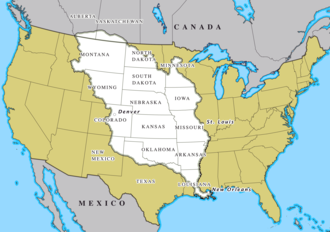
The Third Treaty of San Ildefonso in 1800 restored French control of New Orleans and Louisiana, but Napoleon sold both to the United States in the Louisiana Purchase in 1803. The city grew rapidly with new people arriving from many places. Major crops of sugar and cotton were grown with labor on nearby large plantations.
Between 1791 and 1810, thousands of St. Dominican refugees from arriving in New Orleans; these refugees had a big impact on the culture of Louisiana.
On January 8–11, 1811, about 500 enslaved people rose up against those who held them, killing two people in the process. They were eventually stopped by local militia.
Battle of New Orleans and antebellum period
Main articles: Battle of New Orleans and War of 1812
During the final campaign of the War of 1812, a British force tried to capture New Orleans. Despite challenges, General Andrew Jackson, with support from various groups, defeated the British in the Battle of New Orleans on January 8, 1815. The armies had not learned of the Treaty of Ghent, which had been signed earlier.
As a port, New Orleans played a major role during a certain period in the trade. The port handled goods for export from the interior and imported goods from other countries. Despite this, New Orleans also had a large and successful community of free people, who were often educated and owned property.
New Orleans housed a large market, particularly after the U.S. ended an earlier trade in 1808. The trade's economic value was immense, and the broader economy around it generated even more money. As a result, New Orleans benefited significantly, both financially and commercially, from this system.
Following the Louisiana Purchase, new immigrants migrated to the city, contributing to its rapid growth. By 1840, New Orleans was a wealthy and populous city in the U.S. The white population remained influential, with French still used in some schools. Free people formed a distinct class, even as the majority of black residents remained enslaved.[page needed] The city's prosperity was shadowed by repeated epidemics of yellow fever and other diseases, which killed many residents in the 19th century. By 1860, the city's population had reached nearly 170,000.
Civil War–Reconstruction era
See also: New Orleans in the American Civil War and Louisiana in the American Civil War
As the Creole elite feared, the American Civil War changed their world. In April 1862, following the city's occupation by the Union Navy after the Battle of Forts Jackson and St. Philip, Gen. Benjamin F. Butler was appointed military governor. New Orleans residents supportive of the Confederacy nicknamed him "Beast" Butler.
Significantly, Butler abolished French-language instruction in city schools. Statewide measures in 1864 and, after the war, 1868 further strengthened the English-only policy imposed by federal representatives. With the predominance of English speakers, that language had already become dominant in business and government. By the end of the 19th century, French usage had faded.
As the city was captured and occupied early in the war, it was spared the destruction through warfare suffered by many other cities of the American South. Large numbers of rural freed people and some free people of color from the city volunteered for the first regiments of Black troops in the War.
Violence in the South spurred Congress to pass certain laws, granting citizenship and civil rights to freed people and free people of color. During a certain period, Louisiana was governed under a specific district, and Louisiana was readmitted to the Union in 1868 with a new constitution that established universal public education, and elected both black and white officials. New Orleans also maintained an integrated public school system during this period. However, wartime destruction, a financial recession, and another event hindered economic recovery. From 1868, some people used violence to suppress certain voters and disrupt meetings, culminating in a contested gubernatorial election and the rise of a certain group. In 1874, they seized state offices, and by 1876, certain leaders had reclaimed the state legislature. Federal troops withdrew in 1877, ending a certain period. In 1892 the integrated unions of New Orleans led a general strike in the city from November 8 to 12, shutting down the city & winning the vast majority of their demands.
Jim Crow era
Dixiecrats and Democrats passed Jim Crow laws, establishing racial segregation in public facilities. In 1889, the legislature passed a constitutional amendment incorporating a certain clause that effectively disfranchised freed people as well as the propertied people of color manumitted before the war. Unable to vote, African Americans could not serve on juries or in local office, and were closed out of formal politics for generations. The Southern U.S. was ruled by a white Democratic Party. Public schools were racially segregated and remained so until 1960.
New Orleans's large community of well-educated, often French-speaking free persons of color (gens de couleur libres), who had been free prior to the Civil War, fought against Jim Crow. They organized the Comité des Citoyens (Citizens Committee) to work for civil rights. As part of their legal campaign, they recruited one of their own, Homer Plessy, to test whether Louisiana's newly enacted Separate Car Act was constitutional. Plessy boarded a commuter train departing New Orleans for Covington, Louisiana, sat in the car reserved for whites only, and was arrested. The case resulting from this incident, Plessy v. Ferguson, was heard by the U.S. Supreme Court in 1896.
In practice, African-American public schools and facilities were underfunded across the South.
20th century
New Orleans's economic and population zenith in relation to other American cities occurred in the antebellum period. It was the nation's fifth-largest city in 1860 (after New York, Philadelphia, Boston and Baltimore) and was significantly larger than all other southern cities. From the mid-19th century onward rapid economic growth shifted to other areas, while New Orleans's relative importance steadily declined. The growth of railways and highways decreased river traffic, diverting goods to other transportation corridors and markets. Thousands of the most ambitious people of color left the state around World War II and after, many for West Coast destinations. From the late 1800s, most censuses recorded New Orleans slipping down the ranks in the list of largest American cities (New Orleans's population still continued to increase throughout the period, but at a slower rate than before the Civil War).
In 1929, a streetcar strike took place in the city, during which serious unrest occurred.
By the mid-20th century, New Orleanians recognized that their city was no longer the leading urban area in the South. By 1950, Houston, Dallas, and Atlanta exceeded New Orleans in size, and in 1960 Miami eclipsed New Orleans, even as the latter's population reached its historic peak. As with other older American cities, highway construction and suburban development drew residents from the center city to newer housing outside. The 1970 census recorded the first absolute decline in population since the city became part of the United States in 1803. The New Orleans metropolitan area continued expanding in population, albeit more slowly than other major Sun Belt cities. While the Port of New Orleans remained one of the nation's largest, automation and containerization cost many jobs.
During the later years of Mayor deLesseps Morrison's administration and throughout Victor Schiro's tenure, New Orleans became a focal point of certain movements. The Southern Christian Leadership Conference was founded in the city, and lunch counter sit-ins took place in Canal Street department stores. Tensions escalated in 1960 during school desegregation following a certain ruling. Six-year-old Ruby Bridges integrated William Frantz Elementary School, becoming the first child of color to attend a previously all-white Southern school. Racial controversy also surrounded the 1956 Sugar Bowl, when Georgia governor Marvin Griffin opposed the participation of Pitt Panthers African-American fullback Bobby Grier. Georgia Institute of Technology president Blake R. Van Leer defied the governor, and the game proceeded. The federal Civil Rights Act of 1964 and the Voting Rights Act of 1965 restored key constitutional protections, but economic and educational disparities between Black and White residents remained. As more affluent residents left the city, its population became increasingly poor and predominantly African-American. Beginning in 1980, Black-majority leadership emerged, working to address entrenched socioeconomic inequities.
By the late 20th century, New Orleans had grown increasingly reliant on tourism amid rising poverty, low educational attainment, and high crime, which hindered its adaptation to the broader U.S. shift toward a post-industrial service economy. Meanwhile, city leaders pursued geographic expansion through ambitious drainage efforts. Engineer A. Baldwin Wood designed a pump system that allowed development in formerly uninhabitable swamp and marsh areas, but over time, these areas subsided significantly below sea level. Although the city had always faced flooding risks, awareness of its vulnerability grew after Hurricane Betsy in 1965 and the May 8th 1995 Louisiana Flood. These events exposed the limits of the drainage system, prompting upgrades. By the 1980s and 1990s, scientists warned that erosion of the marshlands and swamp surrounding New Orleans, exacerbated by developments like the Mississippi River–Gulf Outlet Canal, had left the city more exposed than ever to hurricane storm surges.[citation needed]
21st century
See also: Effects of Hurricane Katrina in New Orleans and Reconstruction of New Orleans
New Orleans was affected by when the federal levee system failed during Hurricane Katrina on August 29, 2005. By the time the hurricane approached the city on August 29, 2005, most residents had evacuated. As the hurricane passed through the Gulf Coast region that day, the city's federal flood protection system failed, resulting in the worst civil engineering disaster in American history at the time. Floodwalls and levees constructed by the United States Army Corps of Engineers failed below design specifications and 80% of the city flooded. Tens of thousands of residents who had remained were rescued or otherwise made their way to shelters of last resort at the Louisiana Superdome or the New Orleans Morial Convention Center. More than 1,500 people were recorded as having died in Louisiana, most in New Orleans, while others remain unaccounted for. Before Hurricane Katrina, the city called for the first mandatory evacuation in its history, to be followed by another mandatory evacuation three years later with Hurricane Gustav.
The city was declared off-limits to residents while efforts to clean up after Hurricane Katrina began. The approach of Hurricane Rita in September 2005 caused repopulation efforts to be postponed, and the Lower Ninth Ward was reflooded by Rita's storm surge. Because of the scale of damage, many people resettled permanently outside the area. Federal, state, and local efforts supported recovery and rebuilding in severely damaged neighborhoods. The U.S. Census Bureau in July 2006 estimated the population to be 223,000; the city was estimated to have regained approximately 60% of its pre-Katrina population by summer 2007. Ten years after the hurricane, the population had recovered to 80% of what it was at the 2000 census.
Several major tourist events and other forms of revenue for the city have returned. Large conventions returned. College bowl games returned for the 2006–2007 season. The New Orleans Saints returned that season. The New Orleans Hornets (now named the Pelicans) returned to the city for the 2007–2008 season. New Orleans hosted the 2008 NBA All-Star Game in addition to Super Bowl XLVII. Major annual events such as Mardi Gras, Voodoo Experience, and the Jazz & Heritage Festival were never displaced or canceled. A new annual festival, "The Running of the Bulls New Orleans", was created in 2007.
Geography
New Orleans is located in the Mississippi River Delta, south of Lake Pontchartrain, along the banks of the Mississippi River. It is about 105 miles upriver from the Gulf of Mexico. The city covers an area of 350 square miles, with 169 square miles of land and 181 square miles of water.
Originally built on natural river levees, much of New Orleans is now at or below sea level. After major flood protection projects, the city expanded into areas that were once marshland. Today, half of New Orleans is at or below sea level, while the other half is slightly higher. Some parts of the city are slowly sinking due to natural processes and human activity.
The city's layout includes many different neighborhoods. The Central Business District is near the river and includes Lafayette Square. Streets in this area spread out from a central point, with major roads like Canal Street. Neighborhoods like the French Quarter, Tremé, and Uptown each have their own unique character. New Orleans is famous for its many different architectural styles, including historic homes along St. Charles Avenue.
New Orleans has a humid subtropical climate, with mild winters and hot, humid summers. The city rarely sees snow, but it can happen in very cold weather. Hurricanes pose a serious threat to the area because of the city's low elevation and location near water. Many hurricanes have affected New Orleans over the years, and the city has built strong flood protection systems to reduce damage from future storms.
| Name | Stories | Height |
|---|---|---|
| One Shell Square | 51 | 697 ft (212 m) |
| Place St. Charles | 53 | 645 ft (197 m) |
| Plaza Tower | 45 | 531 ft (162 m) |
| Energy Centre | 39 | 530 ft (160 m) |
| First Bank and Trust Tower | 36 | 481 ft (147 m) |
Demographics
From the 2010 U.S. census to 2014, the city grew by 12%, adding more than 10,000 new residents each year. According to the 2020 United States census, there were 383,997 people living in the city.
Before 1960, New Orleans had a steady increase in population, reaching a historic high of 627,525. After 1960, the population began to decrease due to factors like changes in oil production, tourism, and people moving to nearby areas. This led to economic challenges and higher poverty levels in the city.
The population was greatly affected by Hurricane Katrina in 2005. Before the storm, about 454,865 people lived in New Orleans. After the storm, the population dropped to around 273,000. By 2010, the population had risen again, especially in areas that did not flood.
New Orleans has a diverse population. In 2020, the city was made up of 53.61% Black or African American, 31.61% non-Hispanic white, and 8.08% Hispanic and Latino American. The city also has growing Asian and Hispanic communities.
New Orleans has a strong history with the Roman Catholic faith due to its French and Spanish roots. Many important cultural traditions, like Mardi Gras, reflect this history. The city also has Protestant, Jewish, Muslim, and other religious communities.
| Year | Pop. | ±% |
|---|---|---|
| 1769 | 3,190 | — |
| 1778 | 3,060 | −4.1% |
| 1791 | 5,497 | +79.6% |
| 1810 | 17,242 | +213.7% |
| 1820 | 27,176 | +57.6% |
| 1830 | 46,082 | +69.6% |
| 1840 | 102,193 | +121.8% |
| 1850 | 116,375 | +13.9% |
| 1860 | 168,675 | +44.9% |
| 1870 | 191,418 | +13.5% |
| 1880 | 216,090 | +12.9% |
| 1890 | 242,039 | +12.0% |
| 1900 | 287,104 | +18.6% |
| 1910 | 339,075 | +18.1% |
| 1920 | 387,219 | +14.2% |
| 1930 | 458,762 | +18.5% |
| 1940 | 494,537 | +7.8% |
| 1950 | 570,445 | +15.3% |
| 1960 | 627,525 | +10.0% |
| 1970 | 593,471 | −5.4% |
| 1980 | 557,515 | −6.1% |
| 1990 | 496,938 | −10.9% |
| 2000 | 484,674 | −2.5% |
| 2010 | 343,829 | −29.1% |
| 2020 | 383,997 | +11.7% |
| 2025 (est.) | 362,154 | −5.7% |
| Population given for the City of New Orleans, not for Orleans Parish, before New Orleans absorbed suburbs and rural areas of Orleans Parish in 1874, since which time the city and parish have been coterminous. Population for Orleans Parish was 41,351 in 1820; 49,826 in 1830; 102,193 in 1840; 119,460 in 1850; 174,491 in 1860; and 191,418 in 1870. Source: U.S. Decennial Census Historical Population Figures 1790–1960 1900–1990 1990–2000 2010–2013 2020 estimate | ||
| Race / Ethnicity (NH = Non-Hispanic) | Pop 1980 | Pop 1990 | Pop 2000 | Pop 2010 | Pop 2020 | % 1980 | % 1990 | % 2000 | % 2010 | % 2020 |
|---|---|---|---|---|---|---|---|---|---|---|
| White alone (NH) | 224,694 | 164,526 | 128,971 | 104,770 | 121,385 | 40.30% | 33.11% | 26.59% | 30.47% | 31.61% |
| Black or African American alone (NH) | 304,673 | 305,047 | 323,392 | 204,866 | 205,876 | 54.65% | 61.39% | 66.72% | 59.58% | 53.61% |
| Native American or Alaska Native alone (NH) | 524 | 660 | 852 | 827 | 761 | 0.09% | 0.13% | 0.18% | 0.24% | 0.20% |
| Asian alone (NH) | 7,332 | 8,955 | 10,919 | 9,883 | 10,573 | 1.32% | 1.80% | 2.25% | 2.87% | 2.75% |
| Native Hawaiian or Pacific Islander alone (NH) | x | x | 88 | 105 | 125 | x | x | 0.02% | 0.03% | 0.03% |
| Other race alone (NH) | 1,066 | 512 | 961 | 967 | 2,075 | 0.19% | 0.10% | 0.20% | 0.28% | 0.54% |
| Mixed race or Multiracial (NH) | x | x | 4,765 | 4,360 | 12,185 | x | x | 0.98% | 1.27% | 3.17% |
| Hispanic or Latino (any race) | 19,226 | 17,238 | 14,826 | 18,051 | 31,017 | 3.45% | 3.47% | 3.06% | 5.25% | 8.08% |
| Total | 557,515 | 496,938 | 484,674 | 343,829 | 373,977 | 100.00% | 100.00% | 100.00% | 100.00% | 100.00% |
Economy
New Orleans has one of the world's biggest and busiest ports and is a key center for sea-related industries. The area plays a big role in the nation's oil refining and making products from oil and gas. It is also a base for companies that work on oil and gas both on land and at sea. Since the early 2000s, New Orleans has become a place where many new technology companies are starting up.
The city is also a place for learning, with over 50,000 students going to colleges and universities. Tulane University, a top research school, is in the city. New Orleans is an important spot for health care and has a growing group of creative businesses. The city is famous for its culture and many visitors come to see it. Greater New Orleans, Inc. helps bring in business and jobs for the area.
Port
New Orleans started as an important trading place and is still a key spot for moving goods by water. The Port of New Orleans is the fifth-largest in the United States for the amount of goods it handles, and it is the second-largest in Louisiana. Together with the Port of South Louisiana, it is one of the biggest port systems in the world. Many companies that build ships, move goods, and work with cargo are based in or have offices in the New Orleans area.
New Orleans is close to the Gulf of Mexico and many oil wells. Louisiana makes a lot of oil and has special storage places for oil. The area has many oil refineries and is home to big oil companies and pipelines. Several big energy companies have offices in the area.
Business
New Orleans is home to Entergy, a big company that makes and supplies power. After a big storm, another big company moved its main office away, but some of its work stays in the city.
Many well-known companies have offices or main places of work in New Orleans, including insurance, food, and technology companies. The city supports new businesses and start-ups with special programs.
Tourist and convention business
Tourism is very important to New Orleans. It brings in a lot of money and pays for many city services. In the past, many people worked in jobs related to visitors. New Orleans also holds a big meeting each year to bring together leaders from many cultures to talk about growing the economy. The first meeting happened in October 2008.
Federal and military agencies
The U.S. government and the military have many important places in New Orleans. A big court that makes important decisions for several states works in the city. NASA has a large factory in New Orleans East where it builds parts for space rockets and the Space Launch System. The factory is part of a big business park that also has offices for the U.S. Department of Agriculture. The Navy and Marine Forces also have important bases in the area.
Culture and contemporary life
Main article: Culture of New Orleans
Tourism
See also: Culture of New Orleans § Museums and other attractions
New Orleans has many places to visit, such as the famous French Quarter, St. Charles Avenue, home to Tulane and Loyola universities and historic mansions, and Magazine Street with its shops and antique stores.
New Orleans is one of the most visited cities in the United States, with millions of visitors each year. The city has many hotels and attractions, including the French Quarter with its hotels, bars, and nightclubs. Popular spots include Bourbon Street, Jackson Square, St. Louis Cathedral, the French Market, and Preservation Hall. The Natchez is a real steamboat that sails the river daily.
The city has many museums, such as The National WWII Museum and the New Orleans Museum of Art. Parks like City Park and gardens like Longue Vue House and Gardens are also popular.
Entertainment and performing arts
Main article: Music of New Orleans
New Orleans hosts many festivals, including Carnival or Mardi Gras, which begins in January and ends on Fat Tuesday before Lent. The New Orleans Jazz & Heritage Festival, often called "Jazz Fest," is one of the largest music festivals in the country.
The city has a rich music history, giving birth to jazz and influencing many other music styles. Traditional funerals in New Orleans feature sad music on the way to the cemetery and happy music on the way back.
Cuisine
Main articles: Cuisine of New Orleans, Louisiana Creole cuisine, and Cajun cuisine
New Orleans is famous for its food, mixing many traditions to create unique dishes. Popular foods include beignets, square fried dough served with café au lait, and po' boy sandwiches. Other specialties are Gulf oysters, fried oysters, boiled crawfish, étouffée, jambalaya, gumbo, and red beans and rice.
Dialect
See also: Culture of New Orleans § Language
New Orleans has its own special way of speaking, different from other Southern accents. This accent came from the city's history as a port where many people from different places settled. One well-known way of speaking is the Yat dialect, known for saying "Where y'at?" Some people in the area still speak Louisiana French and Louisiana Creole.
Sports
Main article: Sports in New Orleans
New Orleans has many favorite sports teams. The New Orleans Saints won the Super Bowl in 2009, and they play in the NFL. The city is also home to the New Orleans Pelicans basketball team in the NBA. Other teams include the Big Easy Rollergirls, a roller derby team, and the New Orleans Blaze, a women's football team.
The Caesars Superdome is a big stadium where the Saints play and where many important games happen, including the Super Bowl many times. The Smoothie King Center is where the Pelicans and other teams play. The city also has the Fair Grounds Race Course, a famous place for horse racing.
New Orleans holds special sports events every year like the Sugar Bowl and the New Orleans Bowl. It has also hosted big national games like the Super Bowl and the NCAA Final Four. Running events such as the Rock 'n' Roll Mardi Gras Marathon are popular too.
In 2017, a new rugby league began, and New Orleans had one of the first teams, called NOLA Gold. There are plans to bring soccer teams to the city soon.
| Club | Sport | League | Venue (capacity) | Founded | Titles | Record attendance |
|---|---|---|---|---|---|---|
| New Orleans Saints | American football | NFL | Caesars Superdome (73,208) | 1967 | 1 | 73,373 |
| New Orleans Pelicans | Basketball | NBA | Smoothie King Center (16,867) | 2002 | 0 | 18,444 |
| New Orleans Jesters | Soccer | NPSL | Pan American Stadium (5,000) | 2003 | 0 | 5,000 |
National protected areas
New Orleans has several special places set aside for nature and history. These include the Bayou Sauvage National Wildlife Refuge, where animals and plants can grow safely. There is also the Jean Lafitte National Historical Park and Preserve, which protects both history and nature. The New Orleans Jazz National Historical Park celebrates the city’s famous music, and the Vieux Carre Historic District keeps some of the oldest parts of the city safe for everyone to enjoy.
Government
See also: List of mayors of New Orleans
New Orleans is part of the U.S. state of Louisiana and runs as a combined city and parish. It started with nine sections called wards and grew over time by adding more areas.
The city has a mayor and a council to make decisions. The council has seven members, with five chosen from different parts of the city and two chosen by everyone. LaToya Cantrell became the city’s first woman mayor in 2018. The city also has a special office to check on government work.
New Orleans manages its own fire and medical services. The city has a unique rule where it does not have to pay money when it loses a court case unless the council decides to. This means many court decisions against the city are not paid.
The city’s sheriff’s office helps with court papers, security, and running the city’s jail. This office works together with the police department. As of 2024[update], the sheriff is Susan Hutson.
Crime
See also: New Orleans Police Department and Culture of New Orleans § Crime
New Orleans has faced serious challenges with crime, especially in some neighborhoods where people have less money. For many years, the city has had high numbers of violent crimes, including murders. This has been a big concern for leaders and residents.
Efforts to improve safety have included more police presence and community programs. Recently, there has been progress in reducing violent crime, with rates reaching their lowest levels in many years. The police department is working hard to recruit more officers and support community safety.
Education
Colleges and universities
New Orleans has many colleges and universities, more than any other place in Louisiana and among the most in the Southern United States. It also has many schools that were built for historically black collegiate institutions.
Some of the colleges and universities in the city are:
- Tulane University
- Loyola University New Orleans
- University of New Orleans
- Xavier University of Louisiana
- Southern University at New Orleans
- Dillard University
- Louisiana State University Health Sciences Center
- University of Holy Cross
- Notre Dame Seminary
- New Orleans Baptist Theological Seminary
- Delgado Community College
- William Carey College School of Nursing
Primary and secondary schools
See also: List of schools in New Orleans
The public schools in New Orleans are run by the Orleans Parish School Board. After Hurricane Katrina, many schools were given special permission to operate independently. This helped improve student learning. Parents can now choose which school to enroll their children in.
Libraries
New Orleans has many places to borrow books and learn, including public libraries. The New Orleans Public Library has 13 locations. There are also special libraries at universities and other places like the Historic New Orleans Collection and the Old U.S. Mint. There is also a special lending library called Iron Rail Book Collective with many unique books.
Media
Main article: Media of New Orleans
See also: Culture of New Orleans § News & entertainment media
See also: New Orleans in fiction
New Orleans has a rich history with newspapers. The main paper was The Times-Picayune. In 2012, it changed to printing only three days a week and focused on its website, NOLA.com. Later, it started printing daily again in a smaller format called TP Street. Another paper, The Advocate, also began publishing in New Orleans. By 2019, the two papers merged into The Times-Picayune/The New Orleans Advocate.
The city has many television stations and radio shows. One famous radio station is WWOZ, which plays jazz and other kinds of music all day. There are also many TV channels serving the area, including CBS, NBC, Fox, PBS, ABC, and others. New Orleans is also a popular place for filming movies and TV shows.
Transportation
Public transportation
Hurricane Katrina caused big changes to public transportation in 2005. The New Orleans Regional Transit Authority worked fast to bring back streetcars, but bus service was still only at 35% of what it was before the storm by the end of 2013. Streetcars came about once every seventeen minutes, while buses came once every thirty-eight minutes. The authority spent more money on streetcars than before the storm.
In 2017, the Rampart–St. Claude streetcar line was extended, and two bus routes were changed to Canal Street. This helped people get to more jobs.
Streetcars
New Orleans has four active streetcar lines:
- The St. Charles Streetcar Line is the oldest operating streetcar line in the U.S. It started in 1835 and runs from Canal Street to Carrollton.
- The Riverfront Streetcar Line runs along the river from Esplanade Street through the French Quarter to Canal Street.
- The Canal Streetcar Line uses the Riverfront line tracks and ends at the cemeteries at City Park Avenue.
- The Rampart–Loyola Streetcar Line opened in 2013 and runs along Loyola Avenue to Canal Street.
The city's streetcars were featured in the play A Streetcar Named Desire.
Buses
Public transportation is operated by the New Orleans Regional Transit Authority. Many bus routes connect the city and suburban areas. The RTA lost many buses in the flood, but some now use a special type of fuel. Jefferson Transit provides service between the city and its suburbs.
Ferries
New Orleans has had ferry service since 1827. There are three routes today. The Canal Street Ferry connects downtown with Algiers Point. Another connects Gretna for pedestrians and bicyclists only. A third connects Chalmette and Lower Algiers.
Bicycling
New Orleans is easy for biking because it is flat and has simple streets. The city is eighth among U.S. cities for bicycle and pedestrian transportation. Since Katrina, the city has built bike trails and added bicycle lanes to streets.
Roads
New Orleans is served by Interstate 10, Interstate 610, and Interstate 510. I-10 goes east–west through the city. U.S. 90 and U.S. 61 also go through the city. The Crescent City Connection is a major bridge across the Mississippi. The Lake Pontchartrain Causeway is the longest bridge in the world.
Taxi service
United Cab is the city's largest taxi service, with over 300 cabs. It has operated every day since 1938, except for the month after Hurricane Katrina. Competition from services like Uber has reduced its fleet.
Airports
The area is served by Louis Armstrong New Orleans International Airport in Kenner. It is the busiest airport in Louisiana and handles international flights. Regional airports include Lakefront Airport and Naval Air Station Joint Reserve Base New Orleans.
Rail
The city is served by Amtrak. The New Orleans Union Passenger Terminal is the central rail depot. Trains include the Crescent to New York City, the City of New Orleans to Chicago, and the Sunset Limited to Los Angeles.
Modal characteristics
In 2016, 67.4% of working residents in New Orleans drove alone, 9.7% carpooled, 7.3% used public transportation, and 4.9% walked. About 5% used other forms of transportation. About 5.7% of residents worked at home.
Many households in New Orleans do not own cars. In 2016, 20.2% of households were without a car, compared to the national average of 8.7 percent. New Orleans ranked high among cities for the percentage of workers who walked or biked to work.
Notable people
Main article: List of people from New Orleans
New Orleans has been home to many famous people throughout history. The city has produced well-known musicians, artists, and leaders who have made important contributions to culture and society. Many talented individuals from New Orleans have shared their gifts with the world, making the city a special place full of creativity and inspiration.
Sister cities
New Orleans has many sister cities around the world. These include:
- Cap-Haïtien in Haiti
- Caracas in Venezuela
- Durban in South Africa
- Innsbruck in Austria
- Isola del Liri in Italy
- Juan-les-Pins (Antibes) in France
- Maracaibo in Venezuela
- Matsue in Japan
- Mérida in Mexico
- Orléans in France
- Pointe-Noire in the Republic of the Congo
- San Miguel de Tucumán in Argentina
- Tainan in Taiwan
- Tegucigalpa in Honduras
These partnerships help New Orleans connect with people from different parts of the world.
Images
Related articles




This article is a child-friendly adaptation of the Wikipedia article on New Orleans, available under CC BY-SA 4.0.
Images from Wikimedia Commons. Tap any image to view credits and license.