Lunar Laser Ranging experiments
Lunar Laser Ranging (LLR) is a way of measuring the distance between the surfaces of the Earth and the Moon using laser ranging. Scientists calculate the distance from the round-trip time of laser light pulses. These pulses travel at the speed of light and bounce back to Earth from the Moon's surface or from one of several retroreflectors placed on the Moon.
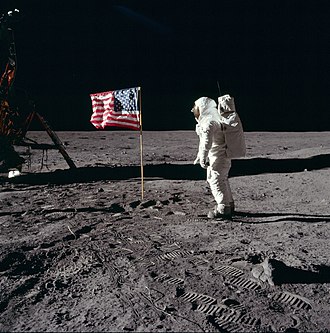
Three retroreflectors were placed on the Moon by the United States' Apollo program, during the Apollo 11, Apollo 14, and Apollo 15 missions. The Soviet Lunokhod 1 and 2 missions placed two more, and India's Chandrayaan-3 mission placed one.
Light or radio waves can also be reflected directly from the Moon's surface, a process known as EME. However, a much more precise range measurement can be made with retroreflectors. Because they are small, the spread in the reflected signal over time is much smaller. The light also returns more evenly, with less scattering.
Laser ranging measurements can also be made with retroreflectors on Moon-orbiting satellites, such as the LRO.
History
The first successful lunar ranging tests were carried out in 1962. Louis Smullin and Giorgio Fiocco from the Massachusetts Institute of Technology saw laser pulses bounce off the Moon's surface. Later that year, a Soviet team at the Crimean Astrophysical Observatory got similar results using a Q-switched ruby laser. Soon after, Princeton University graduate student James Faller proposed placing mirror-like reflectors on the Moon to make the measurements more accurate. The crew of Apollo 11 placed a reflector array on July 21, 1969. Apollo 14 and Apollo 15 later left two more. The first successful measurements to these reflectors were reported on Aug. 1, 1969, by the telescope at Lick Observatory. Other observatories, including the Air Force Cambridge Research Laboratories Lunar Ranging Observatory in Arizona, the Pic du Midi Observatory in France, the Tokyo Astronomical Observatory, and the McDonald Observatory in Texas, soon joined in.
The uncrewed Soviet rovers Lunokhod 1 and Lunokhod 2 carried smaller arrays. In 2010, NASA's Lunar Reconnaissance Orbiter found the Lunokhod 1 rover in images, and a team from the University of California measured its array. The Apollo 15 array is three times the size of the earlier Apollo arrays. Newer technology now lets smaller arrays be used more often, at sites such as the Côte d'Azur Observatory in Nice, France, and the Apache Point Observatory Lunar Laser-ranging Operation (APOLLO) in New Mexico. New retroreflectors were planned in the 2010s, including the MoonLIGHT reflector, which was to go to the Moon on the private MX-1E lander. That launch has since been canceled. In August 2023, India's Chandrayaan-3 lunar lander placed a sixth reflector on the Moon.
Principle
See also: Apache Point Observatory Lunar Laser-ranging Operation § Principles of operation
The distance to the Moon can be roughly calculated by multiplying the speed of light by the time the light takes to reach the Moon and return, then dividing by two. Because the speed of light is a fixed number, time and distance can be converted exactly. Getting a precise answer takes into account many factors, such as the Moon's position in the sky, the movement of Earth and the Moon, Earth's rotation, lunar libration, polar motion, weather, how light slows down in different layers of the Earth atmosphere, the place where the observing station sits and how it moves because of crustal motion and tides, and relativistic effects. The round trip takes about 2.5 seconds. The distance keeps changing, but on average it is 385,000.6 km (239,228.3 mi) from the center of the Earth to the center of the Moon.
The laser beam is about 6.5 kilometers (4.0 mi) wide when it reaches the Moon. Scientists compare aiming it to shooting a rifle at a moving dime 3 kilometers (1.9 mi) away. The reflected light is too faint for human eyes to see. Out of a pulse of 3×10¹⁷ photons sent at the reflector, only about 1 to 5 return to Earth, even in good conditions. Scientists can still pick out this light because the laser light is made of just one colour (monochromatic). As of 2009, the distance to the Moon can be measured to the nearest millimeter. This makes it one of the most precise distance measurements ever made. It is as accurate as measuring the distance between Los Angeles and New York to within the width of a human hair.
List of retroreflectors
Main article: List of retroreflectors on the Moon
List of observatories
The table below shows Lunar Laser Ranging stations on Earth. Some of these stations are still active, and some are inactive.
| Observatory | Project | Operating timespan | Telescope | Laser | Range accuracy |
|---|---|---|---|---|---|
| McDonald Observatory, Texas, US | MLRS | 1969–1985 1985–2013 | 2.7 m | 694 nm, 7 J 532 nm, 200 ps, 150 mJ | |
| Crimean Astrophysical Observatory (CrAO), USSR | 1974, 1982–1984 | 694 nm | 3.0–0.6 m | ||
| Côte d'Azur Observatory (OCA), Grasse, France | MeO | 1984–1986 1986–2010 2010–present (2021) | 694 nm 532 nm, 70 ps, 75 mJ 532/1064 nm | ||
| Haleakala Observatory, Hawaii, US | LURE | 1984–1990 | 532 nm, 200 ps, 140 mJ | 2.0 cm | |
| Matera Laser Ranging Observatory (MLRO), Italy | 2003–present (2021) | 532 nm | |||
| Apache Point Observatory, New Mexico, US | APOLLO | 2006–2021 2021–present (2023) | 532 nm, 100 ps, 115 mJ | 1.1 mm | |
| Geodetic Observatory Wettzell, Germany | WLRS | 2018–present (2021) | 1064 nm, 10 ps, 75 mJ | ||
| Yunnan Astronomical Observatory, Kunming, China | 2018 | 1.2 m | 532 nm, 10 ns, 3 J | meter level |
Data analysis
Scientists collect Lunar Laser Ranging data to find numbers for several measurements. Studying this data involves the study of motion, along with the geology of Earth and the Moon. The work has two main parts: calculating the Moon's orbit and orientation accurately, and modeling the time that laser light takes to travel from an observing station to a retroreflector and back. Modern data can be fit with an error of about 1 centimetre. A computer program calculates the distance between the centres of Earth and the Moon, and the same program tracks the Moon's three-axis orientation, called physical Libration.
The range model accounts for the station's position, including movement from plate tectonics, Earth rotation, precession, nutation, and polar motion. It also includes tides and seasonal movement of the solid Earth with respect to its center of mass, effects of relativity on time and space, and Lorentz contraction of the Moon. Other parts of the model cover the delay caused by Earth's atmosphere, the position of the retroreflector, and thermal expansion and contraction of the retroreflector mounts. For details about the Earth model, the IERS Conventions (2010) is a useful source.
Results
Data from lunar laser ranging can be found at the Paris Observatory Lunar Analysis Center, the International Laser Ranging Service archives, and active stations. Some of the findings of this long-term experiment are about the Moon itself. The distance to the Moon can be measured with millimeter precision. The Moon is slowly moving away from Earth at about 3.8 cm per year, a rate that has been described as unusually high. The Moon probably has a liquid core about 20% of its radius in size, and the Moon has librations that need one or more causes. Measurements also describe the core's flattening and its free nutation.
The experiments also teach scientists about gravity. Einstein's theory of gravity, the general theory of relativity, predicts the Moon's orbit to within the accuracy of the laser measurements. Gauge freedom plays a major role in understanding the relativity effects seen in the Earth-Moon system. A hypothetical effect called the Nordtvedt effect, a small difference in how the Moon and Earth are pulled toward the Sun, has been ruled out to high precision. This strongly supports the strong equivalence principle. The pull of gravity is very stable, and the experiments limit the change in Newton's gravitational constant G to a factor of (2±7)×10−13 per year.

Quiz time!
5 questions about Lunar Laser Ranging experiments
What do scientists measure to work out the distance to the Moon?
Pictures
Keep exploring


This article is a child-friendly adaptation of the Wikipedia article on Lunar Laser Ranging experiments, available under CC BY-SA 4.0.
Images from Wikimedia Commons. Tap any image to view credits and license.