Mainland China
"Mainland China" is a geopolitical term for the territory directly run by the People's Republic of China (PRC) after the Chinese Civil War. Besides the main land area, the term also includes some islands, such as Hainan, Chongming, and Zhoushan.
By convention, some places are not included in the term. The Special administrative regions of China are considered parts of the country, but they keep their own separate systems of government, courts, and economy. These are Hong Kong, which was once a British colony, and Macau, which was once a Portuguese colony.
Taiwan, together with Penghu, Kinmen, Matsu, and other small islands, is known as the Taiwan Area. It has been the main territorial base of the government of Taiwan (ROC) since 1950. The ROC still claims the "Mainland Area" as its territory under its constitution.
In Taiwan, the term is often used to mean all the territories run by the PRC. It is also widely used in Hong Kong, Macau, and Taiwan, and around the world, including by many Overseas Chinese communities and diasporas.
Background
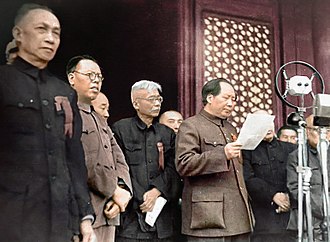
In 1949, the Chinese Communist Party (CCP) and the People's Liberation Army had largely defeated the Kuomintang (KMT)'s National Revolutionary Army in the Chinese Civil War. This forced the Kuomintang to move the government of the Republic of China to Taiwan, an island that had been placed under its control after Japan's surrender at the end of World War II in 1945. When the People's Republic of China was founded on 1 October 1949, the CCP government saw itself as the only legitimate government of China. The Republic of China, whose authority is now limited to Taiwan and other islands, made competing claims. This led to two co-existing governments competing for international legitimacy and recognition as the "government of China". As Taiwan became more democratic in the 1990s and the Taiwanese independence movement grew, some people simply began using the term "China" instead.
Because Hong Kong and Macau were colonies of foreign countries when the People's Republic of China was founded in 1949, the phrase "mainland China" leaves out Hong Kong and Macau. After the return of Hong Kong and the return of Macau to Chinese control, both kept their own legal, political, and economic systems and their distinct identities. So "mainland China" still generally excludes them, because of the "one country, two systems" policy the Chinese government adopted for these regions. The term is also used in economic reports, such as the IMD Competitiveness Report. International news media often use "China" to mean only the mainland of the People's Republic of China.
Political use
The Exit and Entry Administration Law of the People's Republic of China uses two Chinese terms that are translated as "mainland." Dàlù means 'the continent,' and Nèidì means 'inland' and excludes Hong Kong and Macau. The PRC uses "mainland" in official talks about Taiwan to stress the One-China policy and avoid giving the ROC "equal footing" in cross-strait relations. For Hong Kong and Macau, it calls itself "the Central People's Government." Hainan is an island, but it is politically counted as part of the "mainland" because its systems match the rest of the PRC. Kinmen and Matsu were governed with Fujian Province before 1949, but since they are not controlled by the PRC, they are not part of "mainland China." Some platforms, like Bilibili, ban the term, and the Foreign Ministry of the People's Republic of China says "Chinese mainland" is the correct term. Hong Kong and Macau have been PRC territories since 1997 and 1999, but under the One Country, Two Systems policy they keep some self-rule, so they are not governed as part of mainland China. They connect to the mainland in places like the north of the New Territories, while islands such as Hong Kong Island are much closer to the mainland than Taiwan and Hainan. Hong Kong and Macau use Nèidì for areas outside their own regions, as seen in the SAR government's "Constitutional and Mainland Affairs" bureau, the Mainland and Hong Kong Closer Economic Partnership Arrangement, and the Mainland and Macau Closer Economic Partnership Arrangement.
Taiwan's state documents began using "mainland" for the PRC and other lost areas as early as 1954. In the 1990s, laws gave more formal meaning to the term. The 1991 Additional Articles of the Constitution of the Republic of China used "mainland area" without defining its borders. The Cross-Strait Act called people under PRC rule "people of the mainland area" and used the "free area of the Republic of China" for land under ROC control. A 1993 Judicial Yuan interpretation also addressed the mainland's territory. In 2012, the Supreme Court of the Republic of China called the Macao Special Administrative Region the "Mainland's Macau Area." Changes made in 2002 to the executive order Enforcement Rules for the Act Governing Relations between Peoples of the Taiwan Area and the Mainland Area (Cross-Strait Act) defined the mainland as areas claimed but not controlled by the ROC, which match the areas under Chinese Communists control within the de facto borders of the People's Republic of China. During the Dangguo era, the KMT used many names for Chinese Communist Party territory, including "Communist bandits" areas. Today, the Pan-Blue Coalition, led by the KMT, prefers the term "mainland China," while the Pan-Green Coalition, led by the Democratic Progressive Party (DPP), prefers simply "China" because it opposes the word "mainland" as suggesting that Taiwan is part of China. This difference has led to many political debates.
Usage of excluding SARs
Mainland China (中國內地), or simply Mainland (Chinese: 內地; lit. 'Inland'), is a political and legal term for the areas under the direct control of the People's Republic of China, not including Hong Kong and Macau. In Taiwan, "mainland China" is often used to mean all areas run by the People's Republic of China, including Hong Kong and Macau.
Chinese courts and laws have used the term in several ways. In 1954, the Supreme People's Court of the People's Republic of China used "mainland" in an answer about a married couple who lived in different places. Later, laws and agreements about Hong Kong and Macau said that references to "Mainland" and other places should be understood as parts of the People's Republic of China. The Standing Committee of the National People's Congress (NPC) made some of these decisions, and the Ministry of Commerce signed agreements with Hong Kong and Macau that defined "mainland" as all the tariff territory of the People's Republic of China. The entertainment industry in mainland China is often called "Mainland entertainment" to tell it apart from the entertainment industries of other places.
Other terms
Some other geography words are used to avoid talking about the political status of the PRC and ROC.
| Simplified Chinese | Traditional Chinese | Pinyin | Jyutping | Hokkien POJ | Description |
|---|---|---|---|---|---|
| 海峡两岸 | 海峽兩岸 | Hǎixiá liǎng'àn | Hoi2 haap6 loeng5 ngon6 | Hái-kiap lióng-gān | The physical shores on both sides of the straits, may be translated as "two shores". |
| 两岸关系 | 兩岸關係 | liǎng'àn guānxì | loeng5 ngon6 gwaan1 hai6 | lióng-gān koan-hē | Reference to the Taiwan Strait (cross-Strait relations, literally "relations between the two sides/shores [of the Strait of Taiwan]"). |
| 两岸三地 | 兩岸三地 | liǎng'àn sāndì | loeng5 ngon6 saam1 dei6 | lióng-gān sam-tè | An extension of this is the phrase "two shores, three places", with "three places" meaning mainland China, Taiwan, and either Hong Kong or Macau. |
| 两岸四地 | 兩岸四地 | liǎng'àn sìdì | loeng5 ngon6 sei3 dei6 | lióng-gān sù-tè | When referring to either Hong Kong or Macau, or "two shores, four places" when referring to both Hong Kong and Macau. |

Quiz time!
5 questions about Mainland China
What does the term "mainland China" mean?
Keep exploring




This article is a child-friendly adaptation of the Wikipedia article on Mainland China, available under CC BY-SA 4.0.
Images from Wikimedia Commons. Tap any image to view credits and license.