
Mausoleum at Halicarnassus
The Mausoleum at Halicarnassus or Tomb of Mausolus was a grand tomb built between 353 and 351 BC in Halicarnassus (present-day Bodrum, Turkey). It was created for Mausolus, a leader from Caria who served in the Achaemenid Persian Empire, and his sister-wife Artemisia II. The tomb was designed by two Greek architects, Satyros of Paros and Pythius of Priene.
Standing about 45 meters (148 feet) tall, the Mausoleum was beautifully decorated with sculptural reliefs on each of its four sides. These sculptures were made by four famous Greek artists: Leochares of Athens, Bryaxis of Halicarnassus, Scopas of Paros, and Timotheus of Epidaurus or Athens. The tomb contained around 400 freestanding sculptures.
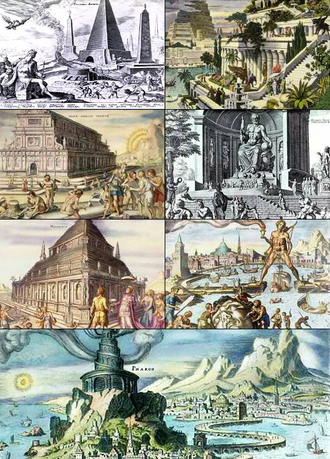
Because of its amazing beauty, the Mausoleum was chosen as one of the Seven Wonders of the Ancient World by the ancient writer Antipater of Sidon. Sadly, a series of earthquakes from the 12th to the 15th century destroyed the Mausoleum. It was the last of the six destroyed wonders to fall. Today, the word mausoleum is used to describe any above-ground tomb, thanks to this famous structure.
Conquest
In the 4th century BC, Halicarnassus was the capital of the small kingdom of Caria, part of the Achaemenid Empire on the western coast of Asia Minor.
After the ruler Hecatomnus of Milas died in 377 BC, his son Mausolus took control. Mausolus expanded his lands, reaching into the area of Lycia. He and his sister Artemisia ruled together for 24 years from Halicarnassus. Mausolus loved the Greek way of life and built many Greek-style cities along the coast.
Mausolus chose Halicarnassus as his capital and spent a lot of money making the city beautiful with statues, temples, and marble buildings. When Mausolus died in 353 BC, Artemisia continued building his grand tomb. After she passed away two years later, their ashes were placed inside the unfinished tomb. The craftsmen finished the work as a tribute to Mausolus and the art of sculpting.
Construction
Mausolus likely began planning his tomb before he passed away, as part of the building work in Halicarnassus. After his death, his sister Artemisia carried on with the project and spent a lot of money on it. She sent people to Greece to find the best artists, including Scopas, who helped rebuild the Temple of Artemis in Ephesus.
The tomb was built on a hill that overlooked the city. It stood in a special courtyard with a stone platform in the middle. A staircase with stone lions led up to the platform, which had statues of gods and goddesses along its walls. At each corner, stone warriors on horses guarded the tomb.
The tomb itself was a tall, square block covered with bas-reliefs showing exciting scenes like battles. On top of this block were tall columns, and between them stood statues. The roof was shaped like a pyramid, and at the very top was a group of four large horses pulling a chariot with images of Mausolus and Artemisia inside.
History
Historians think it would have taken more than two years to build such a grand building. It is believed that construction started by Mausolus before he died or was finished later by other leaders. The Mausoleum looked like a temple but had slightly higher outer walls. It stood in Halicarnassus, which was controlled by the Achaemenid Empire in 353 BC. The Roman architect Vitruvius said it was built by Satyros and Pytheus, who wrote about it in a book that is now lost. The Romans thought the Mausoleum was one of the greatest wonders of the world and named all their big tombs “mausoleums” after it.
We do not know exactly when or how the Mausoleum was destroyed. A writer named Eustathius in the 12th century said it was still a wonder in his time. Some believe it was ruined by an earthquake. When the Knights of St John of Jerusalem arrived in 1402, they found it in ruins and used many stones to build their castle at Bodrum. By the 19th century, only the foundations and some broken sculptures remained. The Mausoleum was famous for its beautiful design and sculptures, and it was considered the seventh wonder of the ancient world.
Jar of Xerxes I
Main article: Jar of Xerxes I
A special jar made of calcite or alabaster was found at the Mausoleum. It had the name of the king Xerxes I on it in four different languages. This jar shows the close ties between the rulers of Caria and the Achaemenid Empire. It may have been a gift from Xerxes to Artemisia I, a skilled leader who helped him during the Second Persian invasion of Greece.
Dimensions and statues
The Mausoleum at Halicarnassus was a large and beautiful building. It had a rectangular shape and was surrounded by 36 columns. On top of the building was a pyramid shape that had 24 steps leading to the top. At the very top were four marble statues of horse chariots. The building also had many sculptures on it, including statues and carvings.
Some important writers, like Pliny the Elder, gave us information about the size of the Mausoleum. They said it was about 43 metres (140 feet) tall. Many big statues were found near the building, including 20 lion statues that were a little bigger than real life. The sculptures on each side of the building were made by different artists. Even today, people are still working to learn more about the beautiful art of the Mausoleum.
Later history
The Mausoleum stood above the city of Halicarnassus for many years. It remained untouched when the city fell to Alexander the Great in 334 BC and was still undamaged after attacks by pirates in 62 and 58 BC. It stayed above the city's ruins for sixteen centuries. Then a series of earthquakes broke the columns and knocked down a bronze chariot.
In 1494, the Knights of St John of Rhodes built Bodrum Castle (Castle of Saint Peter). They used stones from the Mausoleum to strengthen the castle. Later, in 1522, rumours of a Turkish invasion led to more parts of the tomb being broken up for the castle walls. Some polished marble from the tomb can still be seen in the castle today.
When the knights entered the base of the Mausoleum, they found a room with a large coffin. However, by the time they returned the next day, the tomb had been looted. Research shows that grave robbers had already dug a tunnel under the grave chamber long before the knights arrived, stealing any treasures. It is believed that Mausolus and Artemisia were cremated, so only an urn with their ashes was placed in the tomb, which explains why no bodies were found.
Discovery and excavation
In the 1800s, a British consul took some statues from Bodrum Castle, and they are now in the British Museum. In 1852, an archaeologist named Charles Thomas Newton was sent to find more parts of the Mausoleum. He studied old writings to learn where the tomb might be and then bought a piece of land to dig. He found walls, a staircase, and parts of the foundation.
Newton also uncovered pieces of the decorations that once covered the walls and roof, including a large broken stone wheel and statues of Mausolus and his sister-wife Artemisia. Some of the marble blocks were taken to Malta to help build a dock for ships. From 1966 to 1977, a researcher named Kristian Jeppesen studied the Mausoleum and wrote a big book about it.
The Mausoleum was famous for its beautiful statues of people and animals, made by four different Greek sculptors. Today, Bodrum still has a big castle, and pieces of the Mausoleum can be seen built into its walls. Only the foundation of the Mausoleum remains, along with a small museum. The British Museum has some of the surviving statues and decorations, including scenes from stories about battles between Greeks and Amazons.
Influence on modern architecture
Many modern buildings were inspired by the design of the Mausoleum of Mausolus. These include the Fourth and Vine Tower in Cincinnati, the Civil Courts Building in St. Louis, the National Newark Building in Newark, New Jersey, Grant's Tomb and 26 Broadway in New York City, Los Angeles City Hall, the Shrine of Remembrance in Melbourne, the spire of St. George's Church, Bloomsbury in London, the Indiana War Memorial (and in turn Salesforce Tower) in Indianapolis, the House of the Temple in Washington D.C., the National Diet in Tokyo, the Soldiers and Sailors Memorial Hall in Pittsburgh, and the Commerce Bank Building) in Peoria, IL.
Gallery of 2nd-century replica site
In Milas is a small copy of the Mausoleum at Halicarnassus from Roman times. This copy is called the Gümüşkesen and shows details like the ceiling and capitals of the tomb.
Gümüşkesen in Milas
-
Milas Gümüşkesen front
-
Gümüşkesen in Milas detail of ceiling
-
Gümüşkesen in Milas detail of ceiling
-
Gümüşkesen in Milas detail of ceiling and capitals
-
Gümüşkesen in Milas capital
-
Gümüşkesen in Milas Lower part of tomb
Pictures
Keep exploring




This article is a child-friendly adaptation of the Wikipedia article on Mausoleum at Halicarnassus, available under CC BY-SA 4.0.
Images from Wikimedia Commons. Tap any image to view credits and license.