 Safekipedia
Meteorology
Adapted from Wikipedia · Discoverer experience
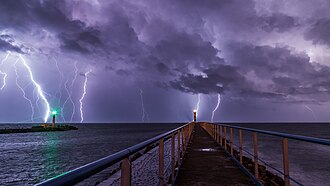
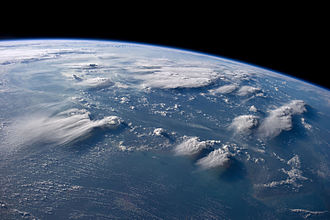
Meteorology is the scientific study of the Earth's atmosphere and short-term atmospheric phenomena, focusing on weather forecasting. It helps us understand everyday weather like clouds, precipitation, and wind, as well as severe events such as tropical cyclones and winter storms. This knowledge is important for many areas, including the military, aviation, energy production, transport, agriculture, construction, weather warnings, and disaster management.
Meteorologists use tools like thermometers, barometers, and weather vanes, along with advanced technology such as weather satellites, balloons, reconnaissance aircraft, buoys, and radars, to collect data and make forecasts. The World Meteorological Organization helps ensure that weather research and forecasting are done in a standard way around the world.
The study of meteorology goes back thousands of years. Ancient people tried to predict weather using folklore, astrology, and religious rituals. Over time, better tools and scientific methods improved our understanding. Today, meteorology uses computers, big data, and supercomputing to create accurate forecasts, even though the atmosphere can be unpredictable.
Etymology
The word meteorology comes from ancient Greek. It combines two words: metéōros, meaning "celestial and meteorological phenomena," and -logia, which means "the study of." So, meteorology is the study of things happening in the sky and the air around us.
History
Ancient meteorology up to the time of Aristotle
Early attempts at predicting weather were often linked to prophecy and ancient religions, which believed weather was controlled by gods. Humans learned to predict rains and floods based on yearly cycles, even before farming began. Priests used astrology to predict weather.
Ancient India mentioned clouds and seasons, and a classical work from around 500 AD recorded weather observations. Babylonian tablets linked thunder and rain, and the Chaldeans studied weather patterns.
The ancient Greeks were the first to develop theories about weather. Without instruments, their studies were mostly based on observations and ideas. One Greek, Thales, predicted a solar eclipse in 585 BC and studied the Nile’s flooding. Others explained thunder and lightning as air moving in clouds. Anaxagoras explained hail as cold air freezing moisture in clouds.
Aristotelian meteorology
These early ideas formed the basis of Aristotle’s work on weather, written in 350 BC. Aristotle is considered the founder of meteorology. His book described the water cycle, a process we still study today. His ideas stayed important for nearly 2,000 years.
After Aristotle, progress slowed. Theophrastus wrote about weather signs and forecasts, using the seasons and moon phases to predict changes. His work stayed influential for centuries.
Meteorology after Aristotle
Meteorology kept developing over the centuries. During the Renaissance, scientists like Galileo and Descartes introduced new ideas, starting a scientific revolution in weather studies.
In the 18th century, new tools like thermometers and barometers allowed scientists to measure temperature and air pressure more accurately. The first weather society formed in 1780.
The 19th century brought advances like the telegraph, which helped create weather networks and track storms. Scientists began using math to predict weather.
In the 20th century, radar and satellites greatly improved how we watch and track weather. Today, computers help make weather forecasts more accurate. Meteorology also studies air quality and climate changes.
Meteorologists
Further information: Meteorologist
Meteorologists are scientists who study the weather. They work in many places, such as government agencies, private companies, research centers, factories, radio stations, television stations, and schools. In the United States, there were about 10,000 meteorologist jobs in 2018.
While many people see weather forecasts on TV or radio, the people who present this weather news are not always professional meteorologists. Often, these weather presenters are reporters without special training in meteorology. Some groups, like the American Meteorological Society and the National Weather Association, give special approval to weather presenters who meet certain standards, but this approval is not required for them to get a job.
Equipment
Main article: Meteorological instrumentation
Meteorology uses special tools to study the weather. Rain, wind, and humidity were some of the first things people measured. Tools like the rain gauge, anemometer, and hygrometer were developed in the mid-1400s to measure these.
Weather stations, ships, and buoys collect many types of weather data. They often measure temperature, pressure, wind, and humidity using tools like thermometers, barometers, anemometers, and hygrometers. Some stations also have sensors for air quality, cloud height, rain or snow, lightning, and more. To get data from higher up in the atmosphere, scientists launch radiosondes. They also use radar, Lidar, and satellites to collect information from far away.
Spatial scales
The study of the atmosphere can be divided into different areas based on time and distance. On very short timescales, like hours or days, meteorology looks at three main scales: microscale, mesoscale, and synoptic scale. Each scale relates to different sizes and times of weather events.
Microscale meteorology studies weather on a very small scale, about 1 kilometre or less. This includes individual thunderstorms, clouds, and turbulence caused by buildings or hills. Mesoscale meteorology looks at weather from 1 kilometre to 1000 kilometres. This includes things like thunderstorms, rain bands, and weather changes caused by mountains or bodies of water. Synoptic scale meteorology predicts weather changes up to 1000 kilometres and over about 3 days. This scale includes large weather systems like cyclones and jet streams, which are shown on weather maps. Global scale meteorology studies very large weather patterns, such as the movement of heat from the tropics to the poles, which can affect climate and weather over months or years.
Main article: Microscale meteorology
Main article: Mesoscale meteorology
Main article: Synoptic scale meteorology
| Type of motion | Horizontal scale (meter) |
|---|---|
| Molecular mean free path | 10−7 |
| Minute turbulent eddies | 10−2 – 10−1 |
| Small eddies | 10−1 – 1 |
| Dust devils | 1–10 |
| Gusts | 10 – 102 |
| Tornadoes | 102 |
| Cumulonimbus clouds | 103 |
| Fronts, squall lines | 104 – 105 |
| Hurricanes | 105 |
| Synoptic Cyclones | 106 |
| Planetary waves | 107 |
Branches of meteorology
Based on methodological approach
Physical meteorology
Physical meteorology looks at how the atmosphere behaves. It studies things like how heat and energy move in the air, how clouds form, and what happens when water drops fall from the sky. It also looks at how light, electricity, and sound act in the atmosphere.
Dynamic meteorology
Dynamic meteorology explores how the air moves. It uses ideas from how fluids flow, how heat works, and how things move to understand why the atmosphere behaves the way it does. Scientists think of tiny bits of air to study how temperature, pressure, and other factors change.
Synoptic meteorology
Synoptic meteorology is about looking at the weather over big areas at the same time. Meteorologists use maps and pictures from satellites to see how the air moves and changes. This helps them predict the weather for the next few days.
Based on scale
Boundary layer meteorology
Boundary layer meteorology studies the air right above the ground. This layer is affected by the surface, like how hot or cold it is and how rough the ground is. It looks at how heat, things floating in the air, and movement happen in this thin layer of air.
Applications
Weather forecasting
Main article: Weather forecasting
Weather forecasting is a way to guess what the air outside will be like in the future. People have tried to guess the weather for thousands of years, and today we use science and computers to help. We look at things like air pressure and current weather to make our guesses.
Computers help a lot, but we still need people to choose the best guess. The air can change in tricky ways, so forecasts are not always perfect. Weather forecasts help us know when to wear warm clothes, when to carry an umbrella, and how to plan outdoor fun.
Aviation meteorology
Main article: Aviation meteorology
Aviation meteorology looks at how weather affects airplanes. Pilots need to know about things like strong winds, ice, storms, and fog to keep flights safe. Learning about weather is a big part of training for pilots.
Agricultural meteorology
People who study agriculture look at how weather affects plants and farming. They care about things like rain, temperature, and how plants grow. They also study how plants and farms can affect the weather.
Hydrometeorology
Hydrometeorology is about water in the air, like rain and snow. Experts make forecasts to warn about heavy rain or snow that could cause flooding.
Nuclear meteorology
This area studies how radioactive materials move in the air.
Maritime meteorology
Maritime meteorology helps ships at sea by giving forecasts about the weather and waves. Groups like the Ocean Prediction Center and the National Weather Service make these forecasts for oceans around the world.
Military meteorology
Main article: Military meteorology
Military meteorology is about using weather knowledge for the military. In the United States, the Navy and Air Force have special teams that handle weather for their operations.
Environmental meteorology
Environmental meteorology looks at how weather affects things like pollution in the air.
Renewable energy
Main article: Energy meteorology
Meteorology helps us find the best places for wind and solar power by studying things like wind patterns and sunlight.
International cooperation
Weather happens all around the world and doesn't stop at country lines. To make good weather forecasts, weather services from different countries need to share what they see in the sky right now. In 1950, a group called the World Meteorological Organization was started to help countries share their weather data, information, and research freely.
Images
Related articles


This article is a child-friendly adaptation of the Wikipedia article on Meteorology, available under CC BY-SA 4.0.
Images from Wikimedia Commons. Tap any image to view credits and license.