 Safekipedia
Cloud
Adapted from Wikipedia · Discoverer experience
A cloud is a beautiful sight in the sky, made up of tiny drops of water or ice crystals floating high above us. These tiny particles form when air cools down or gets enough moisture, turning into visible masses we call clouds. Mostly made of water, clouds can appear in many shapes and sizes.
We see clouds in Earth’s atmosphere, which includes layers close to the ground and higher up. Scientists who study clouds call this field nephology, a part of meteorology—the science that helps us understand weather. Clouds have special names based on where they are in the sky and what they look like, using both Latin and common names.
Clouds play an important role in Earth’s climate. They can reflect sunlight, which cools the planet, or trap heat rising from the ground, which can warm it. The height, shape, and thickness of clouds decide whether they have a cooling or warming effect. While clouds in higher layers of the atmosphere are too thin to change the climate much, those closer to the ground have a big impact on how warm or cool our planet stays.
Etymology
The word "cloud" comes from old English words clud or clod, which meant a hill or a big piece of stone. Around the 1200s, people started using this word to describe rain clouds because they looked like piles of rock. This new use of the word eventually replaced the old English word weolcan, which was the actual term for clouds.
Homospheric nomenclatures and cross-classification
The table here shows many ways to name clouds. It uses different naming styles for clouds near the ground and those higher up, but both styles are approved by the World Meteorological Organization. They both help us understand the shape and height of clouds to sort them into groups, including the common low clouds and some special types found above the main cloud layer. The cumulus clouds, for example, have different sizes that can change how high they reach.
Form Level | Stratiform non-convective | Cirriform mostly non-convective | Stratocumuliform limited-convective | Cumuliform free-convective | Cumulonimbiform strong-convective |
|---|---|---|---|---|---|
| Extreme-level | Noctilucent veils | Noctilucent billows or whirls | Noctilucent bands | ||
| Very high-level | Nitric acid and water PSC veils | Cirriform nacreous PSC | Lenticular nacreous PSC | ||
| High-level | Cirrostratus | Cirrus | Cirrocumulus | ||
| Mid-level | Altostratus | Altocumulus | |||
| Towering vertical | Cumulus congestus | Cumulonimbus | |||
| Multi-level or moderate vertical | Nimbostratus | Cumulus mediocris | |||
| Low-level | Stratus | Stratocumulus | Cumulus humilis or fractus | ||
| Surface-level | Fog or mist |
History of cloud science
Main article: Timeline of meteorology
Long ago, people studied clouds along with other weather and natural events. Around 340 BC, a Greek thinker named Aristotle wrote a book called Meteorologica, which gathered what was known about nature, weather, and climate. He was the first to call rain and the clouds that make rain "meteors," from a Greek word meaning "high in the sky." This idea later helped create the word meteorology, the study of clouds and weather. His book used observation but not the careful steps scientists use today.
In the early 1800s, two scientists began real studies of clouds. Luke Howard in England and Jean-Baptiste Lamarck in France both tried to sort out cloud types. Howard used Latin names that were easy for everyone to understand, and his work became very popular. Lamarck used French names that were harder to follow, so his system didn’t catch on. Later, in 1891, Howard’s ideas were made into an official system. Even higher clouds were given their own names later on.
Formation
Clouds can be found high up in the sky, where the air is very cold. When air cools down to a special temperature called the dew point, it can hold no more water vapor. This causes the water vapor to turn into tiny droplets or ice crystals, forming clouds.
One way this happens is when warm air rises and cools. This can be caused by the sun heating the ground, which makes the air above it rise. When this air cools, it can form clouds. Another way is when air is pushed up by weather patterns or when it moves over mountains. All these actions help create the conditions needed for clouds to form.
Tropospheric classification
Classification in the troposphere groups clouds by their structure and height. There are ten main types, which can be further divided into smaller groups.
Clouds in the troposphere have five main shapes based on how they form. These shapes help scientists study clouds from satellites. They are listed from least to most unstable:
- Nonconvective stratiform clouds appear in stable air and have flat, sheet-like shapes. They can form at any height. Examples include high-level cirrostratus, mid-level altostratus, low-level stratus, and multi-level nimbostratus.
- Cirriform clouds look like thin, wispy strands. They form high in the sky where the air is stable. Examples include cirrus clouds.
- Stratocumuliform clouds have both layered and puffy shapes. They form in stable air with some convection. Examples include cirrocumulus, altocumulus, and stratocumulus.
- Cumuliform clouds appear in isolated piles or tufts. They form in unstable air. Small cumuliform clouds show weak instability, while larger ones show stronger activity. Examples include cumulus clouds.
- Cumulonimbus clouds are large, towering clouds. They form in very unstable air and can reach high into the sky. These clouds often have anvil-shaped tops.
Levels and genera
Clouds form at different heights in the sky. They are grouped into three levels based on their altitude:
High-level
High clouds form between 3,000 to 7,600 meters in polar regions, 5,000 to 12,200 meters in temperate regions, and 6,100 to 18,300 meters in tropical regions. All cirriform clouds are high clouds. Examples include:
- Cirrus (Ci) – These are thin, wispy clouds made of ice crystals. They often appear as delicate white strands in the sky.
- Cirrocumulus (Cc) – These are small, white puffy clouds that appear in rows or groups.
- Cirrostratus (Cs) – These are thin, icy clouds that can create halos around the sun or moon.
Mid-level
Mid-level clouds form from near the surface up to about 4,000 meters near the poles, 7,000 meters at midlatitudes, and 7,600 meters in the tropics. Examples include:
- Altocumulus (Ac) – These are mid-level clouds that appear in patches or sheets. They are made of water droplets and ice crystals.
- Altostratus (As) – These are gray or blue-gray clouds that often cover the sky. They can bring light rain or snow.
Low-level
Low clouds form from near the surface up to 2,000 meters. Examples include:
- Stratocumulus (Sc) – These are low, layered clouds that appear in patches or sheets. They can bring light rain.
- Cumulus humilis – These are small, fair-weather clouds with flat bases and rounded tops. They do not bring rain.
- Stratus (St) – These are flat, gray clouds that can resemble fog. They can bring light drizzle or snow grains.
Multi-level or moderate vertical
These clouds have bases from near the surface to about 2,400 meters and tops that can reach mid-level heights. Examples include:
- Nimbostratus (Ns) – These are thick, dark gray clouds that bring steady rain or snow over a wide area.
- Cumulus mediocris – These are medium-sized cumulus clouds with flat bases and domed tops. They usually do not bring rain.
Towering vertical
These large clouds have bases in the low to mid-level range but tops that reach high into the sky. Examples include:
- Cumulus congestus – These are tall cumulus clouds that can bring moderate to heavy showers.
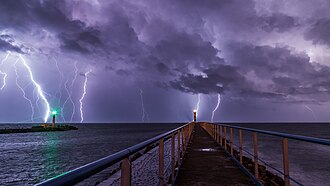
- Cumulonimbus (Cb) – These are massive, towering clouds that can bring thunderstorms, heavy rain, hail, strong winds, and tornadoes.
| Forms and levels | Stratiform non-convective | Cirriform mostly nonconvective | Stratocumuliform limited-convective | Cumuliform free-convective | Cumulonimbiform strong convective |
|---|---|---|---|---|---|
| High-level | Cirrostratus nebulosus fibratus | Cirrus non-convective uncinus fibratus spissatus castellanus floccus | Cirrocumulus stratiformis lenticularis castellanus floccus | ||
| Mid-level | Altostratus no differentiated species (always nebulous) | Altocumulus stratiformis lenticularis castellanus floccus volutus | |||
| Low-level | Stratus nebulosus | Stratocumulus stratiformis lenticularis castellanus floccus volutus | Cumulus | ||
| Multi-level or moderate vertical | Nimbostratus no differentiated species (always nebulous) | Cumulus | |||
| Towering vertical | Cumulus | Cumulonimbus calvus capillatus | |||
Distribution
Main articles: Intertropical Convergence Zone, Extratropical cyclone, Cold front, and Warm front
The way clouds spread around the world depends mostly on where the air is moving and how much pressure there is. Clouds are most common near the equator and around the 50th parallels in both the northern and southern hemispheres. This happens because the warm air near the equator rises and cools, making clouds form easily. In places farther from the equator, clouds can still appear, but they depend on how warm or cold the air is and how much moisture it holds.
In areas where the air is sinking or moving apart, like near the poles and in some parts close to 30 degrees north and south, there are usually fewer clouds. These places are sometimes called the horse latitudes. Big areas of high pressure, called subtropical ridges, also help keep these areas clearer by pushing the air away from the ground.
Luminance, reflectivity, and coloration
The brightness of a cloud depends on how it reflects and scatters light. Thick, low clouds usually look very white because the tiny water droplets are packed closely together, reflecting most of the sunlight. As you look deeper into the cloud, the light gets weaker, so the bottom of the cloud can look gray depending on its thickness.
Clouds can change color depending on the time of day and the light. During the day, clouds often look white on top with gray underneath. At sunrise or sunset, they can turn red, orange, or pink because of the way the sunlight spreads through the air. At night, clouds look dark unless the moon or lights from Earth shine on them. Sometimes clouds can appear green or blue, especially in strong storms, because of the way light bends through large amounts of water.
Effects
See also: Cloud cover, Cloud feedback, Global dimming, and Climate change
Clouds have many important effects on our planet's weather and climate. They are essential for rain and snow, which help spread water across the Earth. Clouds can also move air up and down, influencing weather patterns.
Clouds can both cool and warm the Earth. Their bright tops reflect sunlight away from the ground, which cools the surface. However, clouds can also trap heat, warming the Earth a bit like a blanket. This dual effect makes it challenging to understand exactly how clouds will change with our warming climate. Scientists are still studying these complex effects to better predict future weather and climate changes.
Stratospheric classification and distribution
Polar stratospheric clouds (PSC's) are found in the lowest part of the stratosphere. There is very little moisture above the troposphere, so these clouds are only seen in polar regions during winter when the air is very cold.
PSC's can look different depending on what they are made of and the conditions in the atmosphere, but they are all found at very high altitudes, between about 15,000–25,000 meters (49,200–82,000 feet). They are all classified as one type and do not have different levels or names like clouds closer to the ground. Instead, they have simple descriptive names based on how they look. Some PSC's look like thin, hazy layers, while others have a shiny, colorful appearance.
Mesospheric classification and distribution
Noctilucent clouds are the highest clouds in the sky. They appear about 80 to 85 kilometers above Earth, which is ten times higher than most other clouds. These clouds glow in the dark after sunset and before sunrise, looking bluish or silvery white, sometimes even red or orange. They are not common and do not change the climate much, but scientists have noticed them appearing more often since the 1800s, possibly because of changes in our climate.
Research shows that during the polar summer, strong upward air movement cools tiny amounts of water vapor until it forms clouds. Tiny particles from burning meteors help these clouds form. There are four main types of noctilucent clouds, each looking different from the others. These clouds are mostly seen near the poles, far from the equator.
Extraterrestrial
See also: Extraterrestrial atmospheres
Clouds can be found on many planets beyond Earth. On Venus, thick clouds made of sulfur dioxide cover the planet and appear in layers high above the surface. On Mars, thin clouds made of water-ice have been seen, especially near the poles.
Both Jupiter and Saturn have layers of clouds made from different materials, like ammonia and ammonium hydrosulfide. Uranus and Neptune also have clouds, but these are made of methane. Saturn's moon Titan has clouds that scientists believe are mostly made of methane as well. Scientists have also found clouds on planets far outside our Solar System, like Kepler-7b, GJ 436 b, and GJ 1214 b.
In culture and religion
Clouds have played important roles in stories and beliefs from many cultures and religions. Ancient Akkadians thought clouds were the breasts of the sky goddess Antu, and rain was like milk from her. In the Book of Exodus, Yahweh is described as guiding the Israelites through the desert as a "pillar of cloud" during the day and a "pillar of fire" at night. In Mandaeism, special celestial beings called uthras are sometimes described as being in anana ("clouds").
The ancient Greek play The Clouds by Aristophanes features the philosopher Socrates telling the main character that the Clouds are the only true gods. In this play, the Clouds change shapes to show the true nature of whoever is watching them. In Shakespeare’s Hamlet, a character looks at clouds and sees many different shapes.
In China, clouds are seen as symbols of luck and happiness. Overlapping clouds are thought to mean eternal happiness, and clouds of different colors are believed to bring many blessings. Watching clouds and imagining shapes in them, known as cloud gazing, is a fun activity many people enjoy.
Images
Related articles


This article is a child-friendly adaptation of the Wikipedia article on Cloud, available under CC BY-SA 4.0.
Images from Wikimedia Commons. Tap any image to view credits and license.