 Safekipedia
Namibia
Adapted from Wikipedia · Discoverer experience
Namibia, officially the Republic of Namibia, is a country in Southern Africa. It borders the Atlantic Ocean to the west, Angola and Zambia to the north, Botswana to the east, and South Africa to the south. The capital and largest city is Windhoek.
Namibia is the driest country in sub-Saharan Africa. It has been home to people such as the Khoi, San, Damara, and Nama people for thousands of years. In 1884, it became a colony of the German Empire, known as German South West Africa. After World War I, South Africa controlled the land until Namibia gained independence in 1990.
Today, Namibia is a parliamentary democracy. Its economy relies on tourism, mining industry for diamonds and other minerals, and agriculture. Despite growth since independence, many people still face challenges, with a large gap between rich and poor. With only about 3.1 million people, Namibia is one of the most sparsely populated countries in the world. It belongs to groups like the United Nations, the Southern African Development Community, and the African Union.
History
Main article: History of Namibia
Namibia's name comes from the Namib desert, the oldest desert in the world. The word "Namib" means "vast place" in the language of the Khoi people. Long before Namibia was a country, the land was home to the San, Damara, and Nama peoples. They lived as hunters and herders for thousands of years.
Later, new groups arrived from other parts of Africa. In the late 1800s, Germany took control of the land and called it German South-West Africa. After World War I, South Africa governed the area. Finally, in 1990, Namibia became its own independent country. Since then, it has worked to build a peaceful and fair society for all its people.
Geography
Main article: Geography of Namibia
Namibia is a large country in Southern Africa, covering 825,615 km2. It is the world's 34th largest country. The land has many different areas, such as the Namib Desert, the Kalahari Desert, and the Central Plateau. The Namib Desert is one of the oldest deserts in the world, with very tall sand dunes.
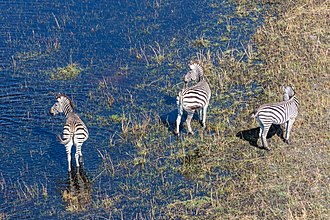
Namibia has a dry climate, with very little rain. The driest place is along the coast, where there is often fog. In the north, there are seasonal floods that can sometimes damage buildings and roads. People in Namibia depend mostly on groundwater for drinking water, and many boreholes have been drilled to reach this water. The country also works hard to protect its wildlife, with many different animals living there, including wild dogs and black rhinos.
Government and politics
Main articles: Politics of Namibia and Elections in Namibia
Namibia is a country where people choose their leaders through voting. The President of Namibia is chosen every five years and leads the country. The government has three main parts: the leader and helpers who make decisions, a group of people who make laws, and courts that make sure everyone follows the rules.
Namibia works well with other countries, especially those in the Southern African area. It joined the United Nations in 1990 and works to help its neighbors.
The main article about how Namibia is divided into regions is: Administrative divisions of Namibia
Namibia is split into 14 regions, and each region has areas called constituencies. Some of the busiest regions are Khomas, where the capital city Windhoek is located, and Erongo, home to Walvis Bay and Swakopmund.
Main article: Human rights in Namibia
Namibia is known for being a free and fair country. It ranks very well in Africa for protecting people’s rights. However, some problems still exist, like unfair treatment in certain areas. The country’s laws support equal treatment for everyone, and efforts are being made to ensure women have fair representation in government.
| Region | Population (2023) | People per km2 | Average household size |
|---|---|---|---|
| Khomas | 494,605 | 13.4 | 3.3 |
| Ohangwena | 337,729 | 31.5 | 4.8 |
| Omusati | 316,671 | 11.9 | 4.2 |
| Oshikoto | 257,302 | 6.7 | 4.1 |
| Erongo | 240,206 | 3.8 | 3.1 |
| Oshana | 230,801 | 26.7 | 3.7 |
| Otjozondjupa | 220,811 | 2.1 | 3.6 |
| Kavango East | 218,421 | 9.1 | 5.3 |
| Zambezi | 142,373 | 9.7 | 3.7 |
| Kavango West | 123,266 | 5.0 | 5.5 |
| Kunene | 120,762 | 1.0 | 3.8 |
| Hardap | 106,680 | 1.0 | 3.6 |
| ǁKaras | 109,893 | 0.7 | 3.1 |
| Omaheke | 102,881 | 1.2 | 3.3 |
Economy
Main article: Economy of Namibia
Namibia's economy is closely linked to that of South Africa. Key sectors include mining, public administration, manufacturing, and education. The country has a well-developed banking system with several major banks.
Namibia faces challenges such as high unemployment and poverty. Despite these issues, it has been recognized as a strong emerging market in Africa. The government works to create jobs and improve business conditions for both local and foreign investors. The cost of living is slightly above average, and the country has good transportation links, including seaports and railways.
Agriculture
Main article: Agriculture in Namibia
About half of Namibia's people rely on agriculture for their living, though the country still needs to import some food. The country has significant income differences between urban and rural areas. Mining plays a big role in the economy, with uranium and diamonds being major exports. Other minerals like lead, tungsten, and gold are also mined.
Tourism
Main article: Tourism in Namibia
Tourism is important to Namibia's economy, creating many jobs and bringing in visitors each year. The country is famous for its wildlife and natural beauty, offering many places to stay and exciting activities to try. Popular spots include Windhoek, Fish River Canyon, and Etosha Pan.
Water supply and sanitation
Main article: Water supply and sanitation in Namibia
Namibia has made progress in providing clean water but still struggles with sanitation, especially in rural areas. Many people lack proper toilets, which can lead to health problems. The government continues to work on improving water and sanitation services for all citizens.
Demographics
Main article: Demographics of Namibia
Namibia has one of the lowest population densities of any country, with just about 3 people for every square kilometer. The country counts its people every ten years. The most recent count in 2023 showed about 3 million people living there.
Namibia is home to many different groups of people. Most are from Bantu groups like the Owambo and Herero, or Khoisan groups like the Damara and Nama. There are also people of mixed backgrounds, as well as small numbers from China and Europe.
Main article: Education in Namibia
See also: List of schools in Namibia
Education is free for all children in Namibia. Most children go to school from ages 6 to 12, and then can continue until age 18. The country has several universities and training schools to help people learn many different skills.
Main article: Religion in Namibia
Most people in Namibia follow Christianity, with many belonging to Lutheran churches. Other religions practiced there include indigenous beliefs, Islam, and Judaism, though these groups are smaller.
Main article: Languages of Namibia
English is the official language used in schools and government. However, many people also speak Oshiwambo, Afrikaans, or other local languages at home.
Main article: Health in Namibia
See also: HIV/AIDS in Namibia
Namibia works hard to keep people healthy, with programs to help with diseases and health education. The country faces challenges with health issues like high blood pressure and diabetes, and continues to address health concerns through its health services.
Culture
Namibian culture shares similarities with South African culture because of their shared history and family ties. Most Namibians prefer to live in their homeland, where they feel safe and proud of their national identity. They enjoy social gatherings and often celebrate with music and food.
Sport
Main articles: Sport in Namibia and Rugby union in Namibia
The most popular sport in Namibia is association football. The Namibia national football team has participated in several Africa Cup of Nations tournaments but has not yet qualified for the World Cup. Some well-known players include Ryan Nyambe, Peter Shalulile, and Collin Benjamin.
Rugby is also very successful in Namibia, with the Namibian rugby team having competed in many Rugby World Cups. Jacques Burger is a famous Namibian rugby player. Other popular sports include cricket, track and field, golf, cycling, and boxing.
Media
See also: Media of Namibia
Namibia has a lot of freedom for its media compared to some other countries. It often ranks high on lists that measure how free the press is. There are many radio and TV stations, as well as several newspapers. The first newspaper in Namibia was called Windhoeker Anzeiger, and it started in 1898.
Today, daily newspapers include The Namibian, Die Republikein, Allgemeine Zeitung, Namibian Sun, and the state-owned New Era. There are also many weekly newspapers and magazines.
Art
The National Art Gallery of Namibia shows art from Namibia, Africa, and Europe. In 2022, Namibia joined the Venice Biennale for the first time with an exhibition called "A Bridge to the Desert," featuring the "Lone Stone Men" project by RENN.
Images
Related articles



This article is a child-friendly adaptation of the Wikipedia article on Namibia, available under CC BY-SA 4.0.
Images from Wikimedia Commons. Tap any image to view credits and license.