 Safekipedia
Natural science
Adapted from Wikipedia · Discoverer experience
Natural science is a way to study and understand the world and the universe around us. It tries to explain how things work by using evidence from observing and testing. There are five main areas of natural science: astronomy, chemistry, Earth science, biology, and physics.
Scientists use careful steps like peer review and checking their work through reproducibility to make sure their discoveries are real. Natural science has two big parts: life science, which is mostly about living things like plants and animals, and physical science, which studies things like matter, energy, and space.
These areas of science sometimes split into even more special topics. They all use tools from mathematics and logic to turn what they see in nature into clear rules, often called the "laws of nature". Over time, natural science grew from older ideas called natural philosophy, with famous thinkers like Galileo Galilei and Isaac Newton helping to shape how we study the world today.
Criteria
Main article: Philosophy of science
Scientists use certain rules to decide what counts as real science. One important idea is falsifiability, which means a theory must be able to be proven wrong through tests. Other key ideas include validity, meaning experiments should give accurate results, and quality control through checking by other scientists and repeating experiments to make sure results are the same.
In natural science, scientists sometimes say something is impossible. They believe this because lots of evidence shows it never happens, and their theories predict it won’t happen. Even though they feel very sure, one new discovery could change their mind and make them rethink.
Branches of natural science
For a topical guide, see Outline of natural science.
Biology
Main articles: Biology and Outline of biology § Branches of biology
Biology is the study of living things. It looks at everything from tiny parts of cells to whole ecosystems. Biologists study how animals and plants live, how they are classified, and how they interact with each other and the world around them.
Important discoveries in biology include genetics, evolution, and how diseases spread. Today, biology includes many areas like molecular biology, which studies life at the chemical level, and ecology, which studies how organisms live together.
Earth science
Main articles: Earth science and Outline of Earth sciences § Branches of Earth science
Earth science is the study of our planet. It includes geology (the study of rocks and minerals), geography, and weather science. Scientists in this field also study oceans, glaciers, and how the Earth changes over time.
Important ideas in Earth science include the theory of plate tectonics, which explains how the Earth's continents move. Earth science helps us understand natural resources, climate change, and how to protect our environment.
Chemistry
Main articles: Chemistry and Outline of chemistry § Branches of chemistry
Chemistry is the study of matter and how it changes. Chemists look at atoms and molecules, and how they combine to form new substances. They study things like gases, liquids, and solids, and how they react with each other.
Chemistry helps explain how living things work and is important for making new materials and medicines. Key ideas in chemistry include the properties of elements, chemical reactions, and the structure of molecules.
Physics
Main articles: Physics and Outline of physics § Branches of physics
Physics is the study of the basic building blocks of the universe and how they interact. Physicists study forces, energy, and motion. They use math to describe the rules that govern the universe.
Important discoveries in physics include Newton's laws of motion, Einstein's theory of relativity, and the development of quantum mechanics. Physics helps us understand everything from tiny particles to the whole universe.
Astronomy
Main articles: Astronomy and Outline of astronomy § Branches of astronomy
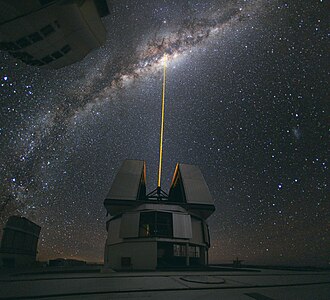
Astronomy is the study of objects and events outside of Earth's atmosphere, like stars, planets, and galaxies. Astronomers observe these objects and try to understand how they formed and how they move.
Astronomy has been studied for thousands of years, but it became a modern science with the invention of the telescope. Today, astronomers use many tools to learn about the universe, including satellites and powerful telescopes.
Interdisciplinary studies
The different areas of natural science often overlap and share ideas. For example, physics helps us understand topics like stars (astrophysics), Earth (geophysics), chemicals (chemical physics), and living things (biophysics). Chemistry also connects to many fields, such as the study of living organisms (biochemistry), the behavior of chemicals (physical chemistry), Earth’s chemicals (geochemistry), and chemicals in space (astrochemistry).
One important field that uses many areas of science is environmental science. It looks at how natural parts like air, water, rocks, and plants work together, especially how human actions affect plants and animals and how we can take care of our world (biodiversity, sustainability). Another example is oceanography, which studies the ocean and includes topics like the physical aspects of water (physical oceanography) and sea life (marine biology).
Materials science
Main article: Materials science
Materials science is a field that studies substances and how to create new ones. It looks at how the building blocks of materials affect their uses. This science helps us understand why things break and how to make better materials for many technologies. By studying how materials are made and what they’re made of, scientists can improve everything from airplanes to medicine.
History
See also: Natural philosophy and History of science
People have always needed to understand the world around them to survive. Long ago, they learned about animals and plants by watching and passing down knowledge through stories. Around 3500 to 3000 BC, cultures like those in Mesopotamia and Ancient Egypt began writing down their ideas about the stars, math, and nature. These early writings were more about religion and myths than science.
Later, in Ancient China, thinkers experimented with mixtures to find cures and long life. They studied nature using ideas like yin (feminine, cold) and yang (masculine, warm). In Ancient India, texts called the Vedas described the universe as always changing. They also studied health and the body.
In Ancient Greece, philosophers like Thales of Miletus and Pythagoras began asking questions about how nature works. They tried to explain things without magic or gods. One idea was that everything is made of tiny, invisible pieces called atoms.
Aristotle, a student of Plato, studied many animals and embryos. His work influenced science for many years. Later, during the time of the Byzantine Empire and Abbasid Caliphate, scholars continued to study and translate these ideas.
In the 1600s, new tools like telescopes and microscopes changed how people saw the world. Scientists like Galileo and Isaac Newton used experiments and math to understand nature better. They discovered laws about gravity and motion that helped explain many things.
Today, natural science is split into two main areas: life sciences, which study plants and animals, and physical sciences, which study things like physics, chemistry, and astronomy.
Images
Related articles


This article is a child-friendly adaptation of the Wikipedia article on Natural science, available under CC BY-SA 4.0.
Images from Wikimedia Commons. Tap any image to view credits and license.