 Safekipedia
Nova
Adapted from Wikipedia · Discoverer experience
A nova is a special event in space where a star suddenly becomes very bright and looks like a "new" star in the sky. This happens because of a star called a white dwarf that is very close to another star. The white dwarf pulls material from its companion star onto itself. When enough material builds up, it gets very hot and explodes, making the star look much brighter for a few weeks or months.
There are different kinds of novae. The most common type is called a classical nova. Another type, called a recurrent nova, can happen again after many years because the companion star keeps giving more material to the white dwarf. Sometimes, if too much material builds up, the white dwarf can explode completely, which is called a Type Ia supernova.
Novae usually appear along the path of the Milky Way in the night sky, but they can show up anywhere. They happen more often than bigger explosions called supernovae, happening about ten times each year in our galaxy. Most novae need a telescope to see, but only a few become bright enough to see without one every dozen years or so. The last very bright nova was V1369 Centauri, which appeared in December 2013.
Etymology
In the 1500s, an astronomer named Tycho Brahe saw a bright new star in the sky. This star was in the constellation Cassiopeia. He wrote a book called De nova stella, which means "concerning the new star" in Latin. Because of this, people began to use the word nova to describe these bright new stars.
Even though the star Tycho saw was actually a supernova, not a nova, the word nova stuck. Later, scientists learned that novae usually happen on objects called white dwarfs, which are what remains after very old stars have ended their lives.
Stellar evolution of novae
A nova happens when two stars orbit each other closely. One star becomes a small, dense remnant called a white dwarf. The other star, which may be normal or older, starts to spill material onto the white dwarf. This material builds up on the white dwarf's surface.
When enough material collects, a big reaction happens. The white dwarf bursts with bright light, looking like a new star. This light fades over weeks or months. Even though it looks dramatic, only a tiny bit of material is lost, and the white dwarf can do this again later. Sometimes, these bursts happen more than once, and the star is called a recurrent nova.
Occurrence rate and astrophysical significance
Astronomers believe the Milky Way sees about 25 to 75 novae each year, but we only see around 10 because distant novae get hidden by space dust. As of 2019, 407 likely novae have been recorded in our galaxy. In the Andromeda Galaxy, about 25 bright novae are found each year.
Studying novae shows they add certain elements like helium and lithium to space. While they do not add as much material as bigger stellar explosions, they still play a part in creating the material around us.
Some novae, like RS Ophiuchi, burst again every few decades, but most take much longer—thousands to hundreds of thousands of years—to repeat. The time between bursts depends more on the weight of the star involved than how fast it gathers material.
Subtypes
Novae are grouped by how quickly their brightness changes:
- NA: fast novae, which quickly grow bright and then dim to about 1⁄16 their peak brightness in under 100 days.
- NB: slow novae, taking 150 days or more to dim to that level.
- NC: very slow novae, which stay very bright for about ten years before slowly fading.
- NR/RN: recurrent novae, which have been seen to burst more than once within 80 years, and are usually fast.
Remnants
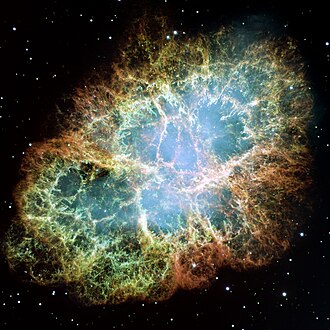
Some novae leave behind visible nebulosity, which is material thrown out during the explosion or in many explosions. This material can sometimes be seen as a cloudy area in the sky.
Novae as distance indicators
Novae can help scientists measure how far away things are in space. They shine very brightly and then slowly fade, making them useful like a special tool for measuring distance. Scientists have found that novae usually have the same brightness 15 days after they first appear, which helps them figure out distances to nearby galaxies and groups of galaxies. These measurements are just as good as another way scientists use, which involves watching certain types of stars called Cepheid variable stars change in brightness.
Main article: standard candle
Main articles: Cepheid, variable stars
Recurrent novae
A recurrent nova is a star that has been seen to shine very brightly many times. These stars usually become about 9 times brighter each time they erupt, while other novae can become even brighter.
Scientists think that up to a quarter of all nova systems might erupt more than once, but only ten of these recurrent novae have been seen in our galaxy, the Milky Way. Some have also been observed in other galaxies, like the Andromeda Galaxy and the Large Magellanic Cloud. One of these, called M31N 2008-12a, can erupt as often as once every 12 months.
In April 2016, a website called Sky & Telescope reported that a star named T Coronae Borealis had been getting brighter since February 2015. Similar brightening happened in 1938 and 1946. By June 2018, the star had dimmed a little but was still brighter than usual. In early 2023, it dimmed again. Some scientists thought it might shine very brightly again between March and September 2024, but as of May 19, 2026, this has not happened yet.
| Full name | Discoverer | Distance (ly) | Magnitude range | Days to drop 3 magnitudes from peak | Known eruption years | Interval (years) | Years since latest eruption |
|---|---|---|---|---|---|---|---|
| CI Aquilae | K. Reinmuth | 8590±830 | 8.6–16.3 | 40 | 1917, 1941, 2000 | 24–59 | 26 |
| V394 Coronae Australis | L. E. Erro | 17000±3000 | 7.2–19.7 | 6 | 1949, 1987 | 38 | 38 |
| T Coronae Borealis | J. Birmingham | 2987±75 | 2.5–10.8 | 6 | 1217, 1787, 1866, 1946 | 79–82 | 80 |
| IM Normae | I. E. Woods | 9800±1600 | 8.5–18.5 | 70 | 1920, 2002 | ≤82 | 24 |
| RS Ophiuchi | W. Fleming | 8740±850 | 4.8–11 | 14 | 1898, 1907, 1933, 1958, 1967, 1985, 2006, 2021 | 9–26 | 4 |
| V2487 Ophiuchi | K. Takamizawa (1998) | 20900±5200 | 9.5–17.5 | 9 | 1900, 1998 | 98 | 27 |
| T Pyxidis | H. Leavitt | 9410±780 | 6.4–15.5 | 62 | 1890, 1902, 1920, 1944, 1967, 2011 | 12–44 | 15 |
| V3890 Sagittarii | H. Dinerstein | 16000 | 8.1–18.4 | 14 | 1962, 1990, 2019 | 28–29 | 6 |
| U Scorpii | N. R. Pogson | 31300±2000 | 7.5–17.6 | 2.6 | 1863, 1906, 1917, 1936, 1979, 1987, 1999, 2010, 2022, | 8–43 | 3 |
| V745 Scorpii | L. Plaut | 25400±2600 | 9.4–19.3 | 7 | 1937, 1989, 2014 | 25–52 | 12 |
Extragalactic novae
Novae happen often in the Andromeda Galaxy (M31), including those that happen again and again. Each year, several dozen novae (which are very bright stars) brighter than a certain level are found in M31. The Central Bureau for Astronomical Telegrams (CBAT) keeps track of these novae in M31, M33, and M81.
Images
Related articles




This article is a child-friendly adaptation of the Wikipedia article on Nova, available under CC BY-SA 4.0.
Images from Wikimedia Commons. Tap any image to view credits and license.