 Safekipedia
Supernova
Adapted from Wikipedia · Discoverer experience
A supernova (pl.: supernovae) is a powerful and luminous explosion of a star. It happens during the last stages of a massive star or when a white dwarf starts a runaway nuclear fusion. After the explosion, the original star either becomes a neutron star or black hole, or it is completely destroyed to form a diffuse nebula. At its brightest, a supernova can shine as brightly as an entire galaxy before slowly fading away over weeks or months.
Supernovae are rare but important events. In our galaxy, they are expected to happen about once every 61 years, though the last one seen was Kepler's Supernova in 1604. In 1987, SN 1987A was observed in the Large Magellanic Cloud, a small galaxy close to our own.
Most supernovae happen in one of two ways: either a white dwarf suddenly restarts nuclear fusion, or a massive star's core collapses under its own gravity. These explosions send out huge amounts of material and energy, creating new elements and helping form stars. They also play a role in creating cosmic rays and may even produce gravitational waves.
Occurrence
The first supernovae studied by astronomers were Tycho's Supernova in 1572 and Kepler's Supernova in 1604. Both occurred in the Milky Way and could be seen without a telescope. Over the past 2,000 years, fewer than 10 supernovae have been visible to the naked eye.
More recently, supernovae are observed in other galaxies as well. These explosions happen in our galaxy about 1.6 to 4.6 times every century. In 1987, SN 1987A appeared in the Large Magellanic Cloud, a small galaxy near the Milky Way. This event was studied closely, and scientists even measured special particles called neutrinos from it for the first time outside of the Sun. The supernova was caused by the explosion of a blue supergiant star.
Etymology
The word supernova can also be pluralized as supernovae or supernovas and is sometimes shortened to SN or SNe. It comes from the Latin word nova, meaning "new," which describes what looks like a bright new star appearing temporarily in the sky. The prefix "super-" helps set supernovae apart from ordinary novae, which are not as bright. The term supernova was first used by scientists Walter Baade and Fritz Zwicky in lectures in 1931, and it appeared in a scientific paper the next year by Knut Lundmark.
Observation history
Main article: History of supernova observation
Supernovae are rare and bright explosions of stars. Because they are so bright, people have noticed them for thousands of years. Only a small number of stars in a galaxy can become supernovae, usually the very massive ones or those in special pairs with a white dwarf star.
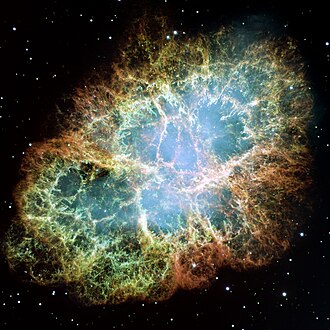
People have recorded supernovae since ancient times. One of the earliest known supernovae was seen in the year 1006 AD, observed in China, Japan, Iraq, Egypt, and Europe. Another famous one happened in 1054 AD and created what we now call the Crab Nebula. These events helped scientists understand that the universe was not unchanging. With telescopes, we can now find supernovae much farther away. These distant supernovae help us measure how fast the universe is growing. Today, both amateur and professional astronomers work together to find new supernovae, using telescopes and special tools to catch them early.
| year | observed in | maximum apparent magnitude | certainty of the SN's identification |
|---|---|---|---|
| 185 | constellation of Centaurus | −6 | possible SN, but may be a comet |
| 386 | constellation of Sagittarius | +1.5 | uncertain whether SN or classical nova |
| 393 | constellation of Scorpius | −3 | possible SN |
| 1006 | constellation of Lupus | −7.5±0.4 | certain |
| 1054 | constellation of Taurus | −6 | certain; remnant and pulsar known |
| 1181 | constellation of Cassiopeia | −2 | likely Type Iax SN associated with the remnant Pa30 |
| 1572 | constellation of Cassiopeia | −4 | certain; remnant known |
| 1604 | constellation of Ophiuchus | −2 | certain; remnant known |
Naming convention
When astronomers discover a supernova, they report it to the International Astronomical Union. The organization gives each supernova a special name. The name starts with "SN," which stands for SuperNova, followed by the year it was found. For example, the third supernova found in 2003 is named SN 2003C.
If many supernovae are found in a year, letters are used to tell them apart. The first 26 supernovae are given capital letters from A to Z. After that, pairs of small letters are used, like aa, ab, and so on. This way, each supernova has its own unique name.
Classification
Astronomers classify supernovae based on their light patterns and the elements they show when studied with special instruments. If a supernova shows hydrogen, it is called Type II. If it does not show hydrogen, it is called Type I. Each of these types has further groups based on other elements seen or how bright the supernova appears over time.
Type I supernovae are split into groups like Type Ia, which shows a specific sign of silicon, and Type Ib and Ic, which do not. Some rare Type I supernovae show very strong lines of calcium and are called calcium-rich. Type II supernovae can also have subgroups, such as Type IIn, which have narrow lines, and Type IIb, which show both hydrogen and helium lines. There are also unusual supernovae that do not fit into these main groups and are called peculiar.
| Type I No hydrogen | Type Ia Presents a singly ionised silicon (Si II) line at 615.0 nm (nanometers), near peak light | Thermal runaway | ||||||
| Type Ib/c Weak or no silicon absorption feature | Type Ib Shows a non-ionised helium (He I) line at 587.6 nm | Core collapse | ||||||
| Type Ic Weak or no helium | ||||||||
| Type II Shows hydrogen | Type II-P/-L/n Type II spectrum throughout | Type II-P/L No narrow lines | Type II-P Reaches a "plateau" in its light curve | |||||
| Type II-L Displays a "linear" decrease in its light curve (linear in magnitude versus time) | ||||||||
| Type IIn Some narrow lines | ||||||||
| Type IIb Spectrum changes to become like Type Ib | ||||||||
Current models
Supernovae are powerful explosions of stars that mark the end of a star’s life. They happen in two main ways: when a massive star runs out of fuel and collapses, or when a white dwarf star gains enough mass from a companion to explode. After the explosion, the star either collapses into a dense object called a neutron star or black hole, or it completely breaks apart.
There are different types of supernovae, mainly classified by what we see in their light and spectra. For example, Type Ia supernovae happen when a white dwarf explodes, while other types come from massive stars collapsing. These explosions spread heavy elements into space and can be so bright that we can see them across great distances in the universe.
| Cause of collapse | Progenitor star approximate initial mass (solar masses) | Supernova type | Remnant |
|---|---|---|---|
| Electron capture in a degenerate O+Ne+Mg core | 9–10 | Faint II-P | Neutron star |
| Iron core collapse | 10–25 | Faint II-P | Neutron star |
| 25–40 with low or solar metallicity | Normal II-P | Black hole after fallback of material onto an initial neutron star | |
| 25–40 with very high metallicity | II-L or II-b | Neutron star | |
| 40–90 with low metallicity | None | Black hole | |
| ≥ 40 with near-solar metallicity | Faint Ib/c, or hypernova with gamma-ray burst (GRB) | Black hole after fallback of material onto an initial neutron star | |
| ≥ 40 with very high metallicity | Ib/c | Neutron star | |
| ≥ 90 with low metallicity | None, possible GRB | Black hole | |
| Pair instability | 140–250 with low metallicity | II-P, sometimes a hypernova, possible GRB | No remnant |
| Photodisintegration | ≥ 250 with low metallicity | None (or luminous supernova?), possible GRB | Massive black hole |
| Typea | Average peak absolute magnitudeb | Approximate energy (foe)c | Days to peak luminosity | Days from peak to 10% luminosity |
|---|---|---|---|---|
| Ia | −19 | 1 | approx. 19 | around 60 |
| Ib/c (faint) | around −15 | 0.1 | 15–25 | unknown |
| Ib | around −17 | 1 | 15–25 | 40–100 |
| Ic | around −16 | 1 | 15–25 | 40–100 |
| Ic (bright) | to −22 | above 5 | roughly 25 | roughly 100 |
| II-b | around −17 | 1 | around 20 | around 100 |
| II-L | around −17 | 1 | around 13 | around 150 |
| II-P (faint) | around −14 | 0.1 | roughly 15 | unknown |
| II-P | around −16 | 1 | around 15 | Plateau then around 50 |
| IInd | around −17 | 1 | 12–30 or more | 50–150 |
| IIn (bright) | to −22 | above 5 | above 50 | above 100 |
| Supernova | Approximate total energy x1044 joules (foe)c | Ejected Ni (solar masses) | Neutrino energy (foe) | Kinetic energy (foe) | Electromagnetic radiation (foe) |
|---|---|---|---|---|---|
| Type Ia | 1.5 | 0.4 – 0.8 | 0.1 | 1.3 – 1.4 | ~0.01 |
| Core collapse | 100 | (0.01) – 1 | 100 | 1 | 0.001 – 0.01 |
| Hypernova | 100 | ~1 | 1–100 | 1–100 | ~0.1 |
| Pair instability | 5–100 | 0.5 – 50 | low? | 1–100 | 0.01 – 0.1 |
| Type | Progenitor star | Fraction |
|---|---|---|
| Ib | WC Wolf–Rayet or helium star | 9.0% |
| Ic | WO Wolf–Rayet | 17.0% |
| II-P | Supergiant | 55.5% |
| II-L | Supergiant with a depleted hydrogen shell | 3.0% |
| IIn | Supergiant in a dense cloud of expelled material (such as LBV) | 2.4% |
| IIb | Supergiant with highly depleted hydrogen (stripped by companion?) | 12.1% |
| IIpec | Blue supergiant | 1.0% |
External impact
Supernovae help create heavier elements that spread through space. When a star explodes, it sends out a shock wave that can cause new stars to form. These explosions also produce cosmic rays, which are high-energy particles moving through space.
Supernovae are important because they create many of the elements found in the universe, from oxygen to metals. They scatter these elements into space, where they can become part of new stars, planets, and even living things. The elements made in supernovae affect the life cycles of stars and can influence whether planets can form around them.
The energy from a supernova can also trigger the birth of new stars by pressing on nearby clouds of gas and dust. Scientists believe that a supernova might have played a role in forming our Solar System about 4.5 billion years ago.
Milky Way candidates
Main article: List of supernova candidates
The next supernova in the Milky Way will likely be bright enough to see even if it happens far away in the galaxy. It might come from a red supergiant star, which is a huge star that will eventually explode. There is also a chance it could come from other types of big stars, like yellow hypergiants or Wolf-Rayet stars. Another possibility is a Type Ia supernova, which happens when a white dwarf star explodes. These are harder to spot before they go off.
Some well-known stars that might explode as supernovae include Betelgeuse, Antares, and Spica. Scientists are still learning which of these stars are closest to exploding. The Milky Way sees about two to twelve supernovae every hundred years, though we haven’t seen one for a long time.
Images
Related articles



This article is a child-friendly adaptation of the Wikipedia article on Supernova, available under CC BY-SA 4.0.
Images from Wikimedia Commons. Tap any image to view credits and license.