 Safekipedia
Plasma (physics)
Adapted from Wikipedia · Discoverer experience
Plasma is one of the four main states of matter, like solids, liquids, and gases. It forms when a gas gets very hot or is exposed to strong electric fields, causing it to break apart into tiny particles with electric charges. These charged particles make plasma act in special ways, such as responding to magnetic fields.
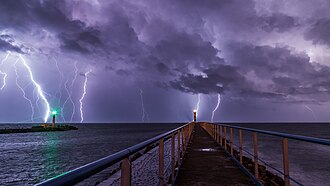
You might see plasma in everyday life without realizing it. Lightning in the sky and the glowing lights inside neon signs are both examples of plasma. Even the bright light from the Sun is made of plasma. In fact, most of the ordinary matter in the universe exists as plasma, even though we don’t see it often here on Earth.
Because plasma contains charged particles, it can conduct electricity and respond to magnetic fields. This special property is used in many useful technologies, such as screens in some old televisions. Scientists also use plasma in laboratories for cutting and shaping materials. Whether a gas is considered plasma depends on how many of its particles have broken apart and gained charges, and this can vary depending on what you are studying.
Etymology
In 1928, a scientist named Irving Langmuir gave a special name to a type of gas that has lost some of its particles. He called it plasma. Langmuir thought of this name because it reminded him of something in our bodies called blood plasma. His friends Lewi Tonks and Harold Mott-Smith remembered that Langmuir was inspired by how blood carries cells. The word plasma comes from an old Greek word about shaping or forming things.
History
Plasma science started with the work of Irving Langmuir in the 1920s, but its roots go back to the history of electricity. The electric arc was found by Vasily Petrov and Humphry Davy in 1803. Later, in 1831, Michael Faraday studied electric glow discharge in thin gases.
At first, people thought electricity moving through gases worked like it does in liquids. But Sir William Crookes, who looked at low-pressure electric streams, suggested in 1879 that there might be a fourth kind of matter.
Definitions
The fourth state of matter
Plasma is called the fourth state of matter after solid, liquid, and gas. It is a special kind of matter where an ionized substance can carry electricity very well, and electric and magnetic forces affect how it behaves.
Plasma usually has about the same amount of positive and negative particles, so it is mostly balanced in charge. Even though these particles move freely, they still feel forces from each other. When they move, they create electric currents, and the movement of one particle can change how others move. This makes plasma behave in a special way that is different from solids, liquids, and gases.
Ideal plasma
See also: Fermi gas
An ideal plasma has three main features:
- The plasma approximation: This means that there are many charged particles close together, so the plasma acts like a group rather than individual particles.
- Bulk interactions: The plasma is large enough that what happens in the middle is more important than what happens at the edges.
- Collisionlessness: The particles move so fast that they don’t bump into each other very often, so electric forces are more important than collisions.
Non-neutral plasma
Main article: Non-neutral plasmas
Sometimes, a plasma can have more of one type of charge than the other. This is called a non-neutral plasma. In these cases, electric forces are very strong. Examples include beams of charged particles, electron clouds in special traps, and plasmas made only of one type of particle.
Dusty plasma
Main article: Dusty plasma
A dusty plasma contains very small pieces of dust that have a charge. These dust particles can affect each other. When larger particles are in the plasma, it is called grain plasma. In labs, dusty plasmas are sometimes called complex plasmas.
State Property | Gas | Plasma |
|---|---|---|
| Interactions | Short-range: Two-particle (binary) collisions are the rule. | Long-range: Collective motion of particles is ubiquitous in plasma, resulting in various waves and other types of collective phenomena. |
| Electrical conductivity | Very low: Gases are excellent insulators up to electric field strengths of tens of kilovolts per centimetre. | Very high: For many purposes, the conductivity of a plasma may be treated as infinite. |
| Independently acting species | One: All gas particles behave in a similar way, largely influenced by collisions with one another and by gravity. | Two or more: Electrons and ions possess different charges and vastly different masses, so that they behave differently in many circumstances, with various types of plasma-specific waves and instabilities emerging as a result. |
Properties and parameters
Plasma is a special kind of matter that forms when gas gets very hot or gets a lot of energy. This makes some of the particles split apart into smaller pieces called ions and electrons. Because these pieces have electric charge, plasma behaves differently from regular gas.
Plasma needs high temperatures to stay apart. When things get too cool, the ions and electrons can come back together and the plasma turns back into a regular gas. In space, most of the matter is thought to be plasma, even though we don’t see it often on Earth.
Mathematical descriptions
Main article: Plasma modeling
Describing a plasma completely would mean tracking every particle's location and speed, which is usually too complex. Instead, scientists use simpler methods.
One method treats the plasma like a smooth flow, using average values such as density and speed at different points. This is called a fluid model and works well when particles interact often.
Another method looks at how particles move and spread out, which is useful when interactions are rare. This is called a kinetic model and can be more detailed but also more complex.
Plasma science and technology
Plasmas are studied by many scientists in a field called plasma science or plasma physics. This includes different areas like space plasma physics.
Plasmas appear in nature in many places. They make up more than 99% of all matter in the universe. Above Earth, the ionosphere and magnetosphere contain plasma. In our Solar System, the space between planets is filled with plasma from the Sun’s solar wind. Stars and areas between stars and galaxies also contain plasma. We also see plasma in accretion disks around stars, white dwarfs, neutron stars, and black holes.
We can create plasmas in labs and factories using electricity and magnetism on gases. These plasmas can differ in how they are made, the pressure they are at, how much they are ionized, and their temperature. They are useful in many ways, like in metal working, cleaning vehicle exhaust, lighting lamps, and even in engines for space travel.
Space and astrophysics
Further information: Astrophysical plasma
Plasma makes up more than 99% of everything we can see in the visible universe. Above Earth, the ionosphere is a plasma, and the magnetosphere contains plasma. In our Solar System, space is filled with plasma from the Sun’s solar wind, stretching from the Sun to the heliopause. All stars and much of the space between stars and galaxies is also filled with plasma, though often very thin. Astrophysical plasmas are seen in accretion disks around stars or objects like white dwarfs, neutron stars, or black holes. Plasma is also linked to material thrown out by astrophysical jets from black holes or in bright galaxies like M87's jet.
Artificial plasmas
Most artificial plasmas are made by using electric and/or magnetic fields on a gas. Plasmas made in labs and factories can differ in several ways:
- The type of power used — DC, AC (often with radio frequency or RF), and microwave
- The pressure they work at — vacuum pressure
- How much they are ionized — fully, partially, or weakly
- The temperature — thermal plasma or non-thermal “cold” plasma
- The setup of electrodes used
- How the particles act in magnetic fields — magnetized, partially magnetized, or non-magnetized
Generation of artificial plasma
There are many ways to make plasma, but they all need energy. Plasma forms when an electric current passes through a dielectric gas or fluid (a material that does not conduct electricity). This happens in a discharge tube, for example, using DC power. The electric field pulls electrons toward the positive anode and the nucleus toward the negative cathode. As voltage increases, the material breaks down and turns from an insulator into a conductor. This process creates many charged particles quickly.
Electric arc
An electric arc is a steady flow of electricity between two points, like lightning. It creates heat, which breaks down gas molecules and turns them into charged particles. This turns electrical energy into heat, which spreads quickly through the gas.
Examples of industrial plasma
Plasmas are useful in many areas, like metal working, cleaning surfaces, making tiny electronic parts, cutting and joining metals, cleaning car exhaust, lighting lamps, helping fuel burn, and in engines for space travel.
Low-pressure discharges
- Glow discharge plasmas: made with DC or low frequency RF power.
- Corona discharge: made with high voltage on sharp points, used in making ozone.
- Dielectric barrier discharge (DBD): made with high voltage across small gaps, used in moving air for cars and treating fabrics.
- Capacitive discharge: made with RF power and electrodes close together, often using gases like helium.
- "Piezoelectric direct discharge plasma": made using a special transformer, good for small devices.
MHD converters
Main articles: magnetohydrodynamic converter, magnetohydrodynamic generator, and magnetohydrodynamic drive
See also: Electrothermal instability
In the 1960s, scientists worked on magnetohydrodynamic converters to turn the movement of plasma into electricity without moving parts. They also studied how plasma acts with magnetic fields to control the flow around vehicles and reduce resistance. These plasmas are usually weakly ionized and nonthermal. When magnetic fields are added, the study becomes complex, needing special math. At a certain point, a problem called the electrothermal instability can happen, which made these developments hard.
| Artificially produced | Terrestrial plasmas | Space and astrophysical plasmas |
|---|---|---|
In plasma displays, including TV screens. Inside fluorescent lamps (low energy lighting), neon signs Rocket exhaust and ion thrusters Plasmas in fusion energy research Plasma globe (sometimes called plasma sphere or plasma ball) Laser-produced plasmas (LPP), found when high power lasers interact with materials | The magnetosphere contains plasma in the Earth's surrounding space environment The ionosphere The polar aurorae Upper-atmospheric lightning, including sprites, blue jets, blue starters, gigantic jets, ELVESs Fire (if sufficiently hot) | Stars (plasmas heated by nuclear fusion) The solar wind The interplanetary medium (space between planets) The interstellar medium (space between star systems) The Intergalactic medium (space between galaxies) Interstellar nebulae |
Complex plasma phenomena
Plasma can behave in many surprising and complex ways, even though the basic rules that govern it are simple. These behaviors are found everywhere in the universe and can create interesting patterns and shapes.
One common pattern in plasma is called filamentation, where plasmas form thin, string-like structures. You can see this in things like plasma balls, the aurora, lightning, and solar flares. These structures can sometimes twist into shapes called magnetic ropes.
Another type of plasma, called impermeable plasma, can act like a solid even though it is made of tiny particles. Scientists have studied this to help contain very hot plasmas, and in recent years they have found ways to create stable impermeable plasma using very high pressure without needing magnetic fields to hold it in place.
Images
Related articles


This article is a child-friendly adaptation of the Wikipedia article on Plasma (physics), available under CC BY-SA 4.0.
Images from Wikimedia Commons. Tap any image to view credits and license.