 Safekipedia
SN 1572
Adapted from Wikipedia · Discoverer experience
SN 1572, also known as Tycho's Star, Tycho's Nova, or Tycho's Supernova, was a very bright explosion of light in the sky. It happened in the constellation Cassiopeia in early November 1572. Many people noticed it and told others about it.
This amazing light was a special kind of explosion called a Type Ia supernova. It was one of only eight such explosions that people could see without any special equipment in all of history.
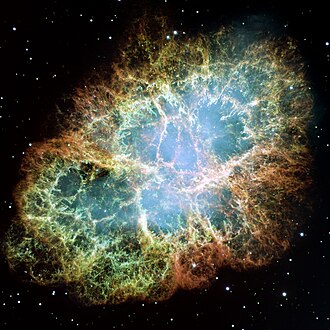
Even though we can't see it with our eyes today, scientists have found the leftovers from this explosion. These leftovers are called a supernova remnant. At first, people saw it with telescopes, but later they found it using radio waves. It's also known by the name 3C 10.
Historic description
The appearance of a bright star in the sky in 1572 was a very important event for astronomy. It helped scientists change old ideas about the stars and led to better tools for studying the sky. This bright star is often called "Tycho's supernova" because of the work of Tycho Brahe, who wrote about his observations of it.
Many people around the world saw this bright star. It appeared after November 2, 1572, and became brighter than the planet Jupiter. By around November 16, it was as bright as the planet Venus, and it stayed visible until early 1574 before slowly fading away.
Supernova
This was a special kind of exploding star called a Type Ia. Scientists figured this out by studying how bright it appeared over time and by looking at its light in a special way.
We can figure out how far away this exploding star was by how bright it was when it first appeared and how its brightness changed over time. It was about 3,800 light-years away from us.
Supernova remnant
SN 1572, also known as Tycho’s Star, is a very old exploding star that we can still see today. Scientists think it is located between 6,500 and 16,300 light-years away from Earth. This exploding star spreads out over a small part of the sky and is still expanding.
In 1952, scientists first found this exploding star using radio waves. Later, they also saw it using X-ray telescopes and optical telescopes. This exploding star is a special kind called Type Ia, where a very dense star called a white dwarf explodes after getting too heavy. Even though it doesn’t create a big, cloudy shape like some other exploding stars, we can still see the gas from it spreading out into space.
Companion star
Main article: Tycho G
In 2004, scientists found a star named Tycho G. This star, similar to our Sun, may have given material to another star that exploded in a big event called a supernova in the year 1572. Studies show that Tycho G was probably a normal star before the explosion, but some of its material was taken away.
Tycho G is moving very fast through space, which suggests it might have been close to the exploding star. However, some recent studies question this idea. The star is far from the center of where the explosion happened and does not spin in a way that might be expected if it were a companion star.
In literature
The bright appearance of this star was mentioned in the book Ulysses by James Joyce. Some people think it might also be described in a play by William Shakespeare called Hamlet.
The star inspired a poem called Al Aaraaf by Edgar Allan Poe. It was also talked about in a story by Arthur C. Clarke and in a funny science article by Frederik Pohl.
Images
Related articles


This article is a child-friendly adaptation of the Wikipedia article on SN 1572, available under CC BY-SA 4.0.
Images from Wikimedia Commons. Tap any image to view credits and license.