Solar eclipses on Jupiter
Solar eclipses on Jupiter happen when any of the natural satellites of Jupiter pass in front of the Sun as seen from the planet Jupiter.
Scientists use different words depending on how big the moon looks. For a body that looks smaller than the Sun in the sky, the proper term is a transit. For a body that looks larger than the Sun, the proper term is an occultation. The angular diameter of an object is how large it appears from a viewpoint.
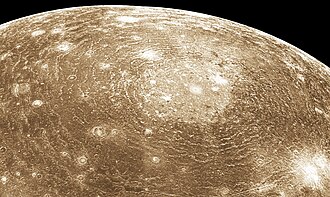
Four of Jupiter's moons can completely block the Sun: Io, Europa, Ganymede and Callisto. The others are too small or too far away to block the Sun completely, so they can only cross in front of it. Most of the more distant moons also have orbits that are strongly tilted compared to the plane of Jupiter's orbit, so they would rarely be seen passing in front of Jupiter.
Eclipses of the Sun from Jupiter are not especially rare. Jupiter is very large, and its axial tilt is relatively small, which is related to the plane of the orbits of its moons. Because of this, most orbits of the four moons that can block the Sun will produce a solar occultation visible from somewhere on Jupiter. Every moon except Callisto is guaranteed to produce an eclipse on every orbit. When the four largest moons, the Galilean satellites, block the Sun, a shadow transit can be seen on the surface of Jupiter. People on Earth can observe this with telescopes.
Observers have studied the related idea of moons passing into Jupiter's shadow since the time of Giovanni Cassini and Ole Rømer in the mid-1600s. Their predicted times often differed from the observed times in a regular way. Rømer correctly realized that these differences were caused by the changing distance between Earth and Jupiter as the two planets moved in their orbits around the Sun. Later, in 1678, Christiaan Huygens used these differences to make the first accurate measurement of the speed of light. Spacecraft have also observed these eclipses, including Pioneer 10 and Pioneer 11, Voyager 1 and Voyager 2, the Galileo orbiter, Cassini–Huygens, New Horizons, and Juno, which has been observing the transits of Jupiter's moons and their shadows since 2016.
Visibility from Jupiter
From Jupiter, the mean angular diameter of the Sun is 372 arc-seconds, or 6' 12". This is about one-fifth of how big the Sun looks from Earth. The apparent size changes slightly, from 381" at perihelion to 357" at aphelion.
Unlike on Earth, where the Moon and Sun look almost the same size, the Galilean moons look much bigger compared to the Sun when seen from Jupiter. Even distant Callisto is over 50% larger, and Io is nearly six times as large. Because of this, the moons' shadows on Jupiter are more defined than the Moon's shadow on Earth during a total solar eclipse, since the penumbra is narrower at a given distance.

Quiz time!
5 questions about Solar eclipses on Jupiter
Which of Jupiter's big moons is the exception that is not guaranteed to produce an eclipse on every orbit?
Pictures
Keep exploring


This article is a child-friendly adaptation of the Wikipedia article on Solar eclipses on Jupiter, available under CC BY-SA 4.0.
Images from Wikimedia Commons. Tap any image to view credits and license.