 Safekipedia
Solutions of the Einstein field equations
Adapted from Wikipedia · Discoverer experience
Solutions of the Einstein field equations are important ideas in physics that help us understand space, time, and how things move in the universe. These solutions come from solving the Einstein field equations, which are part of a theory called general relativity. General relativity explains how gravity works by showing that space and time can bend and stretch.
When we solve these equations, we find special ways that space and time can be arranged. These arrangements are called metrics of spacetimes. They tell us how space and time behave in different situations, like near a star or in the empty vastness of space.
The Einstein field equations connect two main parts: the Einstein tensor and the stress–energy tensor. The Einstein tensor shows how space and time are curved, while the stress–energy tensor shows where energy and matter are located. By solving these equations, scientists can predict how gravity affects the universe, from the motion of planets to the expansion of space itself.
Solving the equations
The Einstein field equations alone aren't enough to fully describe how gravity works in many situations. They depend on something called the stress–energy tensor, which relates to the movement of matter and energy. This movement, in turn, depends on gravity itself, creating a loop that needs to be solved together.
To find answers, we use the Einstein field equations along with another important equation called the continuity equation. However, these still aren't enough because they leave out details about how matter behaves. We need additional rules, called equations of state, to complete the picture. Common simplifications include looking at empty space (vacuum), where there is no matter, or studying perfect fluids, which behave like ideal liquids. Even with these simplifications, solving the equations exactly is very difficult. Scientists often use computer simulations, look for solutions with symmetry, or apply approximations to understand gravitational effects.
Exact solutions
Main article: Exact solutions in general relativity
Scientists work hard to find exact answers to the Einstein field equations. These equations help us understand how space and time bend and stretch because of mass and energy. An exact solution means we can describe space and time very precisely using simple math.
Some famous solutions include:
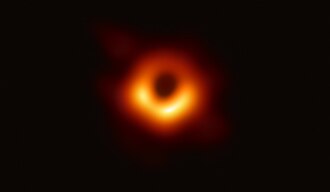
- The Schwarzschild solution, which tells us about space and time around a round, still, heavy object. For small enough objects, this can create a black hole. Far away from the object, these ideas match older gravity theories.
- The Reissner–Nordström solution looks at round, still objects that have an electric charge.
- The Kerr solution expands on the Schwarzschild idea to include spinning objects.
- The Kerr–Newman solution is for spinning objects that also have a charge.
- The cosmological Friedmann–Lemaître–Robertson–Walker solution helps us understand how the Universe grows and changes over time.
Even with these solutions, some situations are still very hard to solve exactly, like figuring out space and time around two moving objects, such as the Sun and Earth.
Non-exact solutions
Main article: Non-exact solutions in general relativity
Non-exact solutions are those that are not perfect matches to the equations of general relativity. They are often used because finding exact solutions can be very hard. Instead, scientists use these solutions as close guesses to understand real-world systems, like the universe or big stars.
To find these solutions, scientists use special math tricks and computer programs. One trick is called perturbation theory, where they start with simple ideas and add small changes to get closer to the truth. Computers help a lot, especially when studying very strong forces, like those around black holes. This computer work is called numerical relativity and can show surprising behaviors and new ideas.
Applications
There are both practical and theoretical reasons to study solutions of the Einstein field equations.
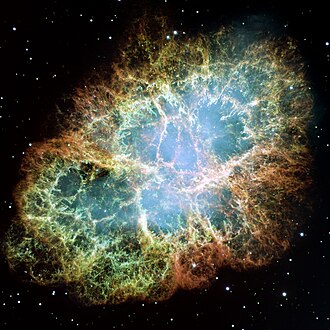
From a mathematical view, it is interesting to understand all the possible solutions of these equations. Some solutions depend on one or more numbers that can change the result. From a physics view, knowing these solutions helps us create very exact models of space objects, such as black holes, neutron stars, and groups of stars. We can make predictions about these systems, like how the path of Mercury moves over time, the area that spins inside spinning black holes, and how objects move around very heavy bodies.
Related articles



This article is a child-friendly adaptation of the Wikipedia article on Solutions of the Einstein field equations, available under CC BY-SA 4.0.
Images from Wikimedia Commons. Tap any image to view credits and license.