 Safekipedia
Physical cosmology
Adapted from Wikipedia · Discoverer experience
Physical cosmology is a fascinating branch of physics and astronomy that helps us understand the universe as a whole. It uses the laws of physics to create models that explain how the universe began, how it has changed over time, and what might happen to it in the future. These models give scientists a way to study big questions about the origin, structure, evolution, and ultimate fate of everything we see.
The study of cosmology really began to take shape in 1915 when Albert Einstein developed his general theory of relativity. This theory changed how we think about space and time. In the 1920s, exciting discoveries changed our view of the universe forever. Edwin Hubble showed that there are many galaxies beyond our own Milky Way, and other scientists found that the universe is actually expanding. These findings led to the Big Bang theory, which explains how the universe started from a single point and has been growing ever since.
Since the 1990s, new observations have helped scientists create a detailed picture of the universe. They have studied the cosmic microwave background, distant supernovae, and how galaxies move away from us. This work shows that the universe contains mysterious substances called dark matter and dark energy, which we still don’t fully understand. Even with these unknowns, the models they have created match observations very well. Cosmology brings together ideas from many areas of physics, such as particle physics, astrophysics, and quantum mechanics, to help us learn more about our vast universe.
Subject history
See also: Timeline of cosmology and List of cosmologists
Modern cosmology grew from both theory and observation. In 1916, Albert Einstein published his theory of general relativity, which described gravity as a property of space and time. He later added something called the cosmological constant to keep the universe steady, but this model was unstable.
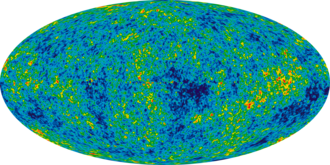
Later, scientists like Vesto Slipher, Georges Lemaître, and Edwin Hubble studied distant objects and found they were moving away from us. This led to the idea that the universe was expanding. Two main ideas explained this: one was Lemaître's "Big Bang" theory, and the other was Fred Hoyle's steady state model. In 1965, the discovery of the cosmic microwave background strongly supported the Big Bang theory.
Energy of the cosmos
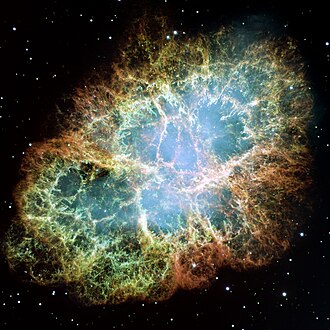
The lightest elements, like hydrogen and helium, were created during the Big Bang. Later, stars combine smaller atoms into larger ones, forming elements such as iron and nickel. These processes can release sudden bursts of energy, seen in events like novae and around powerful objects such as black holes, quasars, and active galaxies.
Scientists cannot fully explain some cosmic events with known energy forms, so they suggest a mysterious type called dark energy that fills all space. As the universe grows, different types of energy change at different speeds. Early on, radiation was very important, but later, matter became more influential. Today, dark energy is thought to be the main force causing the universe to expand faster.
History of the universe
See also: Timeline of the Big Bang
The history of the universe is a key topic in cosmology. It is divided into different periods, called epochs, based on the main forces and processes at work during each time. The most commonly accepted model today is known as the Lambda-CDM model.
Observations suggest that the universe began about 13.8 billion years ago. In its very early stages, the universe was extremely hot, and particles had very high energies. As the universe expanded and cooled, protons, electrons, and neutrons formed, followed by nuclei and atoms. The formation of neutral hydrogen led to the emission of the cosmic microwave background. Later, matter began to clump together, forming the first stars, quasars, and eventually galaxies, clusters of galaxies, and superclusters. According to current models, the universe will continue to expand forever.
Areas of study
Physical cosmology is a branch of physics that studies the universe as a whole. It looks at how the universe began, how it has changed over time, and what might happen in the future. Cosmologists use physics to create models that explain the largest structures and movements in the universe.
One key area of study is the very early universe. Scientists think the universe started with the Big Bang, but there are still mysteries. For example, why is the universe mostly matter and not antimatter? And why does the universe look mostly the same in all directions? These questions help scientists understand the rules of physics in the early moments after the Big Bang. Another important topic is the Big Bang Theory, which explains how the lightest elements like hydrogen and helium were formed when the universe was very young. Today, scientists also study the cosmic microwave background, the faint radiation left over from the early universe, to learn more about its history. Finally, researchers explore how galaxies and other large structures formed over time, the existence of dark matter that we cannot see but whose gravity affects stars and galaxies, and dark energy, which seems to be making the universe expand faster and faster. All these areas help us piece together the story of our universe from its beginning to today.
Images
Related articles



This article is a child-friendly adaptation of the Wikipedia article on Physical cosmology, available under CC BY-SA 4.0.
Images from Wikimedia Commons. Tap any image to view credits and license.