 Safekipedia
South Tyrol
Adapted from Wikipedia · Discoverer experience
South Tyrol, officially called the Autonomous Province of Bolzano/Bozen – South Tyrol, is an autonomous province in northern Italy. It is the northernmost province of the country and has an area of 7,400 square kilometres. The capital and largest city is Bolzano.
South Tyrol has a high level of self-government, keeping most of its tax money while still supporting the national budget. It is the wealthiest province in Italy and one of the wealthiest in the entire European Union. It also has the lowest rate of poverty or social exclusion in the EU.
The people of South Tyrol speak different languages. About 57.6% speak German as their first language, 22.6% speak Italian, mainly in Bolzano and Merano, and 3.7% speak Ladin, a Rhaeto-Romance language. The area has a rich history and culture because of these different languages and backgrounds.
Name
South Tyrol is the common English name for this area, coming from part of the old County of Tyrol. German and Ladin speakers call it Südtirol, while in Italian it is often called Alto Adige, meaning “Upper Adige.” This name dates back to the time of Napoleon Bonaparte, who created a region along the Adige River with the same name.
Today, the province’s official name in German is Autonome Provinz Bozen — Südtirol, and in Italian it is Provincia autonoma di Bolzano — Alto Adige. German speakers often refer to it as a Land, similar to the states in Germany and Austria.
History
Main article: History of South Tyrol
South Tyrol's history began during the First World War. Before 1918, it was part of the Austro-Hungarian County of Tyrol. After the war, Italy took control and made it part of their country. Over time, the area faced many changes in leadership, including periods under Italian Fascism and Nazi Germany.
After World War II, South Tyrol stayed with Italy but gained special rights to protect its German-speaking culture. This led to agreements ensuring both German and Italian languages were used officially. Today, South Tyrol enjoys a lot of self-government, which helps keep peace between different groups living there.
Geography
South Tyrol is located at the northernmost point in Italy. It is bordered by Austria to the east and north, specifically the Austrian states Tyrol and Salzburg, and by the Swiss canton of Graubünden to the west. The Italian provinces of Belluno, Trentino, and Sondrio border to the southeast, south, and southwest, respectively.
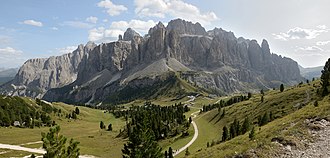
The landscape of South Tyrol is highly mountainous, dominated by the Alps. The highest peak is the Ortler (3,905 metres), which is also the highest peak in the Eastern Alps outside the Bernina Range. The famous Dolomites are located in the eastern part of the region. Between the mountains are many valleys, where most people live.
The province is divided into eight districts, each headed by a president and two bodies called the district committee and the district council. These districts are responsible for resolving disputes between municipalities and providing services such as roads, schools, and retirement homes. The province also has 116 municipalities.
South Tyrol has various climate zones, ranging from cold winters and warm summers in the Adige valley to harsh winters and cool summers in the highland areas above 1,700 metres. The province’s geology includes metamorphic rocks, volcanic complexes, and sedimentary layers formed over millions of years. Notable natural features include the Bletterbach Gorge and the Ritten Earth Pyramids.
The three main valleys are the Adige Valley, the Eisack Valley, and the Puster Valley. The most important river is the Adige, which drains most of the region’s surface area. South Tyrol also has many natural lakes, most of which are located above 2,000 metres. About 50% of the area is covered by forests, with the rest being either above the forest line or used for agriculture.
| Name | Highest peak (German/Italian) | metres | feet |
|---|---|---|---|
| Ortler Alps | Ortler/Ortles | 3,905 | 12,811 |
| Sesvenna Range | Muntpitschen/Monpiccio | 3,162 | 10,374 |
| Ötztal Alps | Weißkugel/Palla Bianca | 3,746 | 12,291 |
| Stubai Alps | Wilder Freiger/Cima Libera | 3,426 | 11,241 |
| Sarntal Alps | Hirzer/Punta Cervina | 2,781 | 9,124 |
| Zillertal Alps | Hochfeiler/Gran Pilastro | 3,510 | 11,515 |
| Hohe Tauern | Dreiherrnspitze/Picco dei Tre Signori | 3,499 | 11,480 |
| Eastern Dolomites | Dreischusterspitze/Punta Tre Scarperi | 3,152 | 10,341 |
| Western Dolomites | Langkofel/Sassolungo | 3,181 | 10,436 |
| District (German/Italian) | Capital (German/Italian) | Area | Inhabitants |
|---|---|---|---|
| Bozen/Bolzano | Bozen/Bolzano | 52 km2 | 107,436 |
| Burggrafenamt/Burgraviato | Meran/Merano | 1,101 km2 | 97,315 |
| Pustertal/Val Pusteria | Bruneck/Brunico | 2,071 km2 | 79,086 |
| Überetsch-Unterland/Oltradige-Bassa Atesina | Neumarkt/Egna | 424 km2 | 71,435 |
| Eisacktal/Valle Isarco | Brixen/Bressanone | 624 km2 | 49,840 |
| Salten-Schlern/Salto-Sciliar | Bozen/Bolzano | 1,037 km2 | 48,020 |
| Vinschgau/Val Venosta | Schlanders/Silandro | 1,442 km2 | 35,000 |
| Wipptal/Alta Valle Isarco | Sterzing/Vipiteno | 650 km2 | 18,220 |
| German name | Italian name | Ladin name | Inhabitants |
|---|---|---|---|
| Bozen | Bolzano | Balsan, Bulsan | 107,724 |
| Meran | Merano | Maran | 40,926 |
| Brixen | Bressanone | Persenon, Porsenù | 22,423 |
| Leifers | Laives | 18,097 | |
| Bruneck | Brunico | Bornech, Burnech | 16,636 |
| Eppan an der Weinstraße | Appiano sulla Strada del Vino | 14,990 | |
| Lana | Lana | 12,468 | |
| Kaltern an der Weinstraße | Caldaro sulla Strada del Vino | 7,512 | |
| Ritten | Renon | 7,507 | |
| Sarntal | Sarentino | 6,863 | |
| Kastelruth | Castelrotto | Ciastel | 6,456 |
| Sterzing | Vipiteno | 6,306 | |
| Schlanders | Silandro | 6,014 | |
| Ahrntal | Valle Aurina | 5,876 | |
| Naturns | Naturno | 5,440 | |
| Sand in Taufers | Campo Tures | 5,230 | |
| Latsch | Laces | 5,145 | |
| Klausen | Chiusa | Tluses, Tlüses | 5,134 |
| Mals | Malles | 5,050 | |
| Neumarkt | Egna | 4,926 | |
| Algund | Lagundo | 4,782 | |
| St. Ulrich | Ortisei | Urtijëi | 4,606 |
| Ratschings | Racines | 4,331 | |
| Terlan | Terlano | 4,132 |
Politics
Main article: Politics of South Tyrol
Since the end of the Second World War, the political scene of the Autonomous Province of Bolzano has been led by the Südtiroler Volkspartei (SVP). This party has usually held a majority in the Provincial Council and has provided the provincial governor and many mayors. It is a centrist party with Christian-democratic roots, and it includes most German- and Ladin-speaking citizens.
Other parties include Die Freiheitlichen, which focuses on protecting South Tyrolean identity, and Verdi del Sudtirolo (South Tyrolean Greens), an ecological party that promotes interethnic cooperation. The local government follows the Italian Constitution and the Autonomy Statute of the Region Trentino-Alto Adige/Südtirol, giving the province strong self-governing powers. The Landtag of South Tyrol handles legislative matters, while the executive powers belong to the government led by the Landeshauptmann Arno Kompatscher.
Main article: 2023 Trentino-Alto Adige/Südtirol provincial elections § South Tyrol
Main article: List of governors of South Tyrol
Economy
South Tyrol is the richest province in Italy, with a GDP per capita of €62,100 in 2023. People there work in many areas, such as growing apples and making famous South Tyrol wine, as well as in industry and services like tourism. The area is also known for its mechanical engineering companies, including leaders in cable cars and wind energy.
The unemployment rate was about 2% in 2024. South Tyrol has good roads, with the important Brenner Motorway (A22) connecting it to Austria and other parts of Italy. There are also many railways, including the Brenner Railway, which is part of a major European route. The Brenner Base Tunnel, under construction, will make travel faster and move more freight to trains. Cycling is popular, with many paths for bikes, and there are many cable cars for both travel and fun. Bolzano Airport serves the area for air travel.
Demographics
Further information: History of South Tyrol § Linguistic and demographic history
German and Italian are both official languages in South Tyrol. Many people there speak a special German dialect called Southern Bavarian. Everyone has the right to use their own language, even in important places like courts. Signs and schools are set up for each language group.
Most people in South Tyrol are Catholic Christians. The main Catholic area is called the Diocese of Bolzano-Brixen. There are also small groups of other religions, like Lutherans, Jews, and Muslims, living in the region.
| Year | Pop. | ±% |
|---|---|---|
| 1921 | 254,735 | — |
| 1931 | 282,158 | +10.8% |
| 1951 | 333,900 | +18.3% |
| 1961 | 373,863 | +12.0% |
| 1971 | 414,041 | +10.7% |
| 1981 | 430,568 | +4.0% |
| 1991 | 440,508 | +2.3% |
| 2001 | 462,999 | +5.1% |
| 2011 | 504,643 | +9.0% |
| 2021 | 532,616 | +5.5% |
| Source: ISTAT | ||
| Year | Italian speakers | German speakers | Ladin speakers | Others | Total |
|---|---|---|---|---|---|
| 1880 | 6,884 (3.4%) | 186,087 (90.6%) | 8,822 (4.3%) | 3,513 (1.7%) | 205,306 |
| 1890 | 9,369 (4.5%) | 187,100 (89.0%) | 8,954 (4.3%) | 4,862 (2.3%) | 210,285 |
| 1900 | 8,916 (4.0%) | 197,822 (88.8%) | 8,907 (4.0%) | 7,149 (3.2%) | 222,794 |
| 1910 | 7,339 (2.9%) | 223,913 (89.0%) | 9,429 (3.8%) | 10,770 (4.3%) | 251,451 |
| 1921 | 27,048 (10.6%) | 193,271 (75.9%) | 9,910 (3.9%) | 24,506 (9.6%) | 254,735 |
| 1931 | 65,503 (23.2%) | 195,177 (69.2%) | n.a. | 21,478 (7.6%) | 282,158 |
| 1953 | 114,568 (33.1%) | 214,257 (61.9%) | 12,696 (3,7%) | 4,251 (1.3%) | 345,772 |
| 1961 | 128,271 (34.3%) | 232,717 (62.2%) | 12,594 (3.4%) | 281 (0.1%) | 373,863 |
| 1971 | 137,759 (33.3%) | 260,351 (62.9%) | 15,456 (3.7%) | 475 (0.1%) | 414,041 |
| 1981 | 123,695 (28.7%) | 279,544 (64.9%) | 17,736 (4.1%) | 9,593 (2.2%) | 430,568 |
| 1991 | 116,914 (26.5%) | 287,503 (65.3%) | 18,434 (4.2%) | 17,657 (4.0%) | 440,508 |
| 2001 | 113,494 (24.5%) | 296,461 (64.0%) | 18,736 (4.0%) | 34,308 (7.4%) | 462,999 |
| 2011 | 118,120 (23.3%) | 314,604 (62.2%) | 20,548 (4.0%) | 51,795 (10.5%) | 505,067 |
| 2024 | 121,520 (22.6%) | 309,000 (57.6%) | 19,853 (3.7%) | 86,560 (16.1%) | 536,933 |
| Language | Number | % |
|---|---|---|
| German | 309,000 | 68.61% |
| Italian | 121,520 | 26.98% |
| Ladin | 19,853 | 4.41% |
| Total | 450,373 | 100% |
Culture
South Tyrol has many interesting traditions that have been passed down for a long time. One famous tradition is the Scheibenschlagen, where people throw burning discs on the first Sunday of Lent. There are also fun legends and stories about the Dolomites mountains, like the tale of King Laurin. Every year in autumn, people celebrate Alpine Transhumance by bringing their animals down from the high mountains with music and dances.
The schools in South Tyrol teach students in German, Italian, or Ladin, depending on their language. There are also special museums, like the one that houses Ötzi the Iceman, and many libraries and research centers for people to learn and discover new things.
Health and social services
South Tyrol has a well-organized healthcare system managed by the South Tyrolean Health Authority. It includes seven hospitals and many smaller health districts that offer various medical services. The health authority uses a large part of the region's budget to provide care for everyone.
The region also has strong social services, mainly run by district communities. These services include financial help, home care, and support for families and the elderly. The South Tyrolean Housing Institute builds and rents affordable homes for people with limited incomes. Many non-profit groups, like church organizations, also help provide social services.
Media
South Tyrol has several important newspapers, such as Dolomiten and Alto Adige, which serve the German- and Italian-speaking communities. Other newspapers include Corriere della Sera and Neue Südtiroler Tageszeitung. There are also many radio and television stations, including Rai – Radiotelevisione Italiana and Österreichischer Rundfunk (ORF)_, which broadcast in German, Italian, and Ladin. Online news websites like Südtirol Online are also popular.
Music
South Tyrol's unofficial anthems are the Bozner Bergsteigerlied and the Andreas-Hofer-Lied. Famous musicians from the region include the folk group Kastelruther Spatzen and rock band Frei.Wild, as well as electronic music producer Giorgio Moroder.
Cuisine
Traditional South Tyrolean food includes dishes like dumplings (Knödel), barley soup, and cold-cut platters. With the growth of tourism, local cuisine has evolved, blending Tyrolean, Italian, and international styles. Typical meals often feature local wines and specialties such as schlutzkrapfen and strauben.
Sports
South Tyroleans are known for their success in winter sports. They have won medals for Italy in the Winter Olympics, including several bronze medals in 2022. Famous athletes from the region include mountain climber Reinhold Messner, luger Armin Zöggeler, and figure skater Carolina Kostner. The region is also home to popular ski resorts like Val Gardena and Alta Badia, and has successful sports teams such as HC Interspar Bolzano-Bozen Foxes and football club FC Südtirol.
Images
Related articles


This article is a child-friendly adaptation of the Wikipedia article on South Tyrol, available under CC BY-SA 4.0.
Images from Wikimedia Commons. Tap any image to view credits and license.