
Trentino
Trentino, officially called the Autonomous Province of Trento, is an special part of Italy in the far north of the country. It is one of two provinces that make up the region of Trentino-Alto Adige/Südtirol, along with South Tyrol. The capital city of Trentino is Trento. This area covers more than 6,000 square kilometers and had a population of over 500,000 people in 2019.
Trentino has a rich and complex history. Long ago, it was home to the Raetian people before becoming part of the Roman Empire. Later, it was ruled by leaders in Trent and then by Austria until the end of World War I. After the war, it became part of Italy and was given special rights to govern itself.
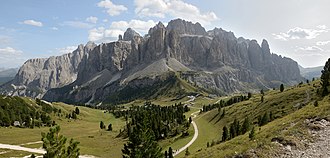
The land of Trentino is very beautiful, with many tall mountains, including parts of the famous Dolomites in the Alps. People there speak mainly Italian, but there are also communities that speak Ladin and some German dialects, showing the area's unique mix of cultures from both Italy and Central Europe.
Etymology
The area is commonly called "Trentino", named after its main city, Trento. Long ago, people only used this name for the city and the lands close to it. When the area was ruled by Austria in the 1800s, German speakers called it Welschtirol or Südtirol, meaning the southern part of a larger region.
In Italian, the area was known as Tirolo Meridionale, referring to the southern part of an old county. The name "Trentino" started being used more widely around 1848. Today, the official name is the autonomous province of Trento.
History
Main article: History of Trentino
The history of Trentino goes back to the middle of the Stone Age. People lived in the valleys, especially near the Adige River, because the climate there was milder.
During the early Middle Ages, the area was part of the Kingdom of Italy and later the March of Verona. In 1027, the Bishopric of Trent was created by Emperor Conrad II, becoming a state within the Holy Roman Empire. It was ruled by the Prince-Bishops of Trento.
A very important meeting called the Council of Trent happened between 1545 and 1563. This council helped shape the beliefs of the Roman Catholic Church in response to changes happening at the time.
Later, after the Napoleonic Wars, the area became part of the Austrian County of Tyrol. During World War I, there was heavy fighting there because it was between Austria-Hungary and Italy. After the war, in 1919, Trentino became part of Italy.
Following World War II, Trentino became part of the autonomous region of Trentino-Alto Adige/Südtirol, giving it special self-government. In 1996, the Euroregion Tyrol-South Tyrol-Trentino was created to help promote peace and cooperation between the nearby areas.
Geography
Trentino is a beautiful mountainous area. The Adige River runs through the center of Trentino in a valley that shares its name. Important towns in Trentino are found in this Adige Valley, which has served as a key path between Italy and Central Europe. Other well-known valleys include the Non Valley, famous for its apples, as well as the Sole Valley, Giudicarie, Fiemme, Fassa, Lagarina, Mocheni, and Sugana Valley.
Trentino covers an area of 6,214 km2. It is home to the stunning Dolomites, a mountainous area recognized as a UNESCO World Heritage Site. The Marmolada is the tallest mountain in the Dolomites, reaching up high above sea level. Other notable peaks include the Kesselkogel, Cermis, Crozzon di Brenta, Latemar, Piz Boè, and Vezzana.
Politics
The 1972 law gave Trentino-Alto Adige/Südtirol more control over its own matters, making the province quite independent. The province handles important areas such as health, education, and transportation. The provincial council has 35 members, including one from the Ladin minority group.
In the 2023 elections, the centre-right group won 21 of the 35 seats. The groups included the Trentino League, Brothers of Italy, and others. The centre-left alliance holds 13 seats, with parties like the Democratic Party. The governor, who leads the provincial government, is Maurizio Fugatti, who won in 2023 with about half of the votes.
Administration
Trentino is divided into many small municipalities. In the late 1970s, larger groups called districts were created, but later, in 2006, new groups called Valley Communities were formed. As of 2009, only a few towns had more than 20,000 people, such as Trento, Rovereto, and Pergine Valsugana.
| # | Name | Municipalities | Inhabitants | Capital | Map |
|---|---|---|---|---|---|
| 1 | Comunità territoriale della Val di Fiemme | 9 | 18,567 | Cavalese |  |
| 2 | Comunità di Primiero | 5 | 9,836 | Tonadico |  |
| 3 | Comunità Valsugana e Tesino | 18 | 25,694 | Borgo Valsugana |  |
| 4 | Comunità Alta Valsugana e Bersntol | 15 | 45,228 | Pergine Valsugana |  |
| 5 | Comunità della Valle di Cembra | 7 | 10,854 | Cembra |  |
| 6 | Comunità della Val di Non | 29 | 37,143 | Cles |  |
| 7 | Comunità della Valle di Sole | 13 | 15,020 | Malè |  |
| 8 | Comunità delle Giudicarie | 25 | 35,647 | Tione di Trento |  |
| 9 | Comunità Alto Garda e Ledro | 7 | 42,955 | Riva del Garda |  |
| 10 | Comunità della Vallagarina | 17 | 78,482 | Rovereto |  |
| 11 | Comun General de Fascia | 6 | 9,195 | Pozza di Fassa |  |
| 12 | Magnifica Comunità degli Altipiani Cimbri | 3 | 4,442 | Lavarone |  |
| 13 | Comunità Rotaliana-Königsberg | 7 | 25,953 | Mezzocorona |  |
| 14 | Comunità della Paganella | 5 | 4,731 | Andalo |  |
| 15 | Val d'Adige territory | 4 | 110,061 | none |  |
| 16 | Comunità della Valle dei Laghi | 3 | 9,349 | Vezzano |  |
Economy
The Gross domestic product of the region was 25.5 billion euros in 2023, which was 1.2% of all of Italy's economy. For each person, the value created was 37,900 euros, which is 126% of the average for Europe in the same year.
Even though the area is mostly mountains, farming is still important. Farms often work together in groups. The main foods produced are apples (50% of all of Italy’s apples, together with South Tyrol), fruits, vegetables (especially in the Val di Gresta area), and grapes. These grapes are used to make dry and sparkling wines, which are known for their quality.
In January 2008, the Edmund Mach Foundation was started to help with research, learning, and services related to farming, food, and the environment.
The main factories, which are usually small or medium-sized, are found in the Valsugana, Vallagarina, and Adige Valleys. They make things like clothes, machines, wood, and paper. Making hydro-electric power is also important.
Tourism is a big part of the economy. Popular places to visit include: Madonna di Campiglio, San Martino di Castrozza, Fiera di Primiero, Canazei, Moena, Cavalese, Folgaria, Folgarida-Marilleva, Riva del Garda and Levico Terme, Comano Terme and Roncegno. The last three are well-known for their warm springs.
The unemployment rate was 3.8% in 2023.
Transport
The Trentino province has important roads and railways that connect Italy to Germany. These include the Brenner A22 motorway and road that goes through the Etsch/Adige Valley. There is a plan to move more traffic from roads to railways.
The province also has two other railways: the Valsugana Line, which connects Trento to Venice and the Trento-Malè-Marilleva railway between Trento and Malè.
Demographics
In 2019, Trentino had a population of 541,098 people. Most people live near the capital city of Trento and in the southern areas. The province is made up of 175 municipalities.
The main language spoken in Trentino is Italian. There are also three special languages protected by laws: Ladin, Mòcheno, and Cimbrian. These languages are used in schools and on street signs. Each of these language groups has its own cultural institute to help keep their traditions alive.
The Ladin language is spoken in the Fassa Valley, while Mòcheno is spoken in a few small towns, and Cimbrian in one village. Since World War II, laws have been created to protect and support these languages and their cultures. Surveys help count how many people speak these languages and where they live.
| Minority languages | 2001 no. of members | 2001 percent compared to the population of Trentino | 2011 no. of members | 2011 percentage compared to the Trentino population | 2021 no. of members | 2021 percentage compared to the Trentino population |
|---|---|---|---|---|---|---|
| Ladin | 16,462 | 3.5% | 18,550 | 3.5% | 15,775 | 2.9% |
| Mòcheno | 2,276 | 0.5% | 1,660 | 0.3% | 1,397 | 0.3% |
| Cimbrian | 882 | 0.2% | 1 072 | 0.2% | 1,111 | 0.2% |
| Language | Respondents 2021 | Understand | Speaks | Read | Write |
|---|---|---|---|---|---|
| Ladin | 125,919 | 17.5% | 11.3% | 10.6% | 7.3% |
| Mòcheno | 4.2% | 0.8% | 1.1% | 0.4% | |
| Cimbrian | 4.0% | 0.6% | 0.9% | 0.3% |
Culture
The Trentino is a place where different cultures meet. In the past, Germans, Italians, and Ladins all lived in this area. The land has tall mountains, valleys, and plains, which helped many traditions and customs stay alive today. The region also has special foods and minority groups that are still part of its culture.
The Trentino has many museums. Some of the most famous include the modern and contemporary art museum in Trento and Rovereto, the science museum in Trento, and the war museum dedicated to the First World War. There are also museums about nature, airplanes, and local history.
The region has many castles that have been restored and are open to visitors. Some of the most important ones are Castel del Buonconsiglio in Trento and Arco Castle in Arco.
The Trentino is great for outdoor activities. People can go mountain climbing, trekking, and enjoy winter sports like skiing and snowboarding. The area also hosts important cycling races and has teams for sports like football, volleyball, and basketball.
Keep exploring



This article is a child-friendly adaptation of the Wikipedia article on Trentino, available under CC BY-SA 4.0.
Images from Wikimedia Commons. Tap any image to view credits and license.