 Safekipedia
Tropopause
Adapted from Wikipedia · Discoverer experience
The tropopause is an important layer in Earth's sky that separates the lowest two layers of our atmosphere. It lies between the troposphere, where weather happens and where we live, and the stratosphere, the layer above it. This boundary is not a fixed height but changes depending on where you are on Earth.
Above the warm areas near the equatorial regions, the tropopause is found about 17 kilometers (11 miles) up. But near the cold polar regions, it is much lower, around 9 kilometers (5.6 miles) above the ground. This difference happens because the atmosphere behaves differently in these areas.
The tropopause plays a big role in how our planet’s atmosphere works. It helps control the movement of air and can affect weather patterns we experience closer to the ground. Understanding this layer helps scientists learn more about Earth’s climate and how it might change.
Definition
The tropopause is the place in the sky where the air stops getting colder as you go higher and becomes dry with almost no water vapor. It is the line that separates the troposphere below from the stratosphere above. At the tropopause, the way temperature changes with height quickly switches from getting colder to getting warmer as you move up.
Location
The troposphere is the lowest layer of Earth's atmosphere, where most weather happens. It starts very close to the ground and goes up about 9 kilometers (5.6 miles) at the poles and 17 kilometers (11 miles) at the Equator. The tropopause is the boundary between the troposphere and the layer above it, called the stratosphere. It is highest above the Equator and lowest above the poles because of temperature differences.
Alternative definitions
There are other ways scientists can think about the tropopause besides looking at temperature changes. One way is called the dynamic tropopause. This method uses a special measurement called potential vorticity, which combines two things: how dense the air is and how it spins. This helps scientists see the difference between the lower atmosphere (troposphere) and the layer above it (stratosphere).
Another way to define the tropopause is by looking at what gases are in the air. The layer above the troposphere, called the lower stratosphere, has more of a gas called ozone and less water vapor than the layer below it. This can also help mark where the tropopause is.
Scientists can also use how stable the air is to find the tropopause. They look at changes in temperature and how these changes relate to the gases in the air, especially ozone, to better understand where the tropopause lies. This helps when other methods might not always work perfectly.
Tropical tropopause layer cold trap
In 1949, a scientist named Alan West Brewer suggested that air from the lowest part of our atmosphere moves through a layer called the tropopause near the equator and then travels upward. This idea is now called the Brewer-Dobson circulation. Because this layer is very cold near the equator, water vapor turns into ice and stays behind, keeping only a tiny amount of water vapor in the upper atmosphere.
Scientists think that changes in our planet's temperature might affect this cold layer. If the Earth gets too warm in the future, this layer might not work as well, and our planet could lose more of its water into space.
Phenomena
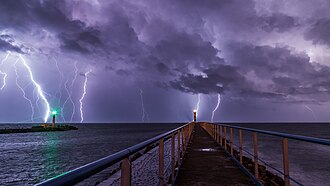
The tropopause is not a fixed line in the sky. Strong thunderstorms, especially in tropical areas, can sometimes reach up into the lower part of the stratosphere above the tropopause. This creates a brief shaking motion in the air, called a gravity wave, which can influence weather patterns and ocean currents nearby.
Many passenger airplanes fly in the lower stratosphere, just above the tropopause, during most of their journey. In this area, there are usually no clouds or big weather changes that happen lower down in the troposphere.
Images
Related articles




This article is a child-friendly adaptation of the Wikipedia article on Tropopause, available under CC BY-SA 4.0.
Images from Wikimedia Commons. Tap any image to view credits and license.