 Safekipedia
Troposphere
Adapted from Wikipedia · Discoverer experience
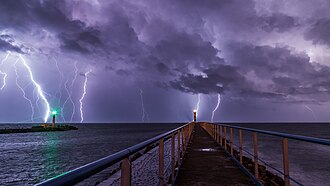
The troposphere is the lowest layer of the atmosphere of Earth. Its name comes from Ancient Greek words meaning "turning" and "sphere." This layer holds most of the air, water vapor, and tiny particles in our atmosphere. It also contains nearly all the weather we experience, from rain and snow to wind and clouds.
From Earth's surface, the troposphere reaches up about 18 kilometers high in warm areas near the equator. In colder areas farther from the equator, it is much thinner, only about 6 kilometers high. On average, it is about 13 kilometers thick all around the world.
The troposphere is very important because it mixes the air through turbulence and friction with the ground. This mixing creates a layer called the planetary boundary layer, which affects how air moves close to the surface. On top of the troposphere is a special layer called the tropopause, which separates it from the layer above, the stratosphere.
Structure
The troposphere is the lowest layer of Earth's atmosphere. It holds most of the atmosphere's mass and almost all of its water vapor. This is where weather happens, like rain, clouds, and wind.
Air pressure is highest at sea level and gets lower as you go higher. Temperature also decreases with altitude, dropping from about 15°C (59°F) at sea level to much colder temperatures near the top of the troposphere. The tropopause marks the boundary between the troposphere and the layer above it, called the stratosphere.
| Altitude Region | Lapse rate | Lapse Rate |
|---|---|---|
| (m) | (°C / km) | (°F / 1000 ft) |
| 0.0 – 11,000 | 6.50 | 3.57 |
| 11,000 – 20,000 | 0.0 | 0.0 |
| 20,000 – 32,000 | −1.0 | −0.55 |
| 32,000 – 47,000 | −2.8 | −1.54 |
| 47,000 – 51,000 | 0.0 | 0.0 |
| 51,000 – 71,000 | 2.80 | 1.54 |
| 71,000 – 85,000 | 2.00 | 1.09 |
Atmospheric flow
The atmosphere generally moves from west to east, but this can change with flows moving north to south or south to north. These movements are called zonal flow (west to east) and meridional flow (north to south or south to north).
The three-cell model helps explain these flows. It includes the Hadley cell near the tropics, the Ferrel cell in the mid-latitudes, and the polar cell near the poles. These cells move warm air from the tropics toward the poles and cold air from the poles toward the tropics, helping balance Earth's temperature.
Solar System
Other planets and moons in the Solar System also have a troposphere, just like Earth. This includes planets like Venus and Mars, as well as Titan, a moon of Saturn. Each of these worlds has its own unique weather and atmospheric conditions. For example, Venus has thick clouds and extreme temperatures, while Mars experiences big dust storms. Titan, the only moon with a substantial atmosphere, has rain made of methane instead of water.
Images
Related articles




This article is a child-friendly adaptation of the Wikipedia article on Troposphere, available under CC BY-SA 4.0.
Images from Wikimedia Commons. Tap any image to view credits and license.